
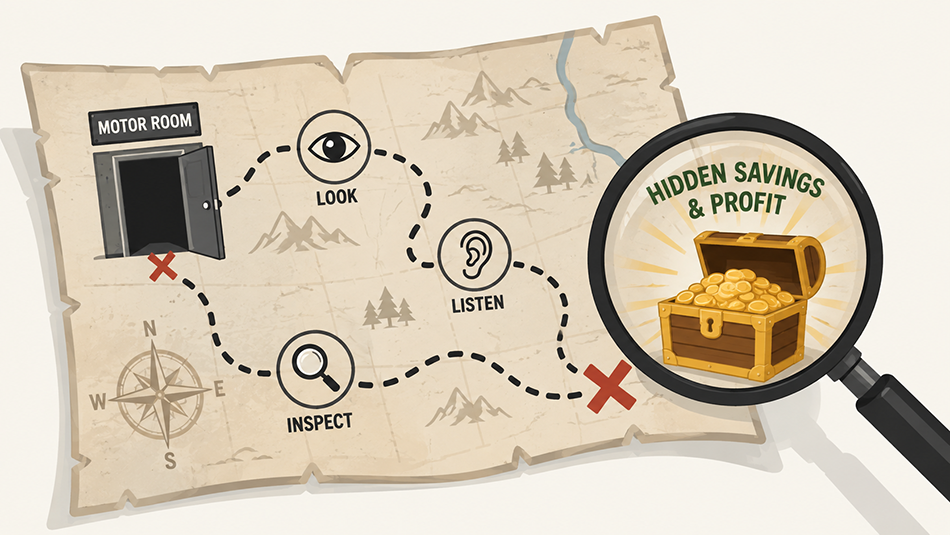
There is a place in every grocery store where no associate dares to venture. There are myths and lore and tales of employees who went beyond the veil and never returned.

What is this place? It’s the motor room in the back of the store or the dreaded doghouse on the roof. It’s a place where rotating equipment whines, dry musty air from lack of circulation hangs and the heat of 1,000 suns can emanate.
Despite these ruins being a scary and mystical space, like all tales, there is treasure that lies within. The bold and courageous are rewarded for their fortitude. The equivalent sales of more than 160 bagged salads can be claimed every day when these ruins are visited.
Explorers need between 30 seconds and a couple minutes to look at valves, compressors and the general cleanliness of these ancient places. They should check that no oil, bubbling, hissing or active moisture is escaping from these vessels.
If not, collect a reward. If so, report them to maintenance immediately. What may be a small imperceptible leak to monitoring systems can be detected by the clever ear or eye of the fearless.
On average, grocery stores spend more than $10,000 annually to repair leaks and charge replacement refrigerant within their systems. More than 40 percent of refrigerant leaks happen in motor rooms. This is more than $4,000 impacting profit – or the equivalent of needing to sell more than $72,000 of product to pay for this inefficiency each year.
Associates tasked with visiting the motor room, roof, backhouse or other spot do not need to be a refrigeration engineer or technician to spot problems. However, most retailers should invest a little time and effort to make it easier to identify them.
Last, but not least: store leadership should confirm that doors, hatches, steps, rails and general access to these areas are operational and safe for passage. The work for daily adventurers is simple – keep their eyes, ears and wits about them, looking for any changes day over day.
Was there oil there yesterday? The floor was dry; now it is not. Hear a hissing sound that was not there before? Inspect the area for evidence of visible foam, bubbles or moisture. It is not necessary to be an expert; having a phone to take a photo showing where and what component may have failed is all that is needed.
Hosing down or washing the motor room is not required. All that is needed for this daily quest is to keep the area free of debris and obstacles. Make sure it is well lit, that the floors are dry and swept and major pieces of equipment are wiped down and free of oil. (Warning: Never place a rag or hand near a rotating piece of equipment such as fan blades, motor shivs or belts.)
This quest and others can be found at Grocery PoP! under FreePoP! By signing up for the monthly newsletter, gain free access to the Daily Treasure Map (checklist). Learn how a 10-minute daily walk-through is worth thousands in annual profit.
Grocery PoP! is a consultancy built on decades of hands-on experience inside grocery stores, warehouses and cold-storage facilities. Founded by Peter Cooke and Jonathan Tan, who have collectively benchmarked thousands of locations, Grocery PoP! specializes in uncovering rapid, meaningful operational improvements.