
By Craig Grayson, Vice President Merchandising & Marketing, Imperial Distributors Inc.

The holiday season has evolved beyond a defined period of gift buying, decorating and seasonal shopping. For today’s consumer, it is a series of interconnected occasions (entertaining, gifting, baking, decorating, celebrating and preparing for family and friends), all taking place against a backdrop of continued budget pressure and increasingly fragmented shopping.
The opportunity is significant. Deloitte forecasts $1.70 trillion to $1.71 trillion in U.S. holiday retail sales for the 2026 season, representing 4 percent to 4.8 percent growth over the prior holiday season. E-commerce is expected to grow even faster, at 7.5 percent to 8.4 percent, reaching approximately $316 billion to $319 billion.
For grocery retailers, the opportunity is not simply to capture a portion of that spending. It is to capture more of the holiday basket by connecting food, beverage and general merchandise around the occasions consumers are already shopping.
Rather than competing directly with mass merchants and e-commerce on every holiday category, grocery can leverage its natural advantages: convenience, immediacy, value and frequent shopping trips.
A bigger role for grocery
Grocery already owns many of the products at the center of holiday celebrations. Food, beverages, baking ingredients and meal solutions drive shoppers into stores throughout the season. Those trips create natural opportunities for general merchandise.
A shopper buying ingredients for Thanksgiving may also need serving pieces, food storage, disposable tableware, candles or kitchen gadgets. A customer preparing for Christmas may be looking for stocking stuffers, gift bags, batteries, greeting cards or a last-minute hostess gift.
The opportunity is not to replicate the assortment of a mass merchant. It is to capture the adjacent needs surrounding the grocery trip.
That opportunity becomes more important as grocery volume remains challenging. Circana reported U.S. retail food and beverage sales up 2.2 percent in the first half of 2026 while volume remained essentially flat. In this environment, incremental growth increasingly depends on creating additional occasions, encouraging cross-category purchases and building larger baskets.
Holiday is particularly well suited to that strategy.
The holiday calendar is expanding
Consumers are also starting their holiday shopping earlier. Circana reports that 48 percent of consumers browsed before Thanksgiving during the 2025 holiday season, while 44 percent planned to shop earlier overall.
For grocery, that means the seasonal strategy should build throughout the season rather than peak around a single holiday event:
- Early season: Establish décor, gifting and entertaining inspiration.
- Thanksgiving: Shift toward tabletop, serving, baking, storage and hosting.
- December: Emphasize gifting, stocking stuffers, wrapping and last-minute needs.
- After Christmas: Transition into New Year’s entertaining, organization and wellness.
This extended calendar creates more opportunities for grocery retailers to remain relevant as shoppers move from one holiday mission to the next.
Where grocery can win
The strongest grocery opportunities are not necessarily the categories where mass merchants have the greatest depth. They are the categories that naturally complement the grocery trip.
- Holiday meal preparation connects food with serveware, storage, kitchen gadgets and disposable products.
- Entertaining and hosting creates opportunities in tabletop, party supplies, beverages, snacks and serving accessories.
- Gifting and stocking stuffers provide incremental purchases through small, affordable and useful products such as beauty minis, accessories, toys, drinkware, candles, kitchen gadgets and novelty items.
- Last-minute and forgotten essentials play directly into grocery’s convenience advantage, particularly gift bags, wrapping supplies, greeting cards, batteries, candles and small gifts.
- New Year’s entertaining can extend the seasonal program beyond Christmas with party supplies, tabletop, snacks, beverages, storage and wellness products.
The common thread is convenience. Grocery does not need to own the entire holiday assortment. It needs to own the holiday needs that shoppers can conveniently add to an existing trip.
Entertaining creates cross-category potential
Holiday entertaining is one of the clearest opportunities for grocery retailers to expand the role of general merchandise. Shoppers are already coming to the store for the food and beverages that anchor gatherings, creating natural opportunities to add the products needed to prepare, serve and enjoy the occasion.
A shopper planning a holiday dinner may also need serving pieces or tabletop décor. Someone hosting a casual gathering may be looking for disposable tableware or party supplies. These needs may sit in different departments, but they are connected by the same shopper mission.
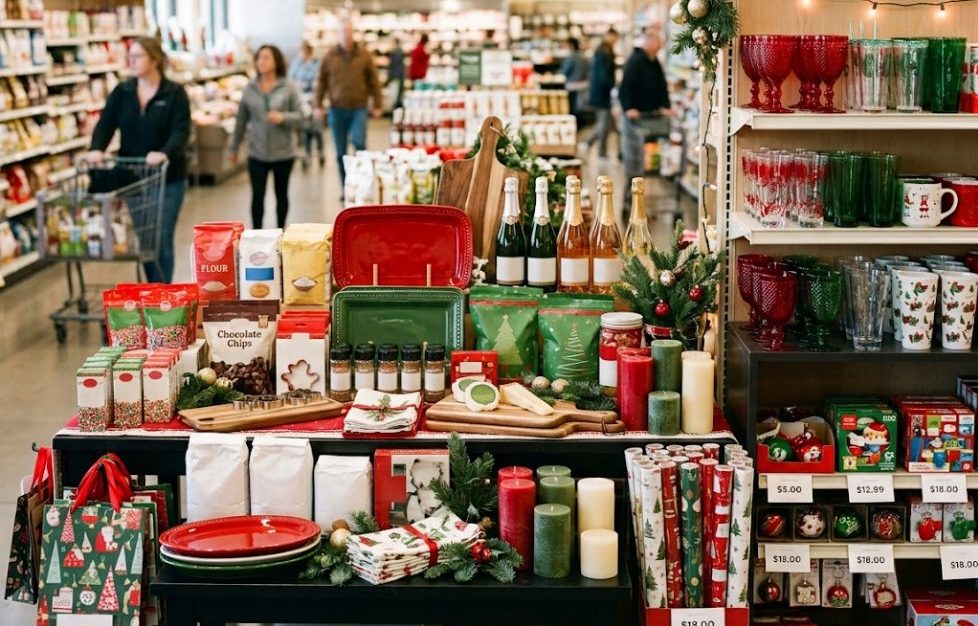
That makes cross-merchandising especially important. Rather than presenting seasonal GM as a collection of individual categories, retailers can build solutions around the occasion. Bringing complementary products together makes the shopping trip easier while encouraging shoppers to add items they may not have originally planned to purchase.
The opportunity is to think beyond the product and merchandise around the complete holiday occasion. When grocery connects food, beverage and general merchandise in ways that help shoppers prepare, host and celebrate, the retailer can capture more of the basket while reinforcing its advantage in convenience.
Value remains central
Value will remain a defining characteristic of Holiday 2026.
Consumers continue to look for ways to celebrate and give while managing household budgets. For grocery retailers, that makes opening-price-point products, private label alternatives, multi-buy promotions and good-better-best assortments important components of the seasonal strategy.
The key is to communicate value without making the holiday feel purely promotional.
Affordable hostess gifts, stocking stuffers at clear price points, value-oriented tabletop, multi-piece entertaining sets, reusable storage, kitchen gadgets, party supplies and small toys can all provide shoppers with products that feel both useful and easy to justify.
In many cases, the strongest holiday GM opportunity may be a product that solves a need and feels like an affordable treat.
Social media is reshaping holiday discovery
Social media is increasingly influencing what consumers discover, want and purchase during the holiday season. Platforms such as TikTok, Instagram and Pinterest can quickly turn a novelty product, entertaining idea or decorating trend into a shopping opportunity.
For grocery retailers, this creates potential to translate social-driven trends into affordable, visually compelling products that complement the grocery trip. Holiday categories such as décor, drinkware, beauty minis, toys, stocking stuffers and entertaining accessories are particularly well suited to this type of discovery.
The opportunity goes beyond responding to viral trends. Social media can help retailers identify emerging products and occasions earlier, while retailer-owned content can inspire shoppers with gift ideas, entertaining solutions and seasonal discoveries.
When those ideas are reflected in-store through strong displays, relevant assortments and occasion-based merchandising, grocery can turn social inspiration into in-store discovery and incremental purchases. In an increasingly trend-driven holiday marketplace, that connection can help grocery remain relevant, differentiated and part of the shopper’s journey, not just the place they make the purchase.
Build the occasion, not just the display
The strongest holiday programs will move beyond collections of seasonal products and instead organize merchandise around complete consumer occasions.
- Holiday entertaining can connect food and beverages with tabletop, serveware, napkins, storage and party supplies.
- Holiday baking can link ingredients with bakeware, decorating accessories, storage and kitchen gadgets.
- Holiday tabletop and home can combine dinnerware, drinkware, serving pieces, candles and décor to create an affordable way for shoppers to refresh their entertaining space.
- Gifting can be organized around clear needs and price points: stocking stuffers, hostess gifts or products under $5, $10 or $15. Small toys, beauty and personal-care products, accessories, drinkware, kitchen gadgets and novelty items can all become part of the solution.
As the season progresses, last-minute needs become increasingly important. Gift bags, wrapping supplies, greeting cards, batteries, candles and small gifts can be positioned in high-traffic areas to capture convenience-driven purchases. After Christmas, the same seasonal footprint can transition into New Year’s entertaining.
This occasion-based approach makes the shopping mission easier to understand while encouraging purchases across categories. Circana’s research reinforces the power of seasonal occasions, with mini-holiday shopping weeks accounting for approximately half of first-half general merchandise dollars and units and about one-third of CPG dollars and units.
The takeaway is simple: build the occasion, not just the display.
The opportunity ahead
Holiday 2026 presents grocery retailers with an opportunity to expand their role in seasonal shopping at a time when consumers are becoming more selective about where and how they spend.
With holiday retail sales expected to approach $1.7 trillion, e-commerce growing more than 7 percent, consumers beginning their shopping earlier and value remaining central to purchase decisions, the opportunity is not simply to carry more seasonal merchandise. It is to make holiday shopping easier, more convenient and more complete.
Grocery already owns the trip for the food and beverages that anchor holiday celebrations. General merchandise can capture the adjacent needs that surround those occasions, from entertaining and tabletop to gifting, stocking stuffers and last-minute essentials.
The future of the holiday in grocery is therefore not simply about selling more seasonal products. It is about owning more of the holiday occasion: helping shoppers prepare, entertain, celebrate and gift within the convenience of the grocery trip.
For retailers, that can mean stronger seasonal relevance, greater cross-category purchasing, larger baskets and more reasons for shoppers to make grocery part of their holiday destination.
Read the previous Non-Food for Thought column, “Home Field Advantage.”