
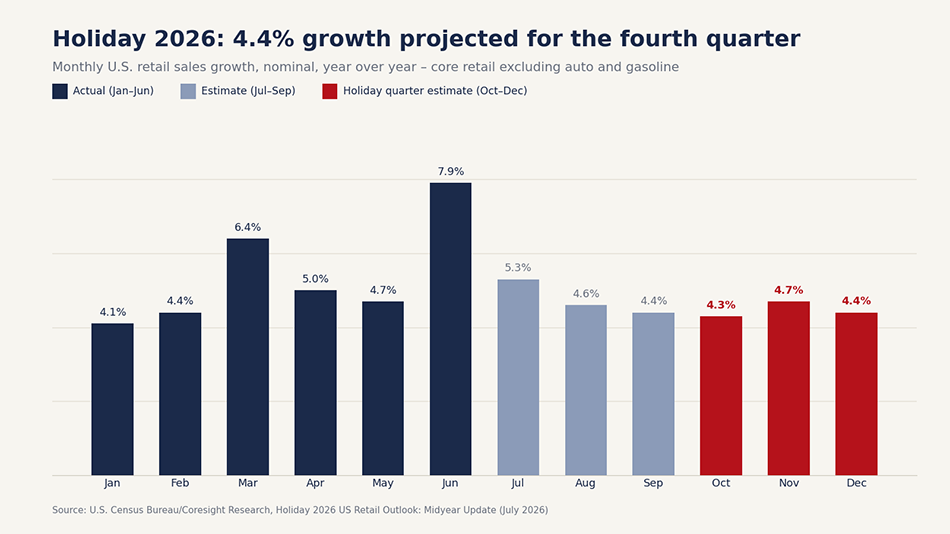
Coresight Research projects total U.S. retail sales will grow 4.4 percent year over year in the fourth quarter of 2026, setting up a holiday season the firm expects to be defined by lean inventories, less discounting and higher-income households driving spending.
Grocery, however, may run counter to the full-price season Coresight expects to take shape in general merchandise.
“Grocery is already a highly price-competitive category, and with food inflation, higher fuel costs and SNAP cuts putting more pressure on household budgets, shoppers are likely to be even more focused on value heading into the holidays,” said Sujeet Naik, analyst at Coresight Research.
Naik said grocery is likely to see more promotional activity than general merchandise this holiday season.
“Grocers can lean more on private label, loyalty programs and sharp pricing on key, high-visibility holiday items,” he said. “They should also keep some flexibility to step up promotions closer to Thanksgiving and Christmas if demand turns out to be softer than expected.”
Upside potential
The 4.4 percent projection, published in Coresight’s midyear update to its holiday outlook, comes from the firm’s machine-learning model and covers core retail sales, which exclude automobile and auto-accessories retailers and gasoline stations.
The figure reflects nominal growth, and the firm said it sees upside potential to the estimate if product inflation accelerates and pushes nominal sales growth higher.
A 4.4 percent gain would outpace growth in holiday 2025 and land in line with the average for 2022-25, though the firm noted inflation has captured a growing share of retail sales increases since 2024.
Gaining momentum
The first half of the year gave retailers momentum. Retail sales growth was supported by an 18.1 percent rise in tax refunds versus a year earlier – about $50 billion as of early May, the latest reported by the IRS.
Coresight estimates more than one-third of the refund increase flowed to retail. June’s 7.9 percent sales growth also benefited from the shift of Amazon Prime Day and rival events such as Walmart Deals from July to June.
Inventory is the variable Coresight flagged most. Consumer goods imports were down year to date through May – not just against 2025, when companies pulled shipments forward ahead of tariffs, but against two and three years earlier as well. Key holiday categories such as clothing and footwear, toys and electronics all saw declines.
Retail inventory values look more stable in dollar terms, but the firm said tariffs are inflating those values, meaning units are lean. Total inventories excluding motor vehicle and parts dealers rose 6.5 percent over two years, which Coresight characterized as soft for a period that included both general cost inflation and tariffs.
Should scarcity confront strong demand, the firm expects less discounting, higher product prices and earlier shopping – a combination that would support retail inflation in holiday categories and, in turn, nominal holiday sales growth. Coresight pointed to 2021, when product scarcity met strong consumer demand, as precedent.
Forecast for food retail
Food retail showed up in the report’s company-level inventory data. Kroger’s first quarter inventories rose 3.7 percent against 2.2 percent sales growth, which Coresight attributed to seasonal working capital and availability investment.
Walmart’s 8.9 percent inventory build was driven by grocery unit demand, receipt timing and fuel, with U.S. inventory quality called strong. Costco’s 7.2 percent build versus year-end tracked in line with its 11.6 percent sales growth, and BJ’s Wholesale Club grew inventories 6.5 percent against 9.9 percent sales growth while recognizing tariff refund benefits in the quarter.
Food-at-home inflation ran at 2.7 percent in June, per Consumer Price Index data cited in the report, while Coresight’s retail-specific inflation measure eased to 2.1 percent in June from a 2026 high of 2.6 percent.
Consumer sentiment toward holiday spending appears to have bottomed out. The net proportion of consumers expecting to spend more this holiday season stood at 7.1 percent in June – above January’s 5.4 percent and a recovery from negative 1.6 percent in March, the low that followed the outbreak of the Iran conflict Feb. 28.
Coresight noted sentiment and spending diverged over that stretch, with retail sales growth holding solid even as broader sentiment slumped alongside rising gasoline prices.
The recovery is uneven across incomes. Households earning $100,000 or more were the most bullish, with a net 18.2 percent expecting to spend more, versus negative 1.9 percent among households earning $50,000-$99,999 and 7.1 percent among those under $50,000.
Coresight estimates $100,000-plus households accounted for about 54 percent of all U.S. retail spending in 2025 and expects higher-income consumers to again drive retail sales expansion in what it describes as a “K-shaped” consumer economy.
SNAP key inflection point
SNAP is the inflection point that matters most for food retailers. The fourth quarter will be the first full holiday period in which all phases of SNAP changes for recipients are operational nationwide.
“Recent changes to the SNAP program at both the federal and state levels will create a modest sales headwind for grocery retailers by reducing overall SNAP spending and changing consumer purchasing patterns,” Naik said.
As federal funding is reduced over the 2025-2034 period, the impact for grocery retailers is likely to be “lower SNAP-funded basket size and weaker traffic from lower-income households, particularly in stores and regions with higher SNAP exposure,” Naik said.
Retailers also may see greater price sensitivity, increased trade-down to private label, smaller baskets and a shift toward value-oriented formats as households stretch reduced benefits across the month, he said.
Annual SNAP benefits declined from $129.5 billion in fiscal 2021 to $95 billion in fiscal 2025 following the expiration of pandemic-era benefits, according to Naik. “We expect further downward pressure on SNAP benefit spending as the new legislation is implemented,” he said.
Fresh food sellers benefit most
The impact will vary by format. Conventional supermarkets, mass merchants, warehouse clubs and regional grocery chains with broad fresh food assortments stand to benefit as SNAP spending shifts toward healthier food categories, Naik said, pointing to Walmart, Kroger, Costco, Publix, Aldi and Ahold Delhaize as “well positioned to capture this spending because of their scale, competitive pricing and extensive fresh food offerings.”
Convenience and dollar stores and retailers with greater exposure to beverages, confectionery and other discretionary center-store categories are likely to see a disproportionate impact in states implementing purchase restrictions, he said, while smaller independent retailers with limited fresh assortments may face competitive pressure as SNAP households consolidate spending at full-service grocery stores.
Naik also pointed to a USDA final rule published in May requiring SNAP-authorized retailers to stock at least seven varieties of products in each of four staple food categories – proteins, grains, dairy and fruits and vegetables – up from the previous requirement of three varieties. He said the rule raises compliance requirements for SNAP-authorized retailers, in particular smaller stores and convenience-oriented formats with limited shelf space.
Other factors to consider
Beyond SNAP, several events before the holidays could move the numbers. The Sept. 30 budget deadline carries shutdown risk, and the Nov. 3 midterm elections could suppress confidence in the run-up, though Coresight said evidence for a direct impact on total consumer spending is more limited.
The firm cited U.S. Energy Information Administration estimates of a 3.1 percent year-over-year increase in residential electricity prices and a 12.8 percent increase in gasoline prices in the fourth quarter.
The Federal Reserve’s June projections underscored inflation’s greater significance this year: The Fed now projects 3.6 percent inflation for 2026 on its preferred measure, up from 2.7 percent in March, and expectations of two quarter-point rate cuts have flipped to a quarter-point rise.
Across retail, Coresight recommended scenario-based pricing and inventory plans, securing fill-in capacity with vendors up front and staying ready to compete on price in October, when major sales events such as Prime Big Deal Days take place.
Data and conclusions in the report are as of July 20. Coresight’s consumer figures draw on weekly online surveys of U.S. adults, with about 400 respondents per wave.