


For many food and agricultural companies, growth has a familiar roadmap. Get into more stores. Expand into another region. Land a major retailer. Add a distributor. Win more shelf space.
Those are worthwhile goals. But they are not the only path to growth.
Sometimes, one of the most promising markets for a product is not the next state over. It may be thousands of miles away.
That can be difficult to imagine, particularly for small and mid-sized food manufacturers still working to expand their U.S. distribution. I have spoken with companies that assume they need to “make it” nationally before they are ready to export.
They don’t.
In fact, a company that has struggled to break through with a major U.S. retailer may discover that its product is exactly what an international buyer is looking for. That is why I believe more U.S. food and agricultural companies should ask a simple question: Why not export?
A Much Bigger Marketplace
Consider the opportunity. Nearly 96 percent of the world’s consumers live outside the United States, and there is strong demand for quality American food and agricultural products.
“Made in the USA” can carry real value internationally. American products are often associated with quality, innovation, food safety, consistency and authenticity across categories from specialty foods and beverages to pet food and seafood.

International buyers are looking for those products. The question is whether U.S. suppliers are looking for those buyers.
For some companies, exporting becomes an important complement to their domestic business. For others, a particular product or brand may resonate especially well in a specific international market.
You Don’t Have to Conquer the U.S. First
It is easy to assume that exporting comes after achieving national U.S. distribution. But international growth is not the final rung on a ladder. It is another path.
Securing space with a major U.S. retailer is highly competitive, with limited shelf space, complicated distribution and significant marketing expectations.
International markets have their own challenges, but they also have different buyers, competitors and consumer preferences. A product competing in a crowded U.S. category may be distinctive in another country. A regional American brand may offer the authenticity an international buyer wants. A particular flavor, format, ingredient or story may fill a gap that is difficult to see when looking only at the domestic market.
“International growth is not the final rung on a ladder. It is another path.”
Exporting expands the question from, “How do I get my product into more U.S. stores?” to “Where in the world might there be demand for what we do especially well?”
Exporting Is More Accessible Than Many Companies Think
Curiosity about international markets naturally brings questions. Where should we start? Which countries make sense? How do we find buyers? What about regulations, labeling and cost?
Those are reasonable questions. They are also exactly why Food Export exists.
We work with food and agricultural companies throughout the Midwest and Northeast to help them explore, enter and grow in international markets, in partnership with our member state agricultural promotion agencies and the USDA Foreign Agricultural Service.
And you do not need to walk through our door already knowing how to export. You can come to us with questions.
Our Export Readiness Program is designed for companies that see potential in international markets but may not know what comes next. Our experienced and passionate team works directly with suppliers to understand where they are today, what they hope to accomplish and what practical steps can help move them forward.
That expertise extends around the world through Food Export’s In-Market Representatives (IMRs), who understand local consumers, business culture, distribution channels, regulations and the competitive landscape. Together, our team and experts abroad help take some of the uncertainty out of exporting.
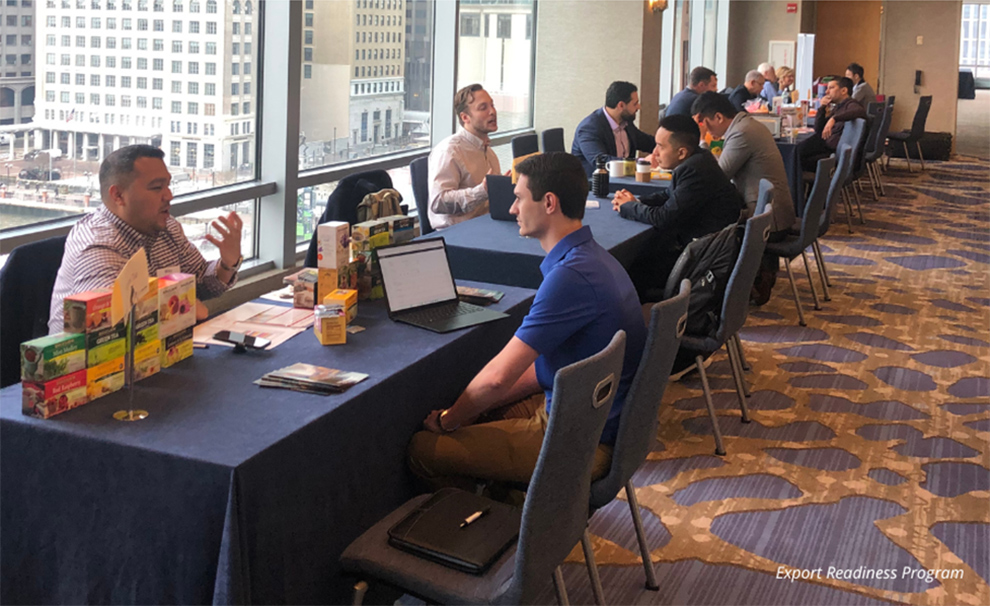
When a company is ready to make connections, our Buyers Missions bring qualified international buyers to the United States for one-on-one meetings with U.S. suppliers. Companies can sit across the table from buyers actively looking for American products and learn firsthand how their products might fit a particular market.
As companies begin to build international business, our Branded Program helps them invest in that growth. Eligible companies can receive 50% cost-share reimbursement for a wide range of international marketing and promotional activities, making the investment required to enter and expand in global markets more manageable.
Together, these programs can help companies move from “Could exporting work for us?” to “We are ready to find out” to “How do we grow from here?”
Companies can also access educational resources, market insights, trade missions, international events and other opportunities. But at every stage, there are people behind those programs who know exporting, know the markets and genuinely want to see American food and agricultural companies succeed.
Start With One Market. One Buyer. One Conversation.
Exporting can sound intimidating when we describe it as “going global.” But it does not have to begin with an international division or a plan for 20 countries.
It can begin with one question: Could there be an international market for our product?
Maybe the next step is a webinar, exploring potential markets or sitting across the table from an international buyer who says, “We are looking for a product like yours.”

I have seen companies begin by wondering whether exporting is realistic for a business their size. Then they make a connection. They learn about a market. They meet the right buyer and make that first international sale.
That is how exporting often grows. Not by trying to conquer the world all at once, but one market, one relationship and one opportunity at a time.
A product made by a company in Pennsylvania, Ohio, Wisconsin, New York, Michigan, Maine or any of the states we serve can eventually find its way onto a retail shelf, restaurant menu or family’s table on the other side of the world.
That is what homegrown and succeeding abroad looks like.
See Where Your Product Can Go
There will always be reasons for a busy company to put exporting off. Maybe you are focused on domestic growth. Maybe you do not have an international sales team. Maybe you are still trying to land that major retailer. Or maybe exporting has simply never felt like something a company like yours does.
Time is limited, marketing budgets are finite, and every growth opportunity competes with another priority. But I would encourage food and agricultural companies across the Midwest and Northeast not to let those assumptions make the decision for them.
You may be more export-ready than you think. The product you are working hard to grow here at home may have potential in a market you have never considered.
Somewhere in the world, there may be an importer searching for a new American brand, a retailer looking for something different or a buyer looking for exactly the kind of quality product your company makes every day. You do not need to know where that opportunity is today. You just need to be curious enough to explore it.
That is where Food Export can help.
For over 50 years, we have helped food and agricultural companies from the Midwest and Northeast explore opportunities beyond our borders. Whether you are wondering if your company is ready, looking to meet your first international buyer or ready to grow an existing export business, there is a place to start.
So perhaps the first step is not deciding to “go global.” It is simply asking: What could exporting look like for us?
Ask the question. Learn what is possible. Talk with our team.
You might be surprised by where a homegrown product can go.