
Food retail (grocery stores) has the most complex supply chain among all of retail. With globally produced and shipped goods, temperature-controlled foods such as fresh seafood, meats and produce and consumer packaged goods ranging from soft drinks to health and beauty products, these “shop keeping units” can range in the tens of thousands per grocery store. 
Associated with each is their respective cost of goods sold (COGS). Global conflict, tariffs and other factors have placed upward pressure on COGS.
Retailers are faced with the challenge of raising prices to cover the burgeoning costs (and risk losing valuable customers) or take reduced margins (in an already low margin environment) to hold on to shoppers.
To help ease the decision-making process related to increases to COGS, there is a “free” resource available for sale that can have a significant impact on a store’s profit: flexible film plastic (FFP).
Flexible film plastic is free resource
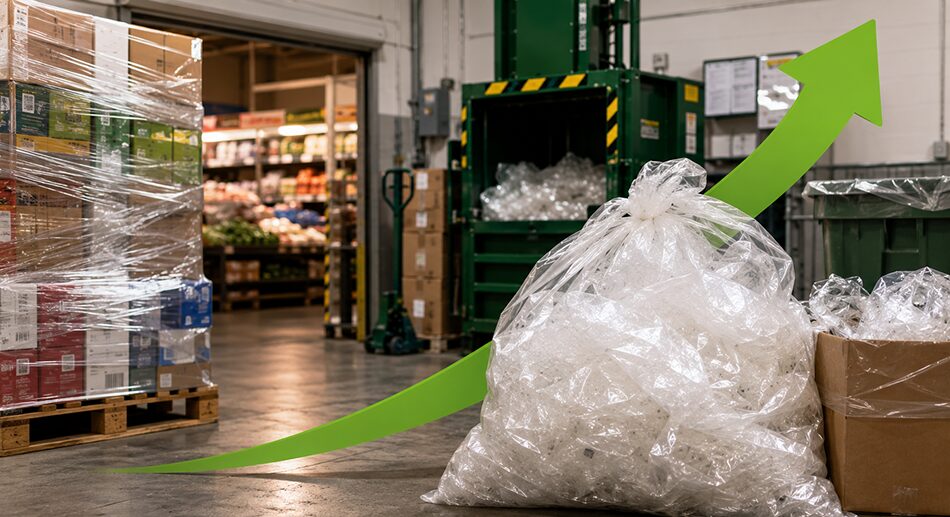
The free resource of flexible film plastic is generated in significant quantities every day. Products arrive at stores on pallets wrapped in stretch film. Thousands of items sold in the store – from paper towels and potatoes to ground beef – are packaged in film plastic.
Film plastic is essential for storing, protecting and transporting products. Regardless of where or how it is used, this material is typically used just once before being discarded.
It is then most often placed in the trash, making it a resource that has been misplaced.
Flexible film plastic – the hidden profit
Flexible film plastic is a “hidden” commodity. Recycling and upcycling markets pay about $0.14 to $0.17 per pound for collected material. Because grocery stores generate this material as a byproduct of their operations, it effectively becomes a revenue source with little to no associated COGS.
The question then becomes: Is it worth the effort?
Depending on store size and volume, a grocery store can generate between one and three large bags of flexible film plastic per day. Each bag can weigh as much as a gallon of milk (8.6 pounds). At current market prices, a single bag full of film plastic can generate up to $1.46 in revenue.
At first glance, that may not seem significant, as one bag per day translates into about $534 annually. But this comes with zero of COGS and an avoidance of paying to dispose of the film plastic in the trash.
This is equivalent to adding almost $11,357 in annual sales or selling more than additional 2,691 gallons of milk each year.
Turning waste into profit, community engagement
Customers can be the largest source of FFP. Providing easy collection for what is waste for them and something that pollutes their landfills and community can be an engagement opportunity.
Collecting customer-returned plastic bags – and even other forms of flexible film plastic, such as dry-cleaning bags – and combining them with the film generated in the backroom represents a practical and effective “hidden profit” enhancing strategy.
Selling a single gallon of milk does not move the needle all that much, but selling thousands of gallons does. The same principle applies to flexible film plastic.
One day’s worth of collection may not seem noteworthy, but a year’s worth of material creates a meaningful revenue stream.
Grocery PoP! is a consultancy built on decades of hands-on experience inside grocery stores, warehouses and cold-storage facilities. Founded by Peter Cooke and Jonathan Tan, who have collectively benchmarked thousands of locations, Grocery PoP! specializes in uncovering rapid, meaningful operational improvements.
Peter Cooke is co-founder of Grocery POP!
Leave a comment