
My colleague Peter Cooke and I are approaching a combined 40 years of helping food retailers improve their operations and, ultimately, their profit. For many of these years, this was represented by best sustainable practices or a similar vernacular. Regardless of the outside wrapper, we helped real retailers – real people – identify and capture the hidden profit embedded in their stores.
Many people have read or heard us discuss the historical low profit margins of food retail and the ratchet effect from reducing operational costs. Many of those same people have heard us say that food retailing is the single hardest business to operate, and the grocery store is the single most important place in our respective neighborhoods.
We believe and know these are true. It has been our mission to help retailers be their best and most profitable, because when they are, their associates, their customers and the community all benefit.
This series will focus on hidden profit sitting in stores. It often is in plain sight but has not been formally identified and quantified.
After being in thousands of stores and reviewing income statements, balance sheets, utility data, maintenance records, waste records and collecting information through our benchmarking process, Peter and I can demonstrably say this is no longer the situation.
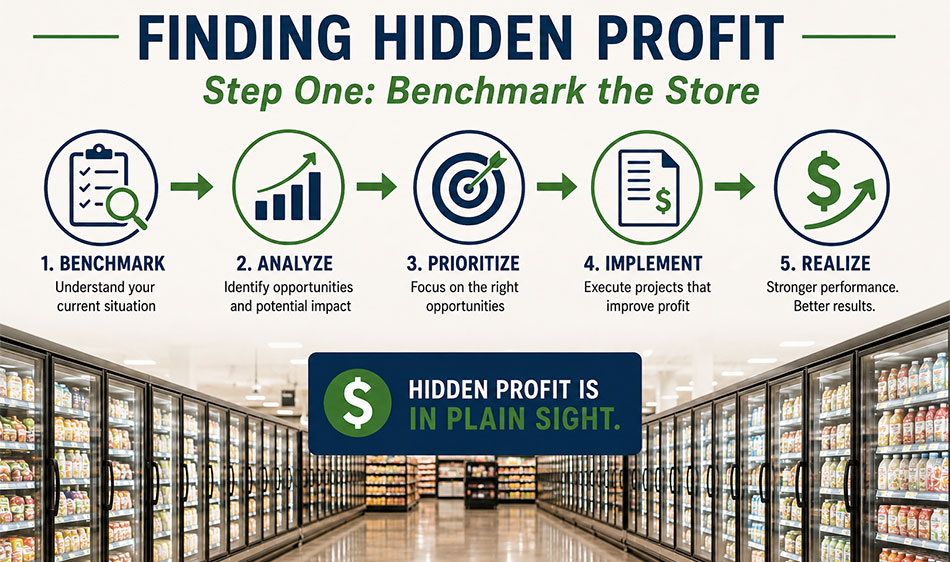
Any process improvement methodology starts with the same first step – current situation. What conditions are an organization or individual operating under at present?
This concept is both intuitive and simple. How can a store or business improve process and profit if it does not know what is happening now? And how does what is happening now compare to what could be happening?
Peter and I have benchmarked stores of different sizes, formats and geographies. The opportunities across these stores are the same and different. They are the same in the fact that each of the opportunities will – and do – improve profit. They are different in the order and the magnitude of the opportunities.
What opportunities should be chased? What is the timing required to complete, and what are the organization’s short- and long-term goals? What are the capital constraints? What are the available resources of people to manage and implement? How is one opportunity prioritized versus another?
Benchmarking a store(s), analyzing what is possible (and achievable) and defining all of the components of a payback are key to inform decision-making for an organization.
This was a process that Barry Queen underwent for Queen’s Price Chopper in Paola, Kansas. Barry was looking to accomplish several things. First and foremost, improve profit.
What and how can the store impact the income statement? How can the store improve short-term cashflow and reduce downside market and regulatory risk? What specific project(s) could be implemented to achieve stated goals? How and where could additional funding be utilized to offset first costs and improve return on invested capital?
After benchmarking the store, aligning short- and long-term goals, analyzing different projects and potential outcomes and identifying a potential outside funder, an initial project was drafted. This project included upgrading store lighting and modernizing refrigeration system controls.
An additional benefit from the refrigeration project was the upgrade from the high global warming potential (GWP) refrigerant of R404a with the lower GWP refrigerant R448a. The refrigerant swap not only provided a messaging opportunity as a commitment to the community of Paola by reducing GHG emissions, it swapped one gas that has experienced more than 300 percent inflation since 2019 to one that is 75 percent the price of it and experiencing slower inflationary pressure, reducing future replacement costs.
The resulting project reduced annual energy consumption of the impacted systems (lighting and refrigeration) by more than 34 percent. Total store energy consumption was reduced by more than 20 percent. The total financial impact from the project was equivalent to adding more than $2.4 million in sales.
Lastly, the store secured a grant to cover 50 percent of the total project costs. With the grant, the return on the project became a robust 41 percent (less than three years). Over the life of the project, the equivalent sales of more than $20 million will be added to the store.
How does a store go about finding its hidden profit? Step one – benchmark the store to determine the current situation and what might be possible.
Grocery PoP! is a consultancy built on decades of hands-on experience inside grocery stores, warehouses and cold-storage facilities. Founded by Peter Cooke and Jonathan Tan, who have collectively benchmarked thousands of locations, Grocery PoP! specializes in uncovering rapid, meaningful operational improvements – often identifying tens of thousands of dollars in profit opportunities within minutes. Grocery PoP! exists for one purpose: to help retailers increase profit, reduce environmental impact and operate with greater confidence and clarity. When your store wins, your community wins – and Grocery PoP! is here to help you pop your profit.