
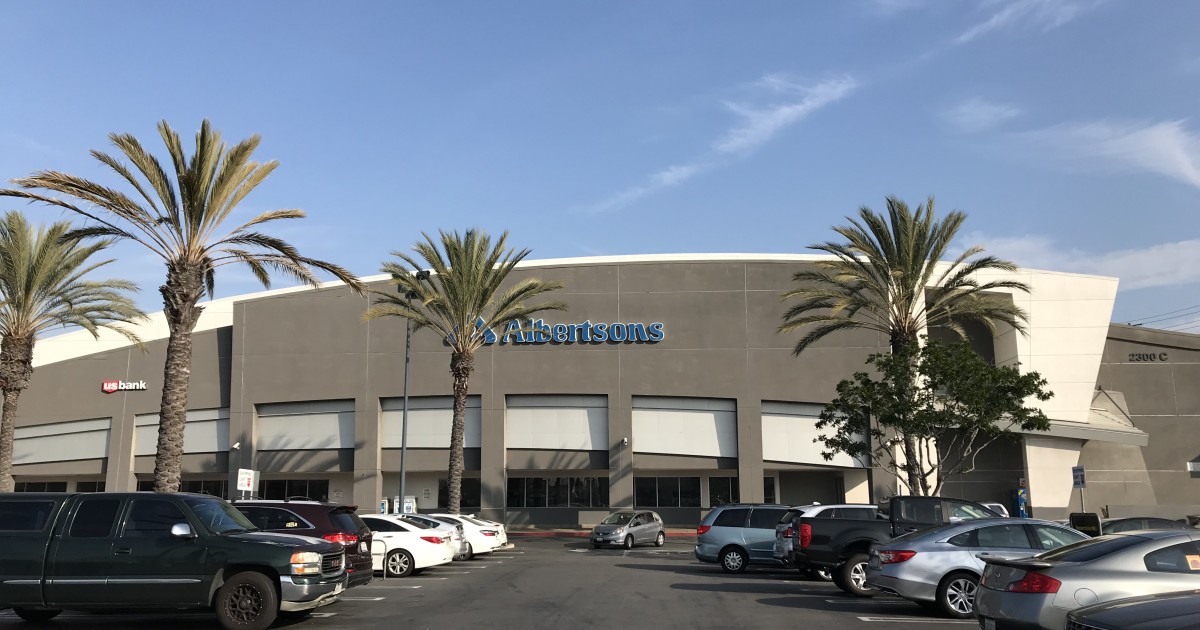
Albertsons Companies lowered its full-year guidance after first-quarter identical sales declined 0.8 percent and announced a restructuring that consolidates its 11 retail divisions into four regions and centralizes center store merchandising under a single enterprise team.
The Boise, Idaho-based grocer, which reported results July 23 for the 16 weeks ended June 20, cited softer industry unit trends and a more cautious consumer. It now expects fiscal 2026 identical sales between negative 1.5 percent and negative 0.5 percent, down from prior guidance of flat to 1 percent growth. Adjusted EBITDA guidance fell to $3.55 billion to $3.625 billion from $3.85 billion to $3.925 billion, and adjusted earnings per share guidance dropped to $1.75 to $1.85 from $2.22 to $2.32.
Net sales rose 0.2 percent to $24.94 billion, driven by higher fuel sales. Net income fell to $84.7 million, or 17 cents per share, from $236.4 million, or 41 cents per share, a year earlier. Adjusted EBITDA was $1.01 billion, or 4.1 percent of sales, down from 4.5 percent.
“While these results did not meet our expectations, they underscored the need to move faster,” said Susan Morris, CEO of Albertsons Cos.
Four regions replace 11 divisions
The restructuring – which Albertsons calls the ACI Edge – groups markets into four regions:
- The California Region covers Southern and Northern California.
- The West Region includes Mountain West, Portland and Seattle.
- The South Region takes in Southwest, Southern and United markets.
- The East Region covers Jewel-Osco, Mid-Atlantic and Shaw’s.
Each region will contain local markets responsible for customer connections, store support and community results. The company said it has no plans to realign stores or districts, and its 22 banners will retain their existing identities and community ties.
“It combines the scale and capabilities of a national retailer with the accountability and local focus that have long distinguished our banners,” Morris said of ACI Edge. “By consolidating 11 divisions into four regions and centralizing center store merchandising, we can make faster decisions, improve in-stocks and move accountability closer to our stores, where fresh, service and local execution matter most to customers.”
The company said the simpler structure, combined with its growing data and AI capabilities, is intended to help teams respond more quickly to customer needs, improve in-stock performance and deliver a more consistent experience across stores and digital channels. A timeline for the transition was not provided.
Center store merchandising moves to enterprise team
The next step in the company’s Merch United model brings customer insights, supplier relationships, strategy, product, placement, promotion and price for center store under one enterprise team. Fresh merchandising decisions will remain in the markets, guided by the Merch United strategy and local customer preferences.
“By bringing center store work together at the enterprise level, we can better leverage our scale, strengthen supplier partnerships and create more capacity for our regional and market teams to focus on fresh, local and the customer needs that make each community unique,” said Michelle Larson, executive vice president and chief merchandising officer at Albertsons Cos.
Morris said the company is accelerating investments in its customer value proposition ahead of expected productivity benefits, a decision reflected in the reduced guidance.
Digital and pharmacy offset grocery softness
Albertsons’ digital sales grew 13 percent in the quarter, and pharmacy sales continued to increase despite headwinds from the Inflation Reduction Act’s Medicare Drug Price Negotiation Program, which took effect Jan. 1. The company attributes an estimated 150 basis points of its identical sales guidance headwind to the program.
Gross margin rate fell to 26.6 percent from 27.1 percent. Excluding fuel and LIFO, the rate declined 23 basis points, driven largely by delivery and handling costs tied to digital growth. Selling and administrative expenses rose to 25.6 percent of sales from 25.4 percent, reflecting higher rent and occupancy costs, merger-related litigation costs, business transformation costs and depreciation.
Capital spending and buybacks
First-quarter capital expenditures were $522.1 million, covering 15 remodels, four new stores and digital and technology investment. Full-year capital expenditure guidance was trimmed to $1.9 billion to $2 billion from $2 billion to $2.2 billion.
The board raised the quarterly dividend 13 percent in April to 17 cents per share and increased the remaining share repurchase authorization to $2 billion. Albertsons repurchased 13.4 million shares for $226.5 million during the quarter.
As of June 20, the company operated 2,240 stores in 35 states and the District of Columbia under 22 banners, along with 1,708 in-store pharmacies, 408 fuel centers, 22 distribution centers and 19 manufacturing plants.