
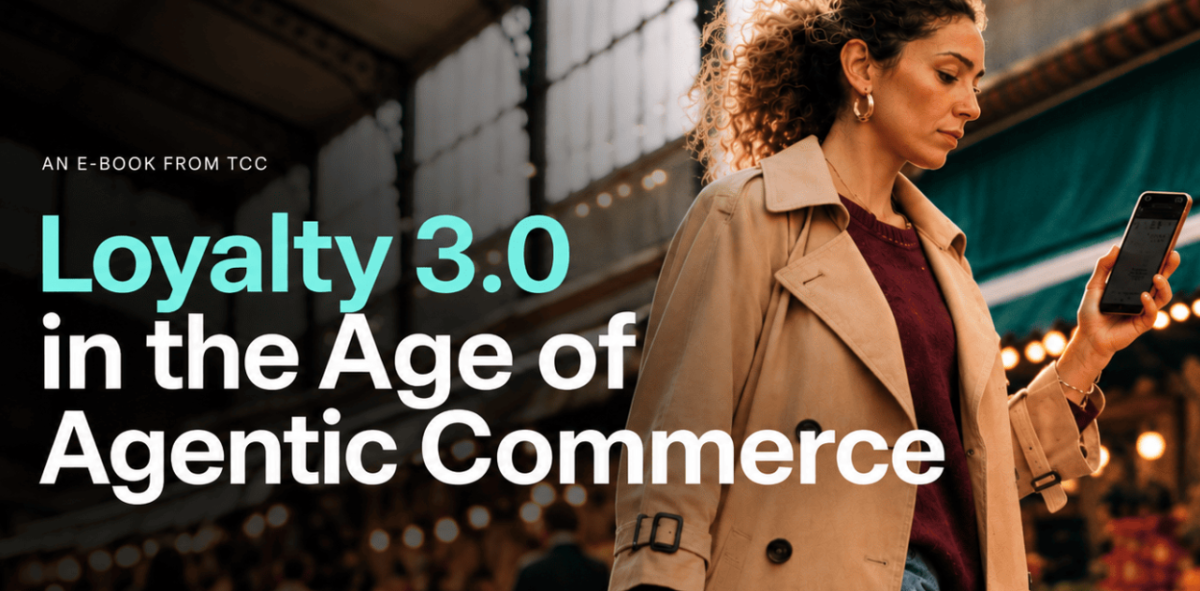
TCC Global, the loyalty marketing company that works with more than 120 of the world’s largest retailers, including Kroger, Albertsons, Carrefour, Lidl, Coles and REWE, has published a new e-book arguing that grocers have a narrow window to rebuild their loyalty programs before AI shopping agents take over routine purchasing decisions.
“Loyalty 3.0 in the Age of Agentic Commerce” addresses the rise of AI agents that research, compare, build and increasingly purchase grocery baskets on a shopper’s behalf. Once agents materially influence purchasing, the report argues, traditional loyalty perks like points, coupons and promotions lose their power, and retailers risk being reduced to interchangeable “fulfillment layers” chosen on price and speed alone.
“The retailers that win in an agentic world will be the ones who treat this as infrastructure, not a marketing campaign,” said Julie Lyle, TCC Global board member. “You have about 18 months to make your loyalty economics computable, your data clean and your pricing logic trustworthy enough for a machine to act on. Wait until agents control a third of the basket, and you’re rebuilding under pressure instead of leading from strength.”
The authors lay out a two-track, 18-month strategy. Track one, becoming agent-ready, calls for simplifying loyalty economics into computable value, cleaning up product and pricing data, building an API layer, piloting subscription models and installing guardrails. Track two, building emotional defensibility, calls for cultural, aspirational and community-based rewards that give shoppers a reason to instruct their AI agent to prefer one retailer’s ecosystem over another.
“AI agents are moving grocery from a world where retailers compete for shopper attention to one where they have to compete for algorithmic inclusion,” said Seb Hill, chief marketing officer at TCC Global. “If your rewards require manual clipping or your pricing logic is inconsistent, an agent won’t just ignore it, it will actively route around it.”
The report reviews live industry activity, including Albertsons’ Safeway plugin in ChatGPT, Walmart’s Sparky assistant and Schnucks’ AI shopping assistant, alongside proprietary TCC research, a five-stage model of shopper trust and a measurement framework with metrics such as “share of baskets AI-assisted” and “loyalty prompt preference rate.”
Key findings
- Agentic shoppers could represent $190 billion to $385 billion in U.S. e-commerce spending by 2030, per Morgan Stanley estimates cited in the report.
- The global AI-agent market is projected to grow from $7.8 billion in 2025 to more than $50 billion by 2030 (IGD).
- 55 percent of consumers would welcome AI automatically reordering everyday household items, and 64 percent are open to AI brand recommendations (Koddi).
- 43 percent of retailers are already piloting autonomous AI agents, and a further 53 percent are evaluating or exploring use cases (eMarketer).
- In-store shopping still accounts for 80 percent of U.S. grocery purchases (WGSN), and 4 in 10 U.S. retail executives plan to reinvest in store experience (Deloitte).
The authors argue grocery is uniquely exposed because it combines frequent, routine, price-sensitive and time-sensitive purchases, the conditions where shoppers are most willing to delegate decisions to an agent. Grocers who wait until agents control roughly 30 percent of baskets to rethink loyalty, they write, will be negotiating from a position of weakness.
The e-book is available as a free download at tccglobal.com. Founded more than 30 years ago and active in more than 70 countries, TCC has delivered more than 8,000 campaigns for retailers worldwide.
Related: Walmart Builds Guardrails For AI Agents Shopping On Customers’ Behalf