
Contributed by Robert Austin, President and CEO, EmpowerFresh Company®
Grocers have no shortage of ways to use AI. The real question is where to spend the first dollar.
I’d argue it should go to operational AI: keeping products on the shelf, protecting margins and giving employees back some of their time. Those problems don’t come and go. They show up every day and hit the P&L directly, which is exactly why they deserve funding ahead of tools built to make one person’s inbox move a little faster or to recap meeting minutes. The cheap tools are fine. The first meaningful investment belongs in operations.
What operational AI actually does
Operational AI is AI pointed at the processes that run the store. It reads the data those processes generate, anticipates what’s coming, spots trouble, and either recommends a fix or handles an authorized task. In a grocery setting that might look like smarter replenishment, catching inventory that doesn’t add up, planning labor or flagging where you’re quietly losing money.
The common thread is that it works on problems the store already has, using data the store already collects. It doesn’t ask a manager to learn a new way of working. It narrows a day’s worth of noise down to the handful of things worth acting on and hands them to the person who can act.
Start with inventory
Inventory records have to keep up with everything happening on the floor: sales, deliveries, spoilage, substitutions, the odd miscount. Keeping them accurate means counting, and with labor this tight, few stores have the hours. A rushed associate misses a case in the back or keys in the wrong unit, small errors pile up, and soon the number on the screen and the product on the shelf tell two different stories.
A good count only solves half the problem. Turning it into the right order has always depended on experience, and many of the veterans who carried that knowledge have retired or moved on. Their replacements are often learning on the job while juggling customers, deliveries and departments. Even with accurate numbers, they’re left guessing.
Consider an item that has gone quiet at the register while the system still shows it in stock. Operational AI can compare that silence with usual sales, recent deliveries and on-hand inventory, then flag it for someone to check the shelf and the back. Run that across the whole assortment, add the sales history a veteran carried in their head, and the system narrows the noise to the discrepancies worth chasing and suggests orders grounded in data. No employee has the hours to cross-check every SKU. The system does it so people can fix what it finds.
The same sales and receiving data that exposes a bad count can also predict demand. Better demand estimates support fresher shelves, prepared foods ready when customers want them and enough stock for key sale items, while reducing excess perishable inventory and food waste. The customer just sees a department that’s ready when they walk in.
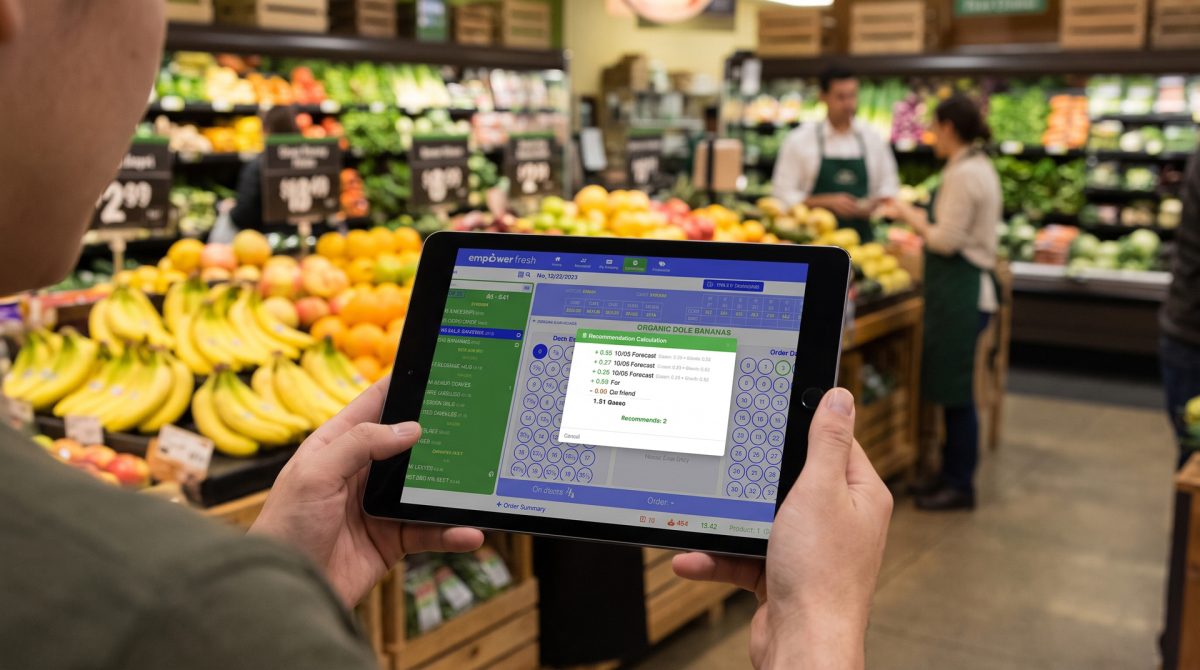
That’s what we see in produce at Empower Fresh, where this is our work. Kowalski’s Market uses AI forecasting across its stores to set produce orders and track shrink, in-stocks and margin in one place, so each department works from the same picture instead of a clipboard and a hunch. The teams still make the call on every order. They just start from a better number.
Protecting the margin, not just the sale
Protecting the sale also means protecting its margin. AI-powered pricing tools can flag cost increases as they land and recommend retails aligned with margin goals, so a vendor increase doesn’t quietly eat a category’s profit for three weeks before anyone notices.
Promotion analysis works the same way. Instead of repeating last year’s ad calendar, retailers can assess which offers actually generated additional sales across items and categories, which ones simply shifted volume from one week to the next and which ones gave margin away for nothing. That gives the next promotion a stronger basis than habit, and it gives the merchandising team a reason to retire the ads that never earned their space.
Putting the right people in the store at the right time
Labor is usually a grocer’s largest controllable expense, yet many schedules are still built by copying last week’s schedule and adjusting on instinct. TimeForge starts with the data the store already has. Its AI forecasting reads point-of-sale history, prep times and seasonal patterns to predict what each day and shift will demand. It then builds schedules to match, following the retailer’s own rules and labor standards and checking them against local labor laws before they’re posted. Managers start from a schedule that fits the traffic they’re likely to see, not a blank grid or a guess.
A forecast is still only a plan, and stores rarely follow the plan exactly. A truck runs late, a cashier calls out or a rainy Saturday turns out slower than expected. Much of the value comes from watching the gap between what was planned and what’s happening. That means flagging employees who are heading into overtime before the shift ends, catching compliance problems before they become penalties and showing which stores keep running over- or understaffed compared with their peers. It’s the same principle as inventory: no manager can check every timecard against every hour of sales, so the system narrows the noise down to the exceptions worth acting on. Woods Supermarket used that approach to cut overtime by 68 percent.
This is also where the other operational tools pay off. When an inventory system flags a shelf to check, or video analytics flags something on the floor, someone must be available to respond. Forecasting the work along with the traffic, and assigning tasks to the hours when staff have room for them, makes it far more likely those hand-offs get done. The manager still makes the final call. The system just gives them a better starting point and tells them where to look.
Anthony Presley, founder of TimeForge, said:
“Every grocer already has the data to schedule better. It’s sitting in their point of sale. What they don’t have is the time to turn it into a schedule that fits each store and each hour, and then catch the moment the day stops going to plan. That’s the work AI should be doing. It gives managers a schedule they can trust and points them to the exceptions that need attention, so they can spend their time running the store instead of building spreadsheets.”
Inventory, pricing and labor management show how operational AI can improve everyday decisions. Loss prevention offers another application of the same principle: give employees useful information early enough to act.
Catching loss while it’s happening
Loss prevention is where this gets visible. Veesion’s software runs on the cameras a store already has and watches for the gestures that usually go with shoplifting, like an item slipped into a coat or a bag. When it sees one, it sends a short clip to an employee’s phone, and that person decides what to do. More than 6,000 stores use it. What matters is the timing: someone on the floor finds out while the customer is still in the building, not weeks later on a shrink report.
Hiren Mowji, head of sales at Veesion, puts the priority this way:
“Retailers don’t need more technology for the sake of technology. They need intelligence that translates into measurable operational improvements. AI has reached a point where it can identify challenges as they’re happening, rather than simply helping retailers understand what went wrong after the fact. That shift from reactive to proactive operations is where we’re seeing tremendous value, and it’s why I believe operational AI needs to be a priority for every grocery retailer today.”
People and data still do the work
That shift toward earlier action still depends on people. Go back to the inventory example: it’s an employee who confirms what’s physically on hand and does something about it. It’s a manager who happens to know the display got moved last week or the delivery ran late. AI can point them at the right spot, but their knowledge and judgment decide what happens next. Retailers must build that hand-off into the workflow, with someone clearly responsible for reviewing what the system surfaces and closing the loop.
All of that depends on data you can trust. Sales, receiving and inventory records have to be current and consistent enough that comparing them tells you something real. Employees also need to see why something got flagged, so they can push back when the system reads a situation wrong. Skip either one and the tool becomes noise. Both belong in the investment conversation from day one.
Where to put the first dollar
The smart way to get started is a pilot aimed at one expensive, recurring problem your people regularly deal with. A retailer looking at inventory AI can test something concrete: does it improve availability and record accuracy while cutting the time spent digging around? Count the full cost, including software, integration, training and the work of acting on what the system recommends. Then measure it against what you can already do today. If it only matches what your team already does, you’ve paid for nothing.
A pilot that can actually tell you something looks like this:
- Pick one problem your people deal with regularly and that costs real money, such as inventory accuracy, overtime or shrink in a single department.
- Put someone in charge of the pilot and record where performance stands now, before anything changes.
- Count the full cost: software, integration, training and the staff time it takes to act on what the system recommends.
- Decide up front what kind of improvement would justify expanding beyond the pilot.
- If it delivers, expand. If it doesn’t, work out whether the obstacle is the technology, the data or the process before you put another dollar behind it.
That’s the case for giving operational AI first claim on the budget. It puts your money right next to the daily work that decides whether the store sells what people came in for, keeps the profit it earns and gives employees the support they need. The reason to use operational AI is a better-run store, and that’s a measure that really matters.
