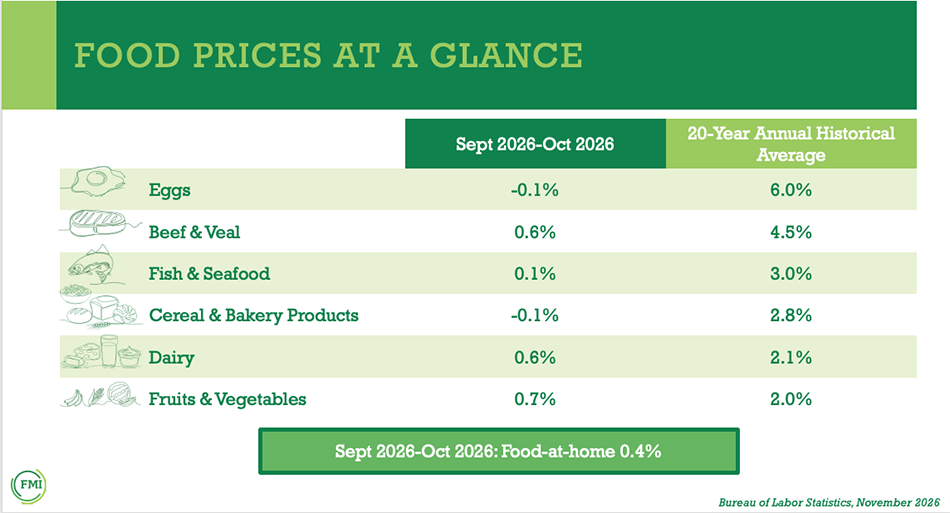
Food prices rose 0.4 percent in the most recent Consumer Price Index release, ending a run of three reports that showed “effectively flat” prices, a Cal Poly professor of agribusiness told reporters during a Nov. 12 media briefing hosted by FMI – The Food Industry Association.
“That doesn’t sound like a lot, but for a monthly increase, it’s pretty substantial,” Ricky Volpe said.
Repeated every month, an increase of that size would add up to nearly 5 percentage points for the year, he added.
“That would be much higher than average food price inflation, and people would really feel that,” Volpe said.
For the year, food price inflation remains moderate. The food-at-home CPI tends to increase about 2 to 2.5 percent in a given year, said Volpe, adding, “We’re probably going to end up in that ballpark.”
Increases linked to energy costs
Volpe tied the latest increase to energy.
“Diesel prices, natural gas, industrial electricity – most of these energy indices have been surging for quite some time for the last several months, and that has created cost pressures for the food system for everyone from growers and shippers to manufacturers and packers, wholesalers and retailers,” he said.
Beef and veal jumped on limited supply coupled with strong demand, with higher energy costs on top.
“I think this is probably a very clear case of energy impact because of how very transportation- and storage-intensive fluid milk is,” Volpe said of dairy.
Weather also having an impact
Lettuce, tomatoes, bell peppers and some citrus fruits are among the commodities with the biggest price increases, he said. Higher energy prices are the overall explanation, and many vegetable commodities also face supply chain disruptions from adverse weather in the Southeast, western Mexico and Southern California.
Volpe does not expect relief soon. He pointed to the El Niño weather pattern underway, which could affect palm oil, rice, cocoa and coffee.
“Looking at these sustained cost pressures over the last two, two-and-a-half years does make me concerned that we’re going to see retail food price inflation remain somewhat elevated through the end of the year and probably into early 2027,” he said. “It would surprise me to see food prices go flat or trend down in the next four or five months.”
A year-over-year comparison for October is not available because the government shutdown left no data from October 2025, he said. 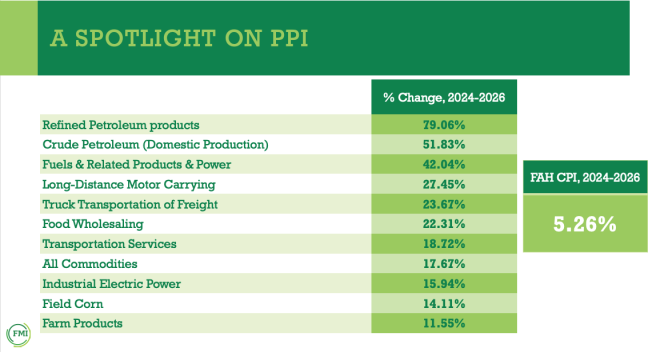
PPI explained
To understand why food prices are behaving as they are and where they are headed, Volpe urged a look at the Producer Price Index, which measures upstream costs borne business-to-business.
“These are not the costs that we as households, as shoppers, see, but they’re crucially important to understanding food prices,” he said.
Data he presented covering January 2024 through the most recent release shows “pretty dramatic increases” for some of the major costs borne by the food supply chain, as he described it. Energy stands out, and wholesaling gross margins and commodity prices also are up. The price a shopper sees on the shelf is the end of that chain, he said, and many of the transactions behind it have been subject to substantial inflation in recent years.
On the rise since 2024
Overall food prices are up a little more than 5 percent since January 2024, while some upstream costs have posted double-digit increases, Volpe said. The U.S. Department of Agriculture estimates energy accounts for 3 to 4 percent of the retail food dollar, so upstream costs do not pass through one-to-one.
Volpe said the gap also is explained by efforts across the food supply chain to mitigate costs. He pointed to sourcing flexibility, ingredient substitution, automation, data analysis and food waste reduction as strategies that work.
“I think the case could be made that based on what’s been going on with upstream costs, food price inflation in the last year or couple years easily could have been higher,” he said.
“The industry is making moves to help prevent inflation reaching levels that we saw in the post-COVID window, and I think that’s very unlikely,” Volpe said.
Consumer pressure
Shoppers are feeling the pressure, said Steve Markenson, VP of research and insights at FMI.
“A majority – 62 percent – say that their income is falling behind inflation,” Markenson said, citing FMI’s U.S. Grocery Shopper Trends holiday report. “But yet 72 percent say that they are doing OK so long as they stick to their budget.”
Sixty-five percent of shoppers are extremely or very concerned about rising grocery prices, a number that has held steady for two years. Concern about holiday expenses is a little higher than last year.
“The holiday meal is not a place where shoppers are looking to cut back,” Markenson said. “They want to keep that traditional holiday meal. They’d rather spend less on holiday clothing, decor, events, other things that comprise the holiday and not compromise on the holiday feast.”
Since August, the share of shoppers who feel they have some or a lot of control over their grocery shopping has risen 13 points to 88 percent. 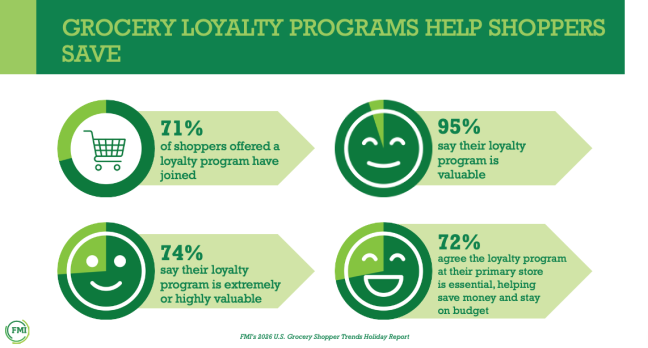
Markenson cited several factors, starting with shopping around. Shoppers visit an average of 5.4 banners and four channels in a 30-day period and spend about 70 percent of their dollars at their primary store.
Leveraging loyalty, deals
He also pointed to loyalty programs, weekly specials, circulars, coupons and private brands, which he estimated have grown from about 15 or 16 percent of grocery store sales about 10 years ago to about 25 percent.
“It’s a great tool that a lot of our members use to offer better prices and offer options to shoppers beyond the national brands,” Markenson said.
Andy Harig, VP of tax, trade, sustainability and policy development at FMI, concurred that loyalty programs are a valuable tool for both grocers and their customers.
“Loyalty programs are one of the most direct ways grocers are meeting shoppers where they live and helping them address some of those concerns about that outpacing of inflation of their income,” Harig said.
Eighty-nine percent of shoppers are aware of the loyalty program at their primary store. About 7 in 10 who have been offered a program have joined, and about 3 in 4 members say it is extremely or highly valuable. About 60 percent of grocers operate one.
Participation trails among lower-income households. Where programs exist, 58 percent of shoppers earning less than $35,000 a year are members, compared with 78 percent of those earning $150,000 or more.
“The households that could benefit the most from these programs are also the least likely to participate and be enrolled,” Harig said.
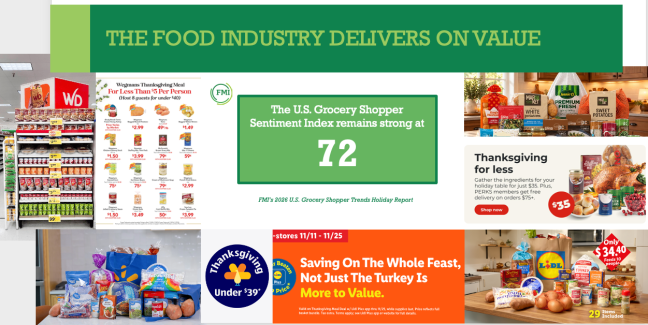
FMI’s U.S. Grocery Shopper Sentiment Index stands at 72, up from 69 in August, said Heather Garlich, SVP of communications at FMI. By contrast, she said, the University of Michigan’s Index of Consumer Sentiment fell to 48 in October, its lowest level since May.
Thanksgiving plans show shoppers heading back into the kitchen, Garlich said. Sixty-eight percent plan to serve turkey, 95 percent plan to take part in the cooking and 59 percent plan to prepare their turkey from scratch at home, up 16 points from fall 2025.