
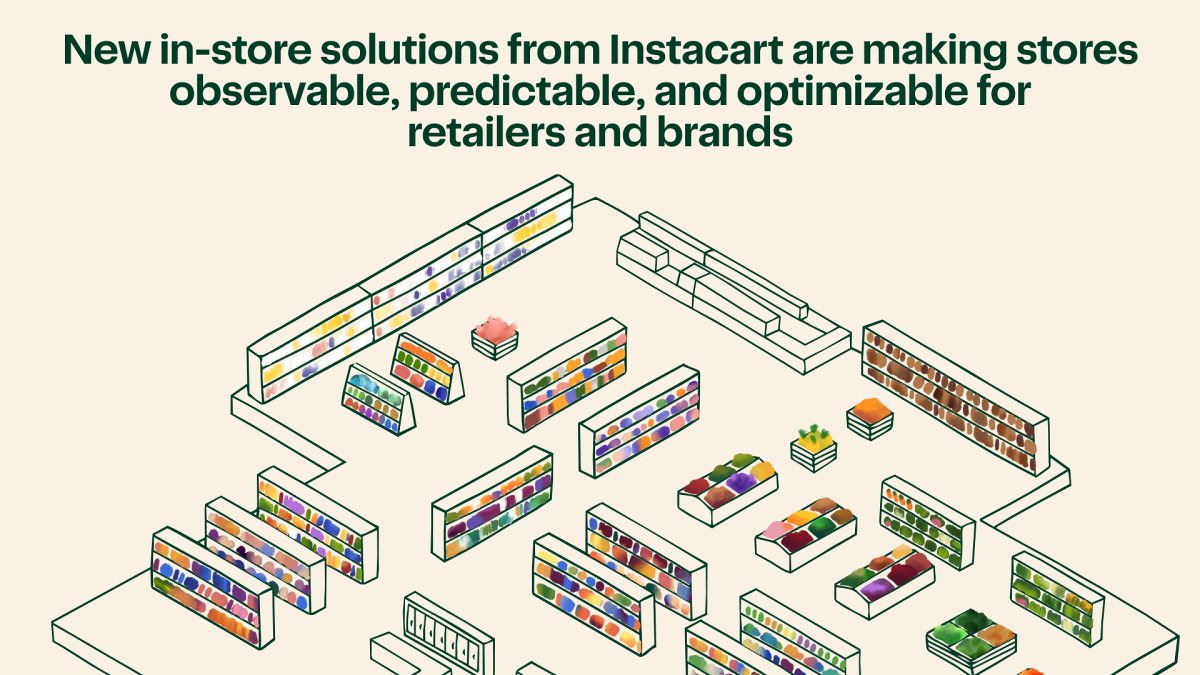
Instacart has announced new in-store software that gives grocers and CPG brands a real-time digital view of grocery shelves, mapping entire stores down to individual products so users can virtually explore aisles, understand what is happening on shelves and act on it.
The company is drawing on data collected by its network of about 600,000 shoppers, who visit stores in North America more than 15 times per store per day on average, generating more than 10 million unique data points daily. Shelf scans are combined with insights from more than 1.6 billion lifetime orders and shelf imagery captured by shoppers and Caper Carts, powered by the Arpalus computer vision technology Instacart acquired in July.
“Grocery stores are the most complex physical environments in retail. A single store carries tens of thousands of items and the floor changes by the minute as customers shop, brands restock, and associates move displays,” said Ryan Hamburger, chief commercial officer at Instacart. “Traditional inventory systems weren’t built for today’s reality – they rely on estimates and periodic counts, leaving grocers and brands with an incomplete picture of what’s actually happening on shelves. By turning the insights Instacart generates every day into real-time intelligence for the physical store, we’ll give retailers and CPG brands a level of visibility that drives better business outcomes and experiences for every customer.”
Inventory Intelligence for store managers
Through Inventory Intelligence, store managers can walk any aisle virtually, view shelf performance and test stocking, merchandising and planogram changes before making them in-store. The tools offer:
- Real-time shelf visibility: continuously updated shelf status as shoppers scan throughout the day, helping in-store teams replenish high-margin, high-velocity items faster, merchandisers optimize layouts and supply chain teams improve forecasting.
- Merchandising optimization: identifying high-velocity products that may need more shelf space, or where adding a facing could recover lost sales.
- Demand forecasting: anticipating which products are likely to run out ahead of holidays and other peak periods.
Store Excellence Portal for brands
For CPG brands, the Store Excellence Portal provides a daily, store-level view of what is on the shelf, including lost sales estimates down to the store and UPC, substitution and competitive benchmarking that tracks whether shoppers who could not find a product switched pack sizes or brands, and forward-looking monitoring that flags which stores and SKUs are likely to go out of stock before it happens.
The solutions, part of the Instacart Enterprise platform, are rolling out with select grocers and CPG brands, with more launching in the coming months.
“Identifying out-of-stock issues has typically meant piecing together information from multiple systems and our store managers spending a lot of time on the floor,” said Dylan Queen at Queen’s Price Chopper. “Having visibility to on-shelf realities and inventory trends over time will help us better orchestrate replenishment across the store and respond to gaps quicker.”
Instacart partners with more than 2,200 retail banners representing nearly 100,000 stores, powering e-commerce, fulfillment, in-store technology, AI offerings and advertising.
Related: Instacart Acquires Arpalus To Boost Shelf Intelligence