
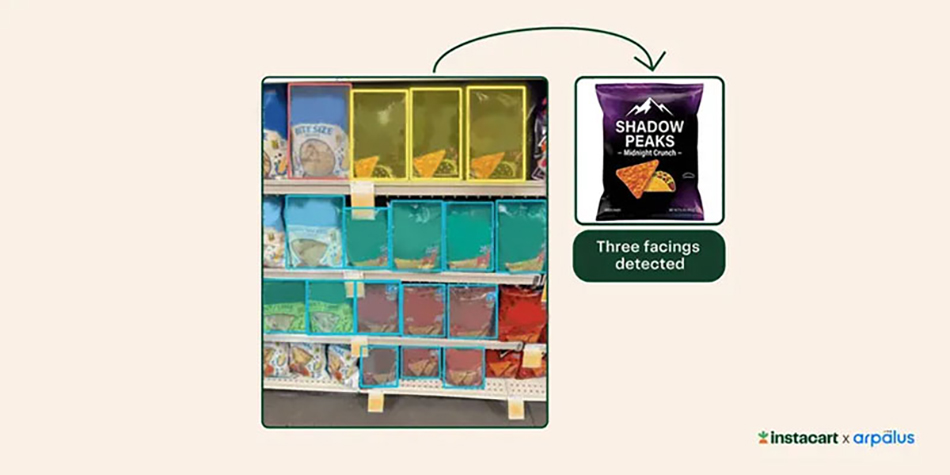
Instacart has acquired Arpalus, a computer vision company that has developed shelf intelligence technology built for grocery retail. Terms of the deal were not disclosed.
Arpalus’ technology turns a video scan of a store shelf into a real-time picture of on-shelf inventory. The company said its computer vision models are built for grocery store conditions – including low or unreliable Wi-Fi, inconsistent lighting and thousands of visually similar products packed together – and can identify individual items on shelves with more than 95 percent accuracy on average.
The technology runs on any smartphone or camera-equipped device, meaning Instacart’s network of 600,000 shoppers can generate shelf intelligence using the app they already use on orders. Arpalus models also can guide shoppers in the moment, prompting them to adjust camera angle or distance.
Instacart said undetected out-of-stocks and catalog gaps are among the most persistent sources of customer dissatisfaction in online grocery, driving substitutions, cancellations and eroded trust. The company said the acquisition gives it a more complete picture of on-shelf inventory and product availability to increase fulfillment accuracy.
“We believe the future of grocery retail is a unified experience powered by Instacart intelligence, where what happens in store connects seamlessly to ecommerce in real time,” said David McIntosh, chief connected stores officer at Instacart. “The Arpalus team has spent years building exceptional shelf intelligence technology, solving the problem of understanding what’s actually on store shelves at any given moment. With our leadership in physical AI for grocery retail and by activating our network of shoppers, we can feed even more accurate shelf information back into our models, delivering better outcomes for customers, shoppers and our retail and brand partners.”
“Arpalus was founded to solve one of retail’s most fundamental challenges: bridging the gap between what happens in-store and the decisions driving business performance,” said Ofir Zilberberg, founder and CEO of Arpalus. “We built an AI platform that gives retailers real-time visibility into inventory and store execution, enabling faster and smarter decisions at scale.”
Instacart’s intelligence system draws on more than 1.6 billion lifetime orders, real-time inventory views from nearly 100,000 stores across North America and machine learning models built for grocery, the company said. Its 600,000 shoppers visit large-format stores more than 15 times a day on average, generating more than 10 million unique daily data points.
Arpalus’ computer vision technology extends to Caper Carts equipped with external cameras, updating in-store on-shelf inventory insights in real time as the carts move through store aisles. Caper Carts have scaled to more than 100 cities globally. The shelf data also enhances Store View, Instacart’s real-time computer vision solution within its AI Solutions, being piloted by retailers including McKeevers and Sprouts, and supports consumer shopping on the Instacart Marketplace and on retailer websites powered by Storefront Pro.
Instacart partners with more than 2,200 retail banners representing nearly 100,000 stores. Through the Instacart Marketplace, Instacart Enterprise platform and Instacart Ads ecosystem, the company powers e-commerce, fulfillment, in-store technology, AI offerings and advertising for partners.
Arpalus, founded in 2019, serves retailers and consumer brands, and its technology is protected by patents in the United States and Europe.