
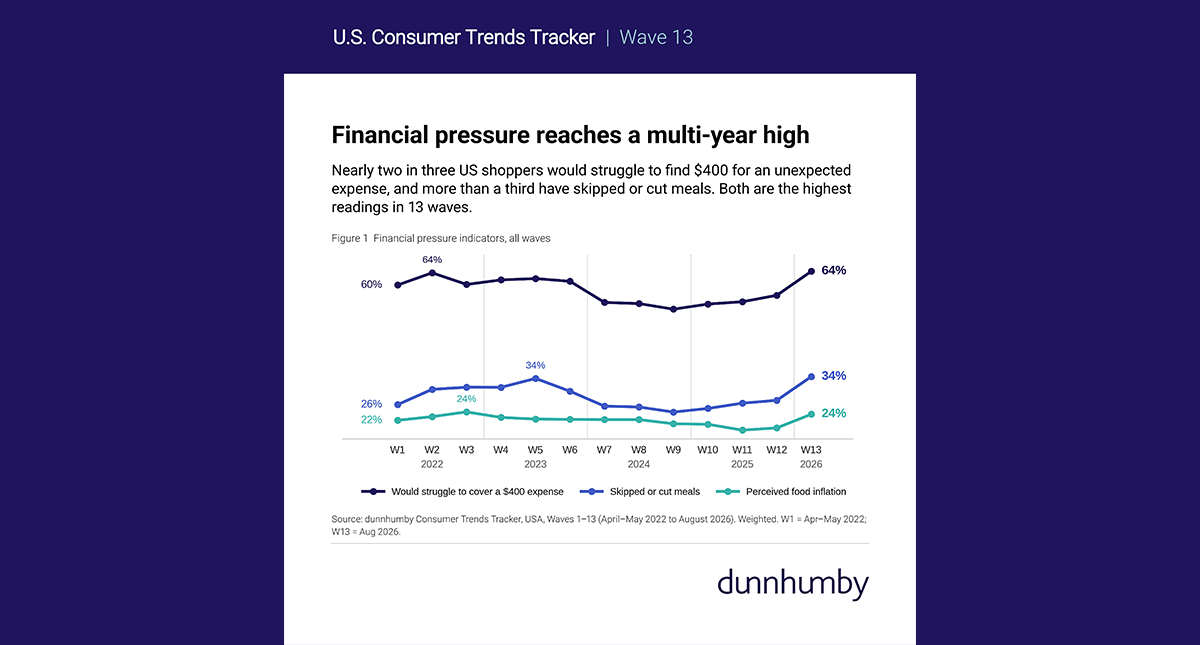
One in three U.S. consumers – 34 percent – reported they skipped meals or cut meal sizes in the past year for financial reasons, up 7 percentage points since December 2025. It marked the largest increase between surveys in the four-year history of the dunnhumby Consumer Trends Tracker.
Middle-income households earning $50,000-$100,000 saw the sharpest rise in the study’s 13th wave, with 31 percent reporting not having enough to eat, up from 19 percent in December. Consumers 65 and older recorded the second-largest increase, nearly doubling to 17 percent.
Working-age consumers remain the hardest hit: 39 percent of those 18-34 and 43 percent of those 35-54 report not having enough to eat, along with 43 percent of households earning less than $50,000 and 39 percent of families with children at home.
SNAP changes affect numbers
The jump comes as SNAP participation has fallen by approximately 5.2 million people since the 2025 federal budget law took effect, according to USDA data compiled by the Food Research & Action Center. Food-at-home costs are 12.4 percent higher than in May 2022; gas prices have hovered above $4 a gallon for most of the year, according to AAA; and University of Michigan consumer sentiment sits more than 20 points below its 20-year average.
“American shoppers are under more financial pressure than at any time since we started tracking them in 2022, and it’s building fast,” said Jamie Samaha, CEO of dunnhumby. “Nearly two in three would struggle to cover a surprise $400 expense, and more than a third have skipped or cut meals for financial reasons. Both are the highest levels we’ve recorded, and both rose seven points in just eight months.
“More and more, shoppers want a low price they can trust every day, not just one they have to hunt for. The retailers and brands that deliver it will earn their loyalty,” Samaha added.
Key findings
- Financial insecurity hit a study high: Sixty-four percent would struggle to cover an unexpected $400 expense, up 7 percentage points since December. Seniors rose 16 points to 46 percent and middle-income households 11 points to 60 percent; the rate was highest among households earning less than $50,000 (76 percent) and adults 35-44 (76 percent).
- Perception far outruns actual inflation: Shoppers believe food prices rose 24 percent over the past year, nearly 22 percentage points above the Bureau of Labor Statistics’ 2.2 percent reading and the highest perceived food inflation since 2022.
- Formats are shifting toward value and convenience: Convenience stores made the largest gain of any format, used by 29 percent of shoppers (up 6 points from the prior wave); dollar stores grew for a fourth straight wave to 45 percent; and online pure-plays rose to 24 percent. Mass merchandisers keep the widest reach at 79 percent, while traditional supermarkets (77 percent) and specialty stores (20 percent) were the only formats to decline.
- Walmart remains the most-shopped grocery retailer at 72 percent; the fastest year-over-year risers are 7-Eleven, Amazon, Dollar General and Dollar Tree.
- Loyalty is losing ground: Willingness to identify themselves to earn rewards fell 4 points to 48 percent, the largest drop of any behavior this wave, while shopping at stores with low base prices rose to 63 percent.
- Online delivery hit a tracker high: Thirty-one percent order groceries for delivery most or all of the time, up 6 points, with app interaction (41 percent) also a record and pickup at 23 percent. Delivery peaks among shoppers 35-44 and households with kids (43 percent each).
- AI remains a value tool with limited trust: Twenty-two percent used AI tools for grocery shopping in the past month, mainly to compare prices (44 percent) and find savings (40 percent); 25 percent trust AI mostly or completely, while 32 percent do not trust it at all.
For Wave 13, dunnhumby surveyed 8,500 grocery shoppers in six countries in the Americas, including 2,000 in the U.S., with online interviews conducted in August. The customer data science company works with retailers and brands including Tesco, Walmart Data Ventures, Meijer, Coca-Cola and Procter & Gamble.
Related: Acosta: Shopper Confidence Falling Despite Steady Purchasing Power