
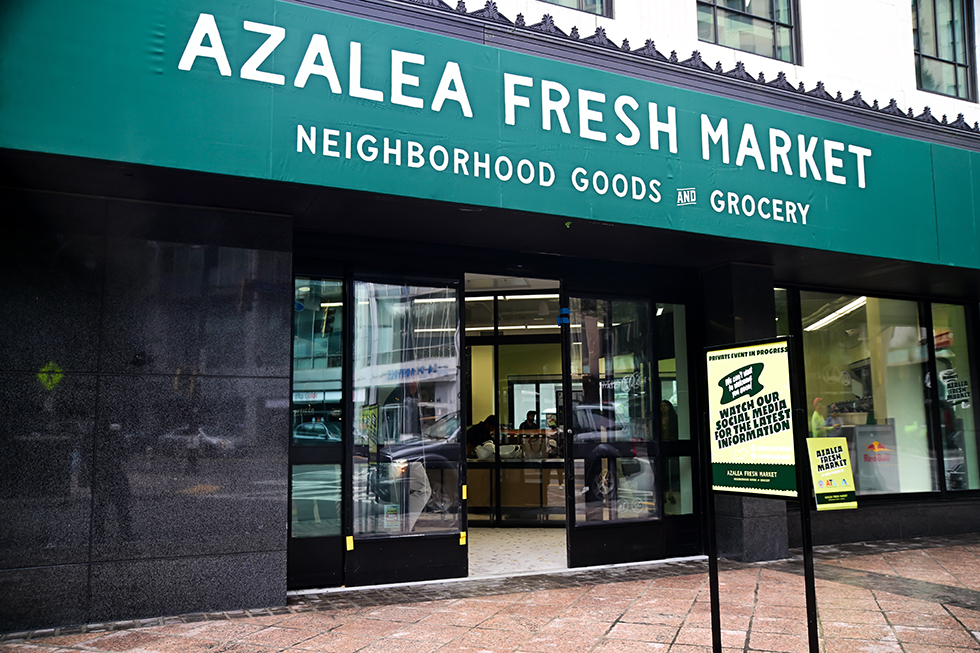
What began as an experiment in one Atlanta neighborhood is becoming a national model for bringing grocery stores to communities that have gone without them.
IGA‘s Community Development program, led by General Manager Ashley Page and Director of Community Store Development Jimmy Wright, now counts some two dozen active projects nationwide, from urban food deserts to small towns that lost their last grocer years ago. And as the program’s flagship Azalea Fresh Market stores prove out the model, Page said, cities from all over the country are calling to ask how to replicate it.
“The Atlanta model is what other areas in the country are trying to emulate,” she said, adding that the program hopes to take on at least one major city project a year, alongside a growing roster of smaller community efforts. “Those are the communities who have been trying to get a grocery store forever. We enjoy those every bit as much as we enjoy getting deep within the cities.”
Second Atlanta store set for October
The program’s next milestone comes Oct. 28, when its second Azalea Fresh Market opens at Campbellton Plaza on the Atlanta’s west side. Like the first Azalea Fresh Market — which opened near the Georgia State University campus in partnership with Mayor Andre Dickens’ administration and economic development agency Invest Atlanta — the Campbellton store is owned by Atlanta entrepreneur Paul Nair, founder of Savi Provisions. Page noted that while press coverage has sometimes suggested the city owns the stores, they are public-private partnerships in which both the city and Nair have invested significantly.
The downtown Azalea Fresh Market this summer enjoyed a successful sales period buoyed by World Cup events, which offset the sales dip the campus-dependent store typically sees when college is out of session. Page said the team learns more about the neighborhood as time passes, “and the store gets a little bit more successful each month.”
The Campbellton store, she said, is a decidedly different model and customer base, and the team is preparing accordingly: establishing a community board; holding meetings ahead of the opening; and planning a safety summit, a job fair and a local product summit that will invite area farmers and vendors to become suppliers. Hiring from the community — and having the store run by someone from within it — is a priority.
Nonprofit partners expand the map
Much of the program’s momentum on Atlanta’s west side comes through nonprofit partnerships. A new market operated by City of Refuge, a ministry known for its work in substance abuse recovery and helping survivors of sex trafficking, was slated to open in late summer on the ground floor of the organization’s new residential development, which transitions people in its programs back to independent living. A similar mixed-use project called The Guild is planned with the same design, and another large Atlanta nonprofit ministry is in preliminary discussions for a store on a planned campus.
“I tell people all the time, I’m the guy that just puts cans of green beans on the shelf,” said Wright, who owns Wright’s Market in Opelika, Alabama. “This opportunity has given us the ability to work with people that are making such a difference.”
The nonprofit work illustrates the program’s listening-first approach. “We don’t go in and say ‘do this, do this, do this,'” Wright said. “We try to listen and understand their purpose and mission. Once we have an understanding, then we can propose a solution to retail that works.” For a substance abuse recovery organization, for example, that might mean recommending the store not sell beer and wine.
The program’s process runs in three phases, Wright explained: listening, analysis and planning first; technical assistance if a project moves forward; and then ongoing support.
“We don’t want to just walk away,” he said. “We hang around and make sure they stay on a good path.”
That technical assistance work is entering its second year for a group of stores the program supports with supply, marketing and basic business consulting, with a slightly different group of stores participating in the program’s second year.
From Omaha to the Deep South
Beyond Atlanta, projects are under way in various stages nationwide. In Omaha, Nebraska, a ground-up store being built by the Heart Ministry Center — a project the program has guided from day one — is expected to open in fall 2027. Wright said a recent planning call spent a full hour on lighting and security cameras alone – a reminder that community grocery development involves far more than shelving and pricing.
Not every project arrives at the ideal moment. Some communities call after plans are already in motion, leaving the team to optimize buildings and layouts that would have benefited from earlier input.
“There is a formula for doing this,” Page said. “There is certainly a process, and the sooner we get the call, the smoother the process.”
The rural work has pushed the program toward something closer to community revitalization. Wright described visiting a town of several thousand people on a busy highway where the grocery store had closed — and then the bank.
“You talk to people and they don’t know how it happened; their town just got away from them,” he said.
In his view, rural decline often begins with the loss of the school system, with consolidation putting children on hour-long bus rides. Saving the grocery store alone, he tells communities, is not the whole answer; education, banking, infrastructure and public safety have to be part of the plan.
“As we got into it, it was much more than just dealing with stores,” Page said. “We deal with sourcing, which can mean that we are dealing with farmers. We deal with a lot of community organizations, because that’s where so much of the funding originates. And a lot of it is government relations, because some of these projects start in the government space.”
The power of partnerships
Page said IGA is positioned to do this work efficiently because the alliance essentially functions like a nonprofit: revenue goes back into serving retailers, and the program adds no consultancy markups. IGA’s board consists of its licensed wholesalers, allowing the program to match each new store with the distributor best suited to it, while Red Oval partners supply equipment and services. Partnerships with the National Grocers Association, FMI – The Food Industry Association, suppliers and government partners round out the network — including new IGA wholesaler member Affiliated Foods in Amarillo, Texas.
The work also is generating institutional knowledge the industry has lacked.
“We now know what it truly costs to open a grocery store,” Page said. “We now know that the reason that so many of these projects have failed is because there was no capital to get the store to profitability. We now know just how important it is to bring vendor partnerships and wholesale partnerships to entrepreneurs that otherwise would not have them.”
One stubborn challenge: supplying very small stores in Atlanta, some of which have been buying inventory from other retailers or convenience store wholesalers at elevated prices. The program is working with Invest Atlanta on a broader solution, including ways to aggregate small orders for stores that don’t have their own loading docks, while helping with local sourcing in the meantime.
The work continues
Despite the challenges, the reception IGA’s community development program has received has affirmed the work. “Nobody has come up to us and said, ‘you guys are crazy,'” Wright said. “I think the industry is thankful that somebody is willing to get their arms around this.”
Page credits Dickens, Invest Atlanta and IGA President and CEO John Ross for the chance to experiment.
“We learn as we go, and the projects get bigger and better with each completion,” she said. “We are confident there is a ton of promise in this space, regardless of what party is in office or what a city or rural community’s path forward is.”