
The Southeast Produce Council unveiled its sixth annual What’s New? consumer research during an educational session at Southern Innovations in Nashville, Tennessee. Study author Anne-Marie Roerink of 210 Analytics presented four trends reshaping fresh produce: financial pressure, GLP-1 medications, generational shifts and artificial intelligence, with retailers, grower-shippers and other industry leaders discussing each in an interactive format.
The study finds consumers navigating tighter budgets, new health priorities and an increasingly digital decision-making environment, with Millennials poised to overtake Boomers as the dominant share of produce spending within two years.
“Fresh produce remains important to all consumers, but a growing number are recalibrating their fruit and vegetable purchases,” said David Sherrod, president and CEO of SEPC. “Consumers are looking to us to provide solutions that make fresh produce fit effortlessly into their daily routines, whether that is a budget, GLP-1 or kid-friendly diet.”
Financial pressure changing how consumers shop
Fresh produce continues to generate significant dollar sales, but deliberate spending decisions are pressuring unit and volume growth. Key findings include:
- While 49 percent of consumers say produce feels expensive but is worth the price, 16 percent of financially struggling consumers describe fresh produce as a luxury.
- Nearly half report buying smaller quantities, while others are switching to cheaper varieties, moving between fresh, frozen and canned formats, shopping multiple stores and prioritizing promotional items.
- Eighty-one percent say they choose sale items over planned or routine produce purchases at least sometimes.
- When consumers unexpectedly have $20 available for groceries, fresh fruits and vegetables are the most common spending choice at 27 percent, ahead of meat and poultry at 24 percent.
GLP-1 medications create new opportunity
The study finds 18.1 percent of U.S. consumers currently use a GLP-1 medication, with usage concentrated among higher-income consumers ages 29-50 in urban and suburban areas.
- GLP-1 consumers report eating less overall, eating smaller portions but more meals, and making more deliberate food choices. Nearly half say they are intentionally eating more fresh fruits and vegetables.
- Eighty-nine percent of GLP-1 consumers seek advice on what to eat while taking the medication, and 86 percent say more in-store information about GLP-1-friendly fruits and vegetables would influence their consumption.
- Consumers express interest in GLP-1-friendly meal stations, recipes, high-protein meal ideas, smaller portions, ready-to-eat produce snacks and nutrition information.
Center of gravity shifting to younger consumers
Boomers remain the largest generation by produce spending today, accounting for 33.5 percent of produce dollars, according to Circana data cited in the study.
- Gen Z produce spending is up 25.4 percent year over year, compared with 3.4 percent for Millennials, 3.3 percent for Gen X and 0.2 percent for Boomers. Based on current growth patterns, Millennials are likely to become the largest generation by share of produce spending within two years.
- Younger consumers are more likely to view fresh produce as the foundation of a meal or a convenient snack, favor global dishes and rely on hybrid meals. Social media and digital platforms play a larger role in influencing what they cook and purchase.
- They are more likely to shop for fresh produce in the mass, club, specialty and online channels, purchase value-added and organic produce, and use AI to research recipes, nutrition, meal plans and shopping.
AI moving into the food journey
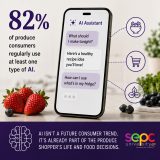 The study found 82 percent of produce consumers regularly use at least one type of AI, with younger consumers tending to use multiple platforms.
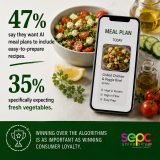
- Seventy-seven percent of AI users have turned to AI for food-related information, inspiration, planning or shopping. Recipes, meal planning, grocery lists and cooking techniques are among the most common uses.
- Consumers envision using AI for meal planning, recipes based on what is already at home, budget-friendly meal ideas, recipes based on promotions and personalized nutrition guidance. They also express interest in technologies such as freshness sensors and nutrient-density scanners in the produce department.
- Consumers have reservations about AI-generated grocery and produce marketing, particularly concerns about authenticity, misinformation and pricing accuracy.
 “Consumers are asking us to solve different problems,” Sherrod said. “Help me stretch my budget, help me eat better, what is GLP-1 friendly, help me figure out what to make tonight and increasingly, help me navigate an enormous amount of information. Those are opportunities for the fresh produce industry.”
The online study of 1,500 consumers, plus an additional sample of 150 verified GLP-1 medication users, was conducted by 210 Analytics and fielded in August. A complete copy of the findings can be requested by contacting Anna Burch at SEPC.
Founded in 1999, SEPC is a nonprofit association of more than 6,500 produce industry professionals.
Related: SEPC To Unveil GLP-1 Findings At Southern Innovations