
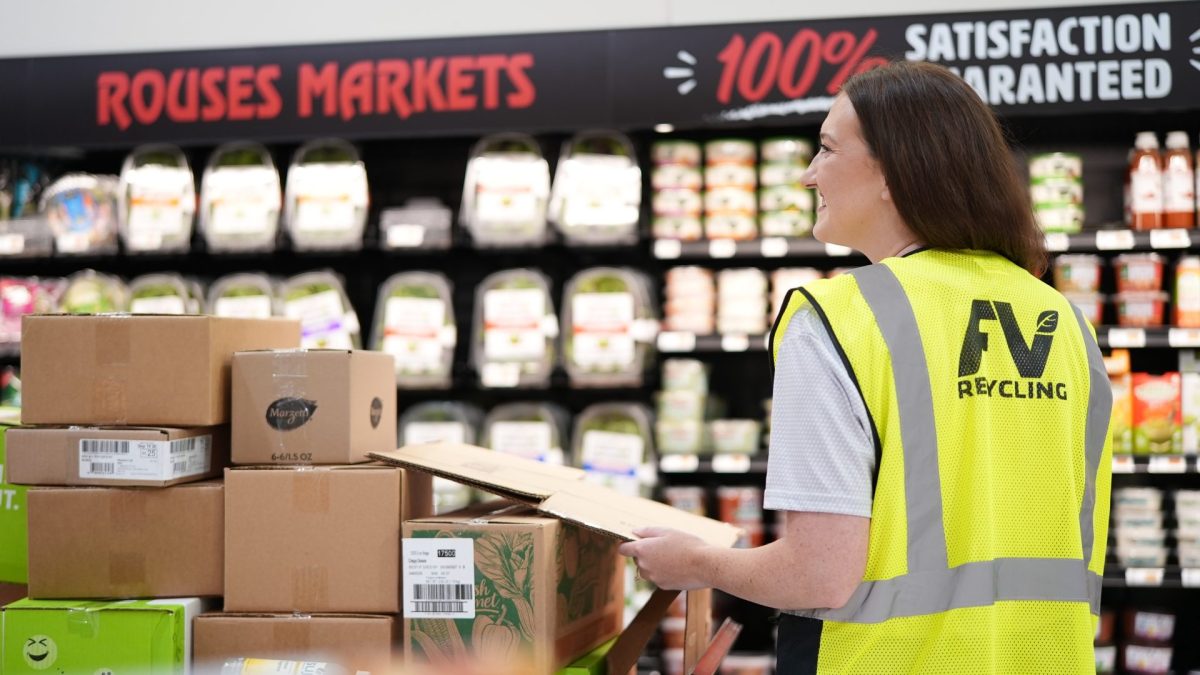
For most grocery operators, cardboard is a byproduct of stocking shelves. A new retail operations report involving Rouses Markets suggests retailers may be overlooking one of the largest recoverable assets in their stores.
The report examines how the Gulf Coast grocer has transformed old corrugated cardboard, or OCC, from a routine waste stream into a more strategic part of store operations through a long-term partnership with FV Recycling, a Hattiesburg, Mississippi-based recycling and waste solutions provider.
Rouses operates 76 stores in Louisiana, Mississippi and Alabama and employs more than 7,000 team members. As the Thibodaux, Louisiana-based grocer continues to expand, growth creates operational complexity, particularly in managing the constant flow of cardboard generated by supermarkets.
“In grocery, you simply can’t let bales back up behind the stores,” said Ozzie Osborne, VP of facilities for Rouses Markets. “Space is limited, lanes are tight and operations move fast. The pickups have to happen on time and consistently every week.”
Coordinating around grocery cycles
FV Recycling’s bale-route model combines logistics coordination, market intelligence, store-level responsiveness and equipment support for retailers generating steady cardboard volumes across multiple locations. Kendell Kendrick, FV’s customer relations specialist, has worked with the Rouses account for more than two decades.
“We monitor stores constantly,” Kendrick said. “Every Monday we’re calling stores, checking bale counts, coordinating with dispatch and transportation. The larger-volume stores may get additional follow-up calls later in the week if they need another pickup.”
That coordination becomes especially important during seasonal surges, hurricane preparation periods, store openings and holiday volume spikes, when OCC generation increases dramatically.
“Case movement changes throughout the year, so OCC changes too,” Osborne said. “Christmas looks different than the Fourth of July. Hurricanes can create huge volume spikes. FV understands our business cycles and plans around them.”
Osborne said FV’s market transparency has been valuable during volatile commodity cycles, with ongoing updates on pricing trends, freight pressures and packaging demand that influence rebate values.
“When markets are strong, everybody benefits. When markets soften, they help us understand what’s happening and why. This type of communication matters because OCC revenue impacts our P&L.”
Bale quality drives value
According to both organizations, producing dense, clean bales is critical to maintaining hauling efficiency and commodity value. Contaminated bales, those mixed with waxed cardboard, produce boxes or other non-OCC material, must be sorted at the processing facility, reducing the credit a retailer receives. Loose or poorly bound bales can break apart during loading, creating cleanup at the dock and lost material.
“We strive to produce good, tight bales,” Osborne said. “If you give recyclers dirty bales with waxed cardboard or contamination mixed in, they have to sort through it and it loses value. Our teams understand that.”
Osborne also pointed to FV’s driver professionalism, noting that damage caused by third-party commercial drivers is a routine and costly reality for chain operators. “Since I arrived in 2018, I have not had to repair one facility issue caused by an FV driver,” he said.
Founded in 2000, FV Recycling is a portfolio company of Jones Capital. The company handles recyclable materials such as cardboard, paper, plastics, aluminum and pallets, focusing on cardboard bale route hauling in the Southeast with brokerage capabilities throughout the U.S. It also provides baler and compactor leasing, sales, maintenance and repair.
Related: Rouses Reveals Plans For First Store In Chalmette, LA