
Walk into a busy grocery store today and you’ll likely find a maze of industrial refrigerators, hand carts and totes stacked wherever there’s room. Orders placed online sometimes sit for hours before a customer arrives, with cold, frozen and ambient items stored in whatever space is available.
It’s a scene playing out across North America as e-commerce grocery orders keep climbing, and it’s an issue a Canadian company has set out to solve.
The company is Storix, a division of the CSF International Group, which has been supporting food retailers for 25 years and operates 12 facilities in North America – including the U.S. – and has more than 500 employees.
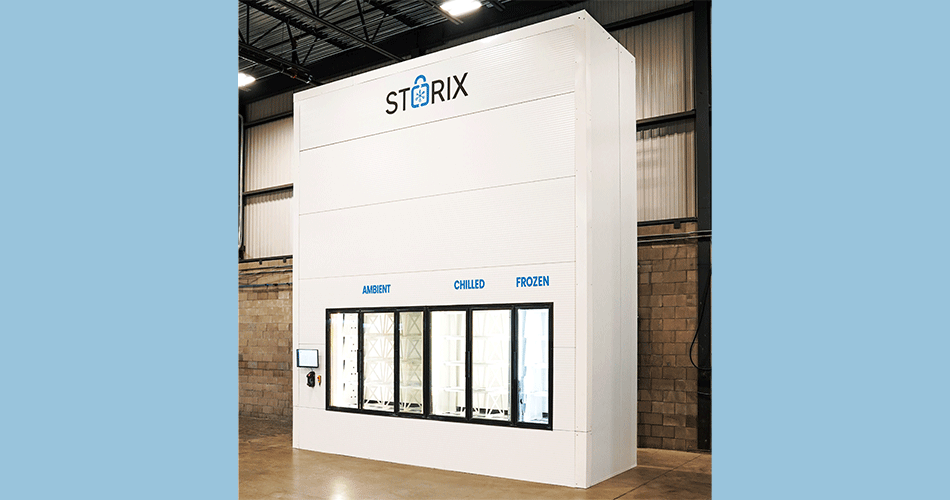
Storix builds vertical, multi-temperature storage systems designed specifically for grocery e-commerce fulfillment. The company describes itself as more than a storage vendor: It’s aiming to be an “innovation layer” to help retailers deliver fresher food, faster service and a better customer experience while cutting operating costs.
The company’s smart storage system centers on three climate-controlled zones – ambient, refrigerated and frozen – combined with high-density vertical storage that protects cold chain integrity from the moment an order is packed to the moment it’s picked up.
Forming a foundation
Sebastien Mailhot has been general manager of Storix for a little over a year, coming to the company after 30 years with high-growth companies in the technology sector, including e-payments and entertainment.

Mailhot was recruited to take the reins at a pivotal moment in Storix’s development.
“The reason I was brought to Storix a year ago is that the project had started five years ago, but CSF International was more of a traditional manufacturing company. They wanted to bring something to the market around e-commerce, but they had limited knowledge about technology, software, AI, hardware,” he said.
The company needed someone who had a technology background to pilot and then accelerate the project. Since Mailhot’s arrival, the company has hired multiple people.
“We’re on a roll,” he said.
The Storix solution was developed over the last five years in collaboration with major retailers and has applications across other industries. Storix is in discussions with many retailers to deploy its first units but cannot disclose their names for confidentiality reasons.
How it works
Asked how he’d explain Storix to a store associate who has never seen it, Mailhot kept it simple: Once an online grocery order is picked, the employee brings it to the Storix system, which visually cues where to place each tote – frozen, refrigerated or ambient zone.
“The system tells the picker where to put the product, so you keep the freshness of the product, which is really, really key in the grocery industry around cold chain integrity,” Mailhot said.
When the order is ready to be pulled back together for delivery or pickup, the correct totes are rotated to the front of the Storix storage solution for the employee to grab.
“We’re trying to simplify the life of the human, taking out mistakes and speeding up the order fulfillment process,” Mailhot said. “It needs to be simple and visual.”
Another plus is that Storix uses vertical space in the store that is empty in most cases.
“When we make the presentation on Storix, some are saying, ‘I never had on my radar a system that could be using the verticality of the store adapted to the grocery industry reality and needs,’ but there have been those kinds of systems in other fields for a long period of time.”
In addition to not using additional space, the system is intentionally low-tech to operate.
“We understand that in most stores, there’s not a lot of technical people,” he said. “There’s some automation – it’s going to rotate – but it’s as simple as it can be for the industry. People are able to troubleshoot it, do the maintenance, without having to have specialized technical people.”
Handling more volume
With U.S. and Canadian grocery chains reporting online order growth north of 20 percent year over year by the end of last year, Mailhot sees Storix as a way to help stores handle volume rather than a threat to store staff, as technology can be labeled in some cases.
“If a retailer could handle more growth with the same head counts, that would be good,” he said. “And if I were an employee, I wouldn’t think I’m going to lose my job; it’s going to make my job simpler and we’ll be more able to handle the volume.”
That design philosophy traces back to the product’s earliest goals.
“When we started five years ago, one of the things we wanted to do was put a product in the market that will benefit the current workflow and how people are already working,” Mailhot said.
Associates still pick orders the way they always have; the difference comes when they reach the Storix unit, they scan the order and let the system direct them.
“We decrease the number of mistakes by a lot because we automate the intelligence part of that,” Mailhot said. “But we wanted to copycat what was the process of the employee as much as possible.”
In addition to monitoring the temperatures in each zone to make sure they’re keeping food at optimal temps, remote monitoring flags orders that have sat too long. Even the ambient part is important, he said, noting that “it’s hot in Texas and humid in Florida,” which can impact the products.
Built to scale – and to fit
Storix is designed to grow with a store’s needs, whether that means a single unit for a smaller grocer or several working together for a high-volume operation.
“You can have one unit and then put in a second unit, third … etc.,” Mailhot said.
How many units are needed is based on how many orders a store handles and the average mix of frozen, chilled and ambient product. With that information, Storix maps out a configuration – sometimes with results that surprise the retailer.
“One retailer thought he would be needing five systems, but when we did some digging, we figured out that if orders were picked closer to the time they were needed instead of hours ahead, he would only need two systems,” he said.
Data and virtual simulation made the case. “If your order stays eight hours in your system, it takes up space for too long. That’s what you need to change, or you’re going to have football field-size system.”
He expects smaller grocers eventually will need to expand their physical footprint to accommodate more e-commerce infrastructure – whether by reworking back rooms or building extensions – and said Storix units can also be installed outdoors to help keep those costs down.
Integration with existing store technology is minimal.
“Technically for us, we just need to have a name of the order, the number of totes or bags, and is it frozen, cold, etc.,” he said. “We’re trying to limit IT integration.”
What’s next
Looking ahead, Mailhot said Storix is developing self-serve capability so customers – or delivery workers from services such as DoorDash or Instacart – could retrieve orders at any hour by scanning a code.
They’re also working on completely automated systems. Pickers would drop off their totes and walk away, with the system sorting them into the correct zone and then pulling them at the prescribed time.
The system can also flex between manual, semi-automated and fully automated operation depending on what a retailer needs.