
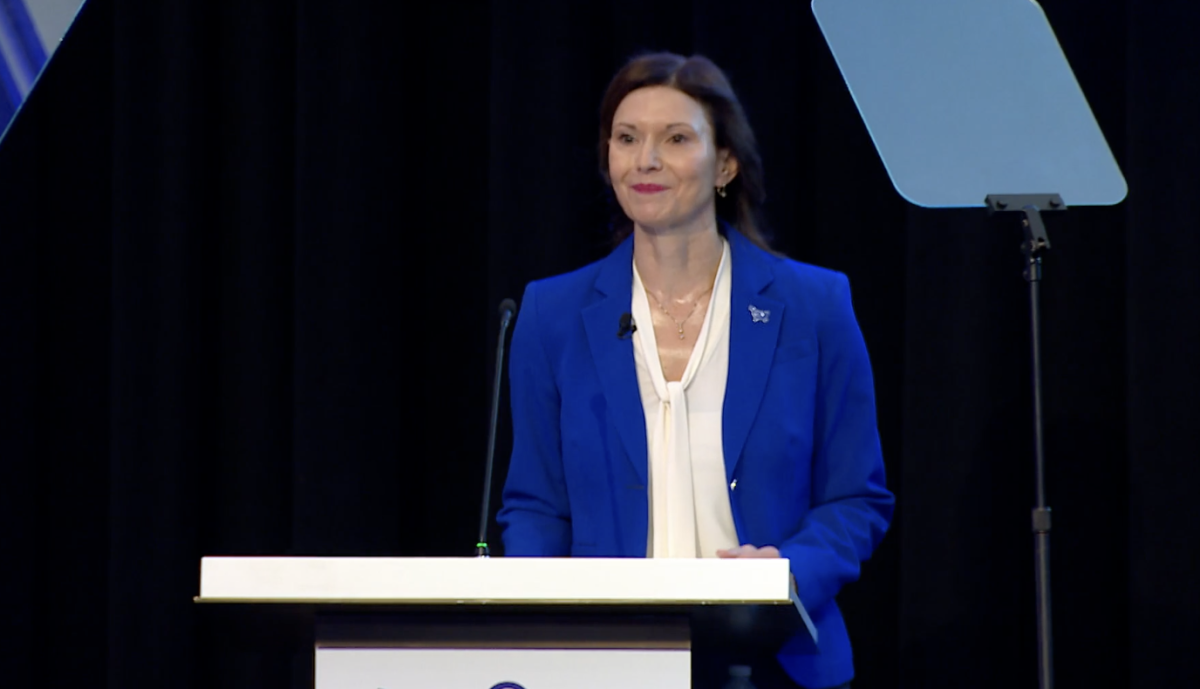
Kroger will invest $5 billion in customer value by 2029, funded entirely by cost savings and reduced promotional spending, Mary Ellen Adcock, EVP and chief merchandising and marketing officer, said at the company’s 2026 Investor Update in New York.
“I’m going to be very direct. Today, not enough of our customers understand the value Kroger offers,” Adcock said. “When we’re on promotion, our items are very competitive, but our promotions are complex. And when we’re not on promotion, our everyday prices appear too high.”
She illustrated the problem with a customer email the company received just weeks earlier, flagging a single offer that carried three price points. “Clearly, too complex, especially if you’re a customer that only wants to buy one item or doesn’t want to download the app,” she said, pointing to store signage layering a three-day sale, a mix-and-match and a buy-two-get-three offer.
Reallocating promotions into shelf prices
Kroger will reallocate value from promotions into everyday shelf prices in store and online, reducing complex and unproductive offers while keeping those that work. “To be clear, we will not abandon promotions. They’re an important way of how customers shop,” Adcock said. “But we will be more selective.”
The approach is grounded in the grocer’s first-party data: approximately 95 percent of sales are tied to loyalty customers, analyzed through its 84.51° arm. “We know what customers buy. We know what offerings customers notice. We know how preferences change by household, by market, and shopping occasion,” she said.
The investment is “entirely self-funded through cost savings and fewer promotions,” Adcock emphasized, repeating the line for effect. Early results back the strategy: in refreshed stores, Kroger lowered prices on thousands of items, and “visits and units moved almost immediately. Customers put more in the basket.” In stores on the strategy for a year, top-line sales grew 230 basis points over the enterprise, with dollar and unit share gains. Investments will reach approximately 450 additional stores next year, up from roughly 250 at the end of this year, with pace controlled by the savings that fund it: “If our results are exceeding expectations, then we’ll go faster.”
Meals, fresh and Our Brands
Fresh makes up 37 percent of the basket, and “customers decide where to shop based on produce, meat and seafood,” Adcock said. “Fresh is where the basket starts, and customers build the rest of the basket around these areas. When we win in fresh, we win more than just the fresh department.”
Kroger, already the largest sushi provider in the United States, is positioning itself as the ready meal destination. Its meals program is already in more than 600 stores, with more than 100 new meals being introduced over the next year, spanning ready-to-cook and ready-to-eat options. Assortment will vary by store size and local preference.
“Meals are an exciting opportunity for us as we better answer the question customers still ask every day: ‘What’s for dinner?'” she said. “Every night that we win the weeknight dinner is a trip that would have gone to food away from home,” a $1.4 trillion market where Kroger holds just 4 percent share. “By becoming America’s ready meal destination, we open up a whole new addressable market for Kroger.”
Kroger also plans to grow its $40 billion, margin-accretive Our Brands portfolio from 35 percent to 40 percent penetration, supported by a network of 35 manufacturing plants. “Customers don’t shop in architecture; they buy items,” Adcock said, “so we deliver the right product at the right price, item by item.”
Premium-tier Private Selection is expected to grow more than 15 percent annually and top $5 billion over the next three years; Simple Truth, the largest natural and organic brand in the U.S. with 30 million households, will invest in nutrient-rich protein products; and value-tier Smartway will add 1,000 items over three years, eight times today’s count, “allowing us to build more of the basket with the budget-conscious consumer.”
Formats and loyalty
New stores come in three food-first formats – at 99,000, 75,000 and 50,000 square feet – with expanded space for fresh, meals and e-commerce fulfillment and reduced space for general merchandise and apparel, “areas where customers tell us choice does not create value.” Each includes a redesigned e-commerce back room and connected-store AI technology.
Kroger’s free loyalty program, which Adcock called the largest in American grocery at more than 65 million households, has added Flex Rewards, letting customers choose whether to redeem points on fuel or groceries. The new Kroger credit card extends the relationship beyond store trips, and its holders spend and visit twice as often; the Boost delivery membership sits on top for the most engaged households. “This membership has one job: to get more of our 65 million households shopping with us every day,” she said.
In the next installment: Nate Faust on building Kroger’s e-commerce business