
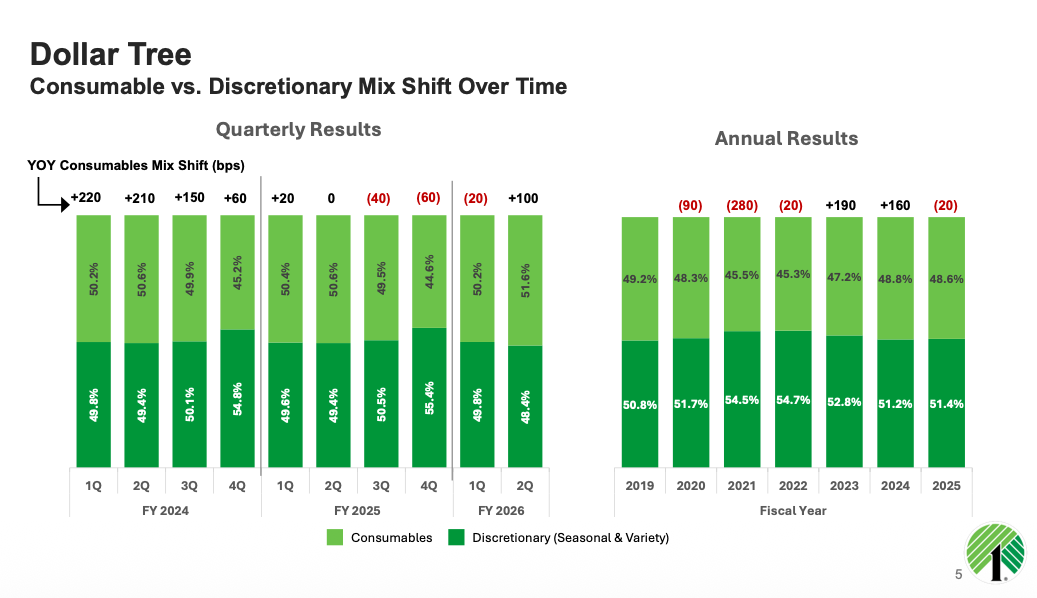
Dollar Tree reported net sales of $4.9 billion for its second quarter ended Aug. 1, up 7 percent from the prior-year period, as value-seeking shoppers lifted both basket size and traffic.
Comparable store net sales increased 3.7 percent on top of 6.5 percent growth a year ago, driven by a 3.3 percent increase in average ticket and a 0.4 percent increase in traffic. In consumables categories, comparable store sales were up 5.8 percent for the Chesapeake, Virginia-based retailer. Discretionary comps – those related to seasonal and variety items – were up 1.6 percent during the quarter.
The consumables increase indicates the dollar channel’s growing pull on food shoppers. Dollar Tree converted or added about 710 stores to its multi-price format during the quarter, ending with approximately 6,600 of those stores. The format expands Dollar Tree’s assortment beyond its traditional price point, including a broader selection of food and consumables that competes more directly with traditional supermarkets.
“What continues to set Dollar Tree apart is our ability to deliver value, convenience and the excitement of discovery all in one shopping trip,” said CEO Mike Creedon in the Aug. 27 earnings release. “Positive traffic trends helped drive strong comparable sales growth and EPS exceeded the high end of our outlook. Our strategies are unlocking a better assortment in better-run stores, while allowing us to engage customers in more relevant and compelling ways.”
Tariff refunds boost margins
Operating income nearly tripled to $690 million for the quarter, and operating income margin expanded 900 basis points to 14.1 percent. The company noted the margin gain included a 650 basis point benefit from the net impact of tariff refunds, which totaled $383 million from refunds issued under the International Emergency Economic Powers Act tariffs.
Gross profit margin increased 850 basis points to 42.9 percent, including 680 basis points from tariff refunds. Dollar Tree said the remaining improvement was driven primarily by lower tariff rates, favorable shrink and occupancy leverage, partially offset by sales mix.
The company opened 75 new stores during the quarter, ending with 9,436 locations under its Dollar Tree U.S. and Dollar Tree Canada banners. It returned $605 million to shareholders through share repurchases and generated $675 million of free cash flow.
Raised outlook
Dollar Tree increased its fiscal 2026 adjusted EPS outlook to a range of $7.70 to $8.05, including an approximate 60-cent benefit related to the net impact of tariff refunds. The company continues to expect net sales of $20.5 billion to $20.7 billion on comparable store sales growth of 3 percent to 4 percent, with about 400 new store openings and 75 closings.
For the third quarter, the retailer projects net sales of $5 billion to $5.1 billion, comparable sales growth of 3 percent to 4 percent and diluted EPS of 80 cents to 95 cents, including an approximate 50-cent impact related to tariff refund reinvestments.
In addition to its retail stores, Dollar Tree operates 19 distribution centers. It employs more than 150,000 associates.