
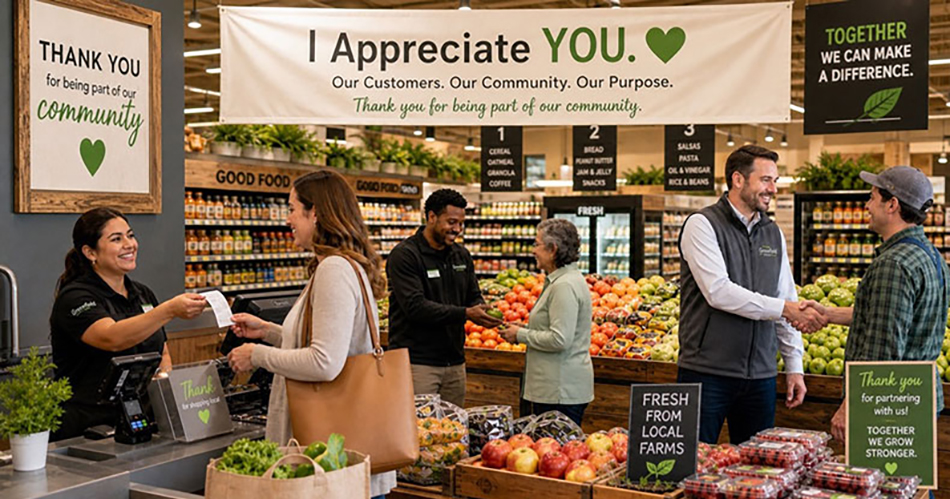
The core leadership lesson here is that three simple words – “I appreciate you” – are more powerful and transformative than “I love you” when it comes to building trust, safety and performance in relationships and teams.

In a 2026 grocery world shaped by tight margins, omnichannel shopping, AI tools and value‑seeking customers, making “I appreciate you” a daily habit with customers, vendor partners and team members is no longer soft stuff; it is a competitive strategy.
Shift to ‘I appreciate you’
I learned this from John C. Maxwell years ago, and he explains that “I love you” can be triggering, watered down or even manipulative, while appreciation is almost always received as safe, sincere and energizing.
We highlight that appreciation, rooted in gratitude, improves physical, mental and emotional health and deepens connection in long‑term relationships.
In a grocery store setting, that same psychological truth applies to work relationships. Specific appreciation (“I appreciate you for handling that upset customer”) is far more powerful than generic praise.
When leaders recognize real behaviors and contributions on a consistent basis, people feel seen, trust goes up and teams will walk through fire for the store, even when retail volatility and margin pressure make every shift more difficult.
Why appreciation is strategic
Grocery in 2026 is busy, demanding and unforgiving. Customers are more price‑sensitive, less loyal and quicker to switch stores if they don’t feel valued or if the experience seems cold and transactional.
At the same time, physical stores still matter a lot. More than half of shoppers continue to shop in‑store, even as online grocery and click‑and‑collect grow toward about 20 percent of sales.
Retailers are leaning into fresh‑first merchandising, flexible fixtures and engaging displays to make the in‑store experience worth the trip.
The chains that win high customer satisfaction scores are known as much for their human warmth as their products and prices. In that environment, visible, audible appreciation on the sales floor becomes a differentiator customers can feel the moment they walk in.
Consumers
Shoppers in 2026 want three things from grocery stores: value, confidence and genuine human connection.
AI, apps and self‑checkout are everywhere, but most consumers say they stay loyal to brands that still prioritize human service over automation. Appreciation is how we deliver that human warmth at scale.
Here are some daily behaviors to consider:
- Greet and thank. “I appreciate you choosing to shop with us today” at the door or checkout reminds value‑seeking customers that they are more than a transaction.
- Recognize patterns and loyalty. When noticing a regular, call it out: “I appreciate seeing you every Sunday; you’re part of our store family.” This builds emotional loyalty in a world where price loyalty is fragile.
- Appreciate feedback, not just praise. When a customer points out a problem – out‑of‑stocks, a confusing sign, service issue – respond with “I appreciate you telling us; it helps us improve for everyone,” turning a complaint into partnership rather than defense.
- Use omnichannel appreciation. As shoppers drive the majority of CPG sales, extend appreciation into order‑ready texts, app notifications and follow‑up emails. “We appreciate your online order. Thanks for letting us shop for you today.”
- Humanize self‑checkout and digital tools. Even with self‑service, position an associate nearby saying, “I appreciate you and I’m right here if you need anything,” balancing efficiency with human presence.
When customers feel appreciated in‑store and online, they stay a little longer in front of displays, try additional private‑label products and are more forgiving when supply chain or pricing issues hit.
Vendor partners
This leadership lesson hints at how appreciation elevates every relationship.
In 2026 retail, vendors are critical partners in surviving tariff pressure, packaging changes and demand shifts, and best‑practice vendor management emphasizes communication, aligned priorities and trust.
Viewing vendors as true partners – and sharing appreciation in concrete ways – builds resilience upstream.
Here are some practical ways to consider doing so:
- Name the partnership, not just the performance. “We appreciate you as a long‑term partner, especially how you’ve helped us navigate supply chain surprises this year.” This reinforces that they are seen as part of the overall strategy, not just a line item.
- Celebrate reliability and thoughtfulness. Vendors who avoid reactionary decisions and communicate create relationships retailers can depend on; appreciating this steadiness encourages more of it.
- Share success stories. When a promotion, new product or display works, tell the vendor: “Our customers loved this launch, thank you. We appreciate your creativity and responsiveness.” This makes innovation feel like a shared win.
- Invite insight and appreciate candor. Best practices recommend asking vendors for insight into their businesses and risks. When they bring tough news on costs or supply, reply with, “I appreciate your transparency; it helps us plan and protect our customers and team.”
Appreciated vendors are more likely to go the extra mile, prioritizing the store on tight allocations, collaborating on smarter packaging or merchandising and supporting omnichannel and retail media initiatives that drive growth.
Team members
This lesson gives vivid examples – thanking a spouse for specific, sometimes mundane acts and maintaining about a 20‑to‑1 ratio of “I appreciate you” to “I wish you’d stop.”
This also points out how powerful it is when leaders pause on the sales floor to tell a stocker or cashier, “I appreciate you; the case looks spectacular,” or “customers love coming through your line.”
In 2026, grocery team members are juggling labor shortages, new technologies, complex omnichannel tasks and demanding customers. Burnout risk is high. Genuine, specific appreciation is the fuel that keeps them caring about the store and each other.
Here are some habits for leaders to consider:
- “I appreciate you” added to store walks. Every time we walk a department, assume everyone is watching and hoping we’ll stop and say something. Make it a daily discipline to share at least three specific appreciations before leaving the floor.
- Appreciate by name and behavior. “Maria, I appreciate you for keeping your cool with that long line and still greeting every customer with a smile,” or “John, I appreciate how you rotate product in dairy. Our food safety depends on that.”
- Celebrate the unseen work. Recognize tasks that rarely get applause, such as cleaning spills, checking temperatures, updating digital pricing, filling online orders with accuracy. “I appreciate you taking care of things customers never see but count on every day.”
- Use team huddles as appreciation rallies. Start every pre‑shift huddle with three shout‑outs from yesterday: “I appreciate you for …” This models peer‑to‑peer appreciation and turns meetings into energy boosts instead of complaint sessions.
- Maintain a wide appreciation ratio. Keep a critique and “wish you’d stop” comments rare and focused but let appreciation be constant and specific. Over time, this shifts the culture from nag‑nag‑nag to brag‑brag‑brag.
Teams that feel appreciated are more willing to embrace new technology, adapt to fixture resets and create merchandised displays that invite customers to linger and buy.
Make it long‑term practice
I want to end with a challenge: Are you going to do it? Not once, but as part of who you are in a month, year or 10 years from now. That’s the essence of leadership growth – transforming appreciation from an occasional technique into a core identity.
To embed appreciation in a 2026 grocery operation:
- Tie appreciation to strategy. Connect appreciations to concrete outcomes – customer loyalty, vendor reliability and team retention – so leaders see it as part of their jobs, not an optional nicety.
- Measure what matters. Use simple metrics like customer satisfaction scores, repeat visit rates, vendor scorecards and employee engagement, then look for correlations with visible appreciation behaviors on the floor.
- Train leaders to be specific. Role‑play appreciation statements in leadership development workshops. Move from vague praise (“good work”) to specific, behavior‑based appreciation aligned with values and store priorities.
- Protect time for connection. Even as artificial intelligence, data and retail media expand, design manager routines that include time with people – walk‑throughs, listening and gratitude being spread around – so technology never replaces humanity.
Keep asking, “How can I let this person know I appreciate them right now?” And then act on it. You will build a grocery culture where customers, vendors and team members all feel like partners in a shared mission, not just cogs in a machine.
Steve Black is CEO and founder of abrighterday.life, a business and leadership coaching organization devoted to helping people and companies with personal growth and implementing simple leadership principles. A 47-year-veteran of the retail grocery arena, Black is the author of “The 5 Rules” and offers an online Masterclass.