
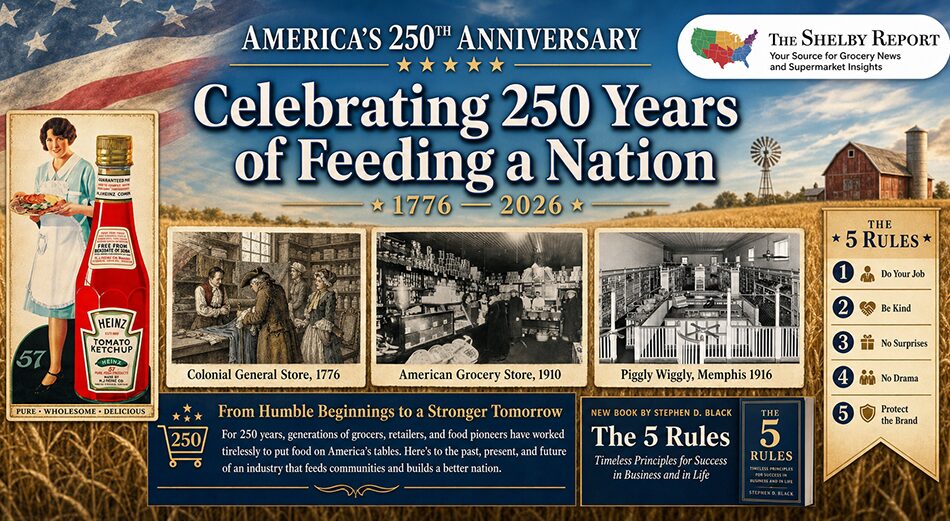
As we celebrate America’s 250th Anniversary on the Fourth of July this year, I wanted to tie in 250 years of grocery retail and the lessons of “The 5 Rules” through the lens of one of my favorite shows – “Food That Built America” on the History Channel.

Having sold groceries for more than 50 years, it’s amazing to see and hear all the details behind how these brands were built. There is a consistent message throughout all the episodes: resilience, creativity, grit and commitment to do the right thing, along with adjusting daily to remain relevant, survive and thrive in an ever-changing world.
A store run on trust
Picture a general store in 1776. The floor is wide pine boards, worn smooth. Behind the counter, the merchant – part banker, part neighbor, part community anchor – weighs out a pound of salt, records it in a ledger and extends credit to a family he has known for 20 years. No scanner, loyalty card or algorithm predicting what they might buy next month.
What held that transaction together was not technology; it was character.
Flash forward 250 years and the American grocery industry generates about $1 trillion in annual revenue, employs millions of people and operates at a complexity that colonial merchants could not have imagined. And yet the principles that govern whether a grocery business endures – or disappears – are not so different from what made that general store matter in the first place.
The leadership framework context of “The 5 Rules” distills those principles to their essence: Do your job. Be kind. No surprises or drama. Protect the brand.
They sound simple. They are not. And the history of the grocery industry is, at its core, the history of what happens when leaders apply them – and what happens when they do not.
Do your job: Henry Heinz and the weight of craft
In 1852, an 8-year-old boy in Pittsburgh began selling vegetables from his mother’s garden to neighbors. He did not have a business plan; he had a wheelbarrow and a belief that doing the work – and doing it with integrity – was its own strategy.
Henry Heinz grew into one of the most consequential food entrepreneurs in American history. He created ketchup in 1876, built one of the first electrified factories in the country and is credited with production innovations that helped inspire the assembly line.
But the through-line from that boy with the wheelbarrow to the factory in Pittsburgh was singular. He did his job. He showed up. He did not cut corners.
“Do your job” is the most unglamorous of “The 5 Rules,” which is why it is the most important. It does not ask for brilliance. It asks for reliability. In a grocery operation, reliability is everything – the supply chain that arrives when promised, the produce buyer who never stops learning the product and the store manager who walks the floor at 6 a.m. – not because someone is watching but because that’s how the job gets done.
Be kind: Coca-Cola and the architecture of loyalty
John Pemberton invented the syrup. Asa Candler built the empire. What Candler understood – and what made Coca-Cola a global phenomenon rather than a footnote in a pharmacist’s notebook – was that the product had to be held together by a set of relationships – with customers, bottlers and the people inside the business.
Being kind is not a soft sentiment; it is a structural decision about how to treat the people a business depends on. Candler invested in relationships up and down the distribution chain at a time when it would have been easier and more immediately profitable to squeeze margins. He treated the product itself with care – standardizing quality so that every bottle in every market delivered the same experience.
In the modern grocery industry, kindness is supply chain integrity. It is the vendor relationship managed with transparency rather than leverage. It is the team member who is corrected with dignity instead of humiliation. Research on retail employee retention is consistent: the top reason workers leave is not pay; it is how they are treated by the people that lead them.
The grocery executive who cannot be bothered with kindness is not a tough leader – they are an expensive one. Turnover in the industry is high enough without adding management as a cause.
No surprises: Will Kellogg and the discipline of message
Will Kellogg’s split from his brother, Harvey, was painful and protracted. But what defined his eventual success with corn flakes was not the product – his brother could have sold corn flakes, too; it was the marketing.
Will Kellogg bet nearly everything he had on communicating the Kellogg name directly to consumers, buying full-page newspaper advertisements at a time when that was an act of considerable faith.
The “No surprises” rule is about eliminating the fog that accumulates inside organizations. In a grocery operation, fog looks like this:
- The buyer who makes a critical vendor decision but forgets to loop in logistics;
- The district manager who delivers feedback so vaguely that the store team has no idea what they are supposed to change; and
- The executive team that knows the financial picture is shifting before anyone on the floor does – and says nothing until the picture becomes a crisis.
No surprises is a behavior; communicate better is the practice. The grocery leaders who have earned long tenures are almost always people who communicate upstream and downstream, early and often. They create cultures where problems surface fast, because everyone knows the cost of problems that surface late.
No drama: Milton Hershey and the long game
Milton Hershey failed – more than once, and publicly. He launched a candy company in New York in his 20s, and it collapsed. He tried again in Philadelphia. That failed, too. He returned to Lancaster, Pennsylvania, started again, and this time it worked – but only as a foundation for what came next.
At the 1893 World’s Columbian Exposition in Chicago, Hershey saw German chocolate-making equipment and made the decision that would redefine American confectionery. He was going to make milk chocolate accessible to everyone, not just the wealthy. He sold his caramel business for $1 million and went all in.
In the modern grocery industry, drama is everywhere. The landscape generates legitimate stress at every level – competitive pressure, margin compression, labor disruptions, supply chain volatility and regulatory change.
The question is not whether leaders will face adversity; it’s whether adversity will define how they lead.
“Leave drama at the door” does not mean leaders should be emotionally unavailable or artificially calm. It means that the team’s emotional weather should not be set by the leader’s worst day. It means that when a competitor opens a new format across the street, the response is strategy, not panic.
Hershey built an entire town – Hershey, Pennsylvania – around his factory, because he was thinking about decades, not quarters. That kind of vision is possible only when we’ve learned not to be consumed by the moment.
Protect the brand: Campbell’s Soup and the innovation of longevity
Joseph Campbell founded his company in 1869. The condensed soup that made Campbell’s a household name came from a different mind – John Dorrance, a chemist who joined the company in 1897 and solved a problem that had limited soup’s commercial reach for years.
Canned soup, at full density, was heavy to ship and expensive to produce at scale. Dorrance removed most of the water. The price dropped, the shelf life extended and distribution expanded. America’s pantry had changed.
What Dorrance and Campbell’s leadership did was subordinate short-term thinking to the question of longevity. They did not ask, “How do we sell more soup this quarter?” They asked, “How do we make this product viable across a continent for the next hundred years?”
Protecting the brand and business is not conservatism, it is stewardship – asking always whether the decisions being made today are building something that will outlast the people making them.
In the grocery industry, that means managing cash with discipline. It means not chasing margin so hard that quality erodes and trust goes with it. It means treating the vendor community as a long-term asset, not a short-term cost center. It means building a culture where people are honest about risk, because leaders who penalize the bearer of bad news eventually find themselves surrounded by people who deliver no news at all.
Rules do not change – their application does
Clarence Saunders opened the first Piggly Wiggly in 1916 in Memphis, Tennessee – and rewrote the physical grammar of the grocery store. Self-service was radical. The idea that a customer could walk through a store, select goods and bring them to a register was not obvious. It took imagination, and it took the discipline to execute a new operational model.
But Saunders didn’t succeed because he abandoned the fundamentals; he succeeded because he applied them in a new context. The store was organized, the prices were clear, the experience was honest. He did his job, he communicated clearly, he built a system designed to protect the business – and he left the drama of skeptics and imitators outside the front door.
The grocery industry has never stopped changing. From dry goods on open shelves to self-service aisles to loyalty programs to e-commerce to same-day delivery, the format has been in constant motion. The leaders who have navigated those transitions are not the ones who had the best forecasts – they are the ones who kept returning to the fundamentals.
These rules are not complicated. They are, however, uncommon in practice. In an industry where margin is thin, competition is relentless and complexity accumulates daily, the temptation always is to look for a sophisticated answer. The truth that 250 years of grocery history keeps offering is more direct: The brands that endure are the ones that make the fundamentals common – not aspirational or occasional but common. They are built into the culture, modeled at the top and expected at every level.
The colonial merchant with his credit ledger knew this. As did Henry Heinz, Will Kellogg, Milton Hershey and the soup chemist.
The shelves have changed; the rules of success have not.
Steve Black is CEO and founder of abrighterday.life, a business and leadership coaching organization devoted to helping people and companies with personal growth and implementing simple leadership principles. A 47-year-veteran of the retail grocery arena, Black is the author of “The 5 Rules” and offers an online Masterclass.