
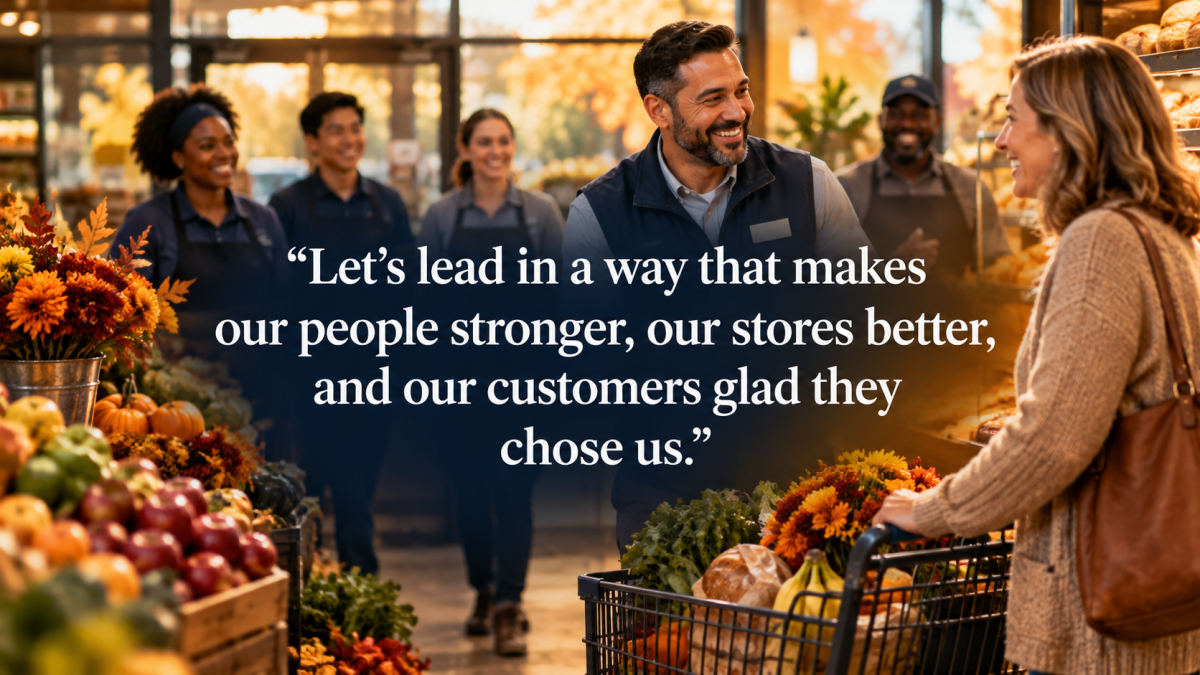

November has always carried special meaning in the grocery business as we’ve all spent months preparing for the start of the holiday season and getting ready for the big sales week of Thanksgiving. I’ve always loved this time of the year, as it’s our opportunity to win the holidays that carries over into the next year with momentum we can’t get any other way.
It is the month when the work becomes real. Holiday displays are no longer concepts on a planning calendar. Seasonal orders have arrived. Ads are in customers’ hands. Parking lots fill, checkout lines lengthen and every department – from produce and meat to bakery, deli, center store, e-commerce and front end – feels the pressure of higher expectations.
Customers are preparing meals, welcoming family, managing budgets and trying to create moments that matter. They are not just buying turkeys, pies, sides, flowers, beverages or last-minute ingredients; they are buying confidence. They want to know the store will have what they need, that prices will feel fair, that associates will be helpful and that the experience will make an already-demanding season easier.
That is why leadership matters so much right now.
As we move through the end of 2026 and look toward 2027, grocery retail continues to operate in a world of change: ongoing value pressure, changing customer expectations, workforce challenges, rapid advances in technology, rising operational complexity and competition like never before.
The best leaders will not respond by working harder or demanding more; they will respond by making their people, priorities and purpose clearer.
Customer still defines the mission
The grocery customer of 2026 is practical, informed and often stretched.
As my family gatherings have changed, I still want Mama’s sweet potatoes and her famous cracker pie. I love having the brown-and-serve rolls my Gramma always had at Thanksgiving and the big turkey that was put in the oven at midnight. Looking back on it, it’s not the food so much as it is the memories made when we gathered around the table that made these holiday special. That, and spending the afternoon watching football games.
As retailers, it’s our job (My Rule No. 1 of “The 5 Rules”) to make sure those moments continue in the generations to come.
The strongest grocery organizations will not define value as lowest price alone; they will define it as the total experience customers receive for the time and money they invest. Value includes a full shelf, clean store, great-looking produce department, accurate pricing, friendly greeting, knowledgeable associate, fast checkout and an easy way to save.
In November, customers will remember the retailer that helped them solve a problem. They will remember the bakery associate who made a recommendation for a family gathering. They will remember the meat manager who suggested a preparation method.
They also will recall the cashier who stayed calm when the front end became busy, as well as whether the store felt organized, welcoming and ready.
The question for every leader is simple: Are we making it easier for customers to enjoy their holiday or are we adding friction to an already busy season?
The answer is found not in a slogan but in the details that leaders inspect, reinforce and celebrate every day.
Priorities for the month
• Be visible where the work happens. Leadership cannot be done just from an office, a conference call or a report.
Walk the store and parking lot. Stand at the front end. Visit the receiving area. Spend time in produce, meat, bakery, deli, frozen and center store. Ask associates what is working, what customers are asking for and what barriers they are facing.
Visibility says, “This work matters, and so do you.”
It also allows leaders to see conditions before they become problems. A leader who walks with purpose notices low displays, confusing signage, checkout congestion, safety concerns, poor cross-department communication and associates who need support.
Most importantly, visible leaders create confidence. In the busiest moments, people want to know they are not alone.
• Make recognition a daily discipline. The holiday season can be exhausting. Teams work longer hours, customers are more rushed and the pace can make people feel invisible.
Recognition does not require a large program or formal ceremony; it requires attention. Thank the associate who stayed late to recover a department. Recognize the cashier who de-escalated a difficult situation. Call out the team that built a great seasonal display. Celebrate the receiver who helped solve a supply problem. Tell a new associate their improvement has been noticed.
Specific recognition matters most. Instead of saying, “Good job,” say, “Thanks for noticing that customer needed help finding gluten-free items, walking them to the aisle and helping them make a choice. That is the kind of service that earns loyalty.”
People repeat what leaders notice.
• Coach for ownership, not dependence. The goal of leadership is not to have every answer. The goal is to develop people who can make good decisions when we’re not around.
In November, leaders can fall into the trap of solving every problem themselves. That may feel efficient in the moment, but it builds dependence. When leaders rescue rather than coach, teams learn to wait rather than act.
Instead, ask better questions:
- What does the customer need?
- What options do we have?
- What can we do now?
- Who else needs to be involved?
- What did we learn?
- How can we prevent this next time?
Coaching builds confidence. It turns associates into problem-solvers and managers into leaders. It is one of the most important investments a grocery organization can make as it prepares for 2027.
• Protect the standard without losing the heart. Busy seasons can tempt organizations to lower expectations. Leaders may say, “We will fix it after the holidays.”
But customers do not experience the store after the holidays; they experience it today.
Standards matter, including cleanliness, food safety, shelf conditions, signage, pricing accuracy, hospitality, speed and product quality. The strongest leaders protect those standards even under pressure.
At the same time, they lead with humanity. Associates have families, stress, financial concerns, health challenges and responsibilities outside the store. A leader can hold people accountable and still care about them. In fact, the best leaders do both.
High standards without compassion create burnout. Compassion without standards creates inconsistency. Great leadership balances the two.
Looking toward 2027
The grocery retailers best positioned for 2027 will understand that the future is not about choosing between people and performance. People create performance. As a reminder, we are in the people business; we just happen to sell groceries.
The industry will continue to evolve. Customers will expect greater convenience, more relevance, better digital integration and stronger value. Labor will remain a strategic issue. Data and technology will become more important. Competition will remain intense.
But the essentials will not change: It’s people serving people. Customers want respect. Associates want to be valued. Teams need clear expectations. Managers benefit from coaching. Every organization will rise or fall based on the quality of its leadership. As John Maxwell says, “Everything rises and falls on leadership.”
The companies that thrive will make leadership development an operating priority rather than an occasional event. They will teach managers how to do their job, be kind, communicate well, have no drama and always protect the brand.
Challenge
As leaders, we have an opportunity this month to set a tone that carries far beyond the holiday season. We can be:
- The person who brings calm when others bring confusion;
- The leader who sees the associate others overlook, who asks how he can help before questioning why it isn’t finished, who refuses to accept mediocre execution as normal; and
- The manager who reminds the team that every customer, department and interaction matters.
November will be demanding. It always is. But demanding seasons create defining moments.
The greatest grocery leaders do not just manage the holiday rush; they use it to build stronger teams, deepen customer trust and create a culture ready for whatever comes next.