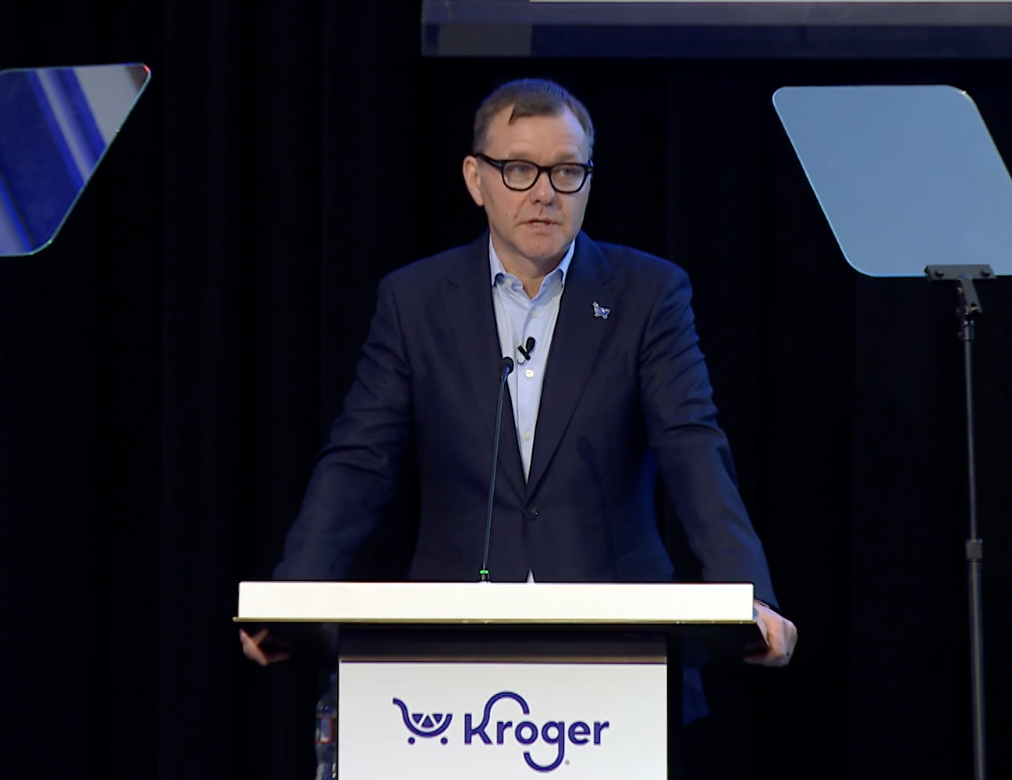
Kroger will deliver approximately $4 billion in annualized structural cost savings by 2029 through four funding sources, CFO David Kennerley said at the company’s 2026 Investor Update on Oct. 20 in New York, where he also introduced a new financial reporting framework. “This is not a plan on paper,” he said. “All this work’s underway, already generating savings.”
$2 billion from cost of goods
The two largest sources sit in cost of goods, together representing approximately $2 billion. Kroger will grow direct sourcing from less than 1 percent of its buying to above 10 percent.
“Through direct sourcing, we buy closer to the producer rather than paying an intermediary to sit between Kroger and the source,” Kennerley said. “This is not a new playbook. It’s common across retail. It’s just new for Kroger.”
The company is launching South America and Asia sourcing hubs with spokes in key locations, with the goal of a fully owned import distribution model over time. Working with one of the world’s largest grape growers in Peru, Kroger has secured about 40 percent of its imported grape volume directly from Peruvian growers for the November 2026 season; citrus, shrimp and frozen vegetables come next, with its first international hire in place in South America and Asia infrastructure planned for 2027.
Smarter buying brings Kroger’s full scale, including its 35 manufacturing plants, to supplier negotiations, aiming for what Kennerley called the largest cost-of-goods takeout in Kroger’s history. “We will not take cost increases unless they are fully justified, and we are clear that every brand, regardless of size, needs to earn its place on the shelf and in the customer’s basket,” he said.
Shopping carts and Bengaluru
On indirect spending, Kennerley offered a telling example: Kroger was buying 20 different shopping cart configurations and took that down to three while consolidating suppliers. “Costs came down, our banners got more consistent, repairs got simpler, and we can now move carts between divisions when we need them,” he said. “Shopping carts alone will not fund this plan, but we have thousands of decisions just like that one. This is about buying exceptionally well thousands of times over.”
The fourth source is the Kroger Capability Center, with a new office opening in Bengaluru, India, housing Kroger and third-party associates and moving repeatable above-store work into a common service model reinvented with AI and machine learning.
Kennerley said the model is expected to affect roughly 3,000 associates.
Pacing the $5 billion value investment
The savings fund a $5 billion customer value investment, the largest single driver of the plan, paced market by market against the savings and promotional optimization that fund it. Value investments reach approximately 450 additional stores next year, up from roughly 250 at the end of this year. “If costs come out faster, or we see stronger results from our investments, we may choose to accelerate. If the opposite is true, we’ll slow the pace to protect our margins,” he said. “We are not trading margin for sales. We are funding one with the other.”
New framework and capital plan
Beginning in fiscal 2027, Kroger will report comparable sales excluding fuel and pharmacy, replacing identical sales; comparable sales have historically run about 20 basis points higher than identical sales year over year, and the company will provide historical reconciliations. Kroger also moves to adjusted EBITDA from adjusted FIFO net operating profit and targets 7 to 11 percent adjusted EPS growth from 2027 through 2029, alongside a shareholder yield of 5 to 6 percent through a growing dividend and buybacks.
Capital expenditures step up to approximately $5 billion in 2029, biased toward new stores, e-commerce and media, and supply chain automation, including an automated facility in Franklin, Kentucky, supporting the Nashville and Louisville divisions and expected to be complete in 2028. The approximately 110 new stores planned by 2029 are expected to generate approximately $7 billion in annualized incremental sales at maturity, with four-wall EBITDA margins of 6 to 7 percent. “ROIC applies to our store pipeline just as it does to the rest of the business,” Kennerley said.
“Kroger is already a high-quality, cash-generative company,” he added. “The plan we’ve shared today makes it a higher-quality, faster-growing and more cash-generative one.”
Giant Eagle acquisition
He also confirmed the planned acquisition of Giant Eagle remains on track to close in 2027, subject to regulatory approval, and is expected to be accretive to adjusted EPS in the second full year after close.
In the final installment: Mark Ibbotson on the ‘connected’ store