
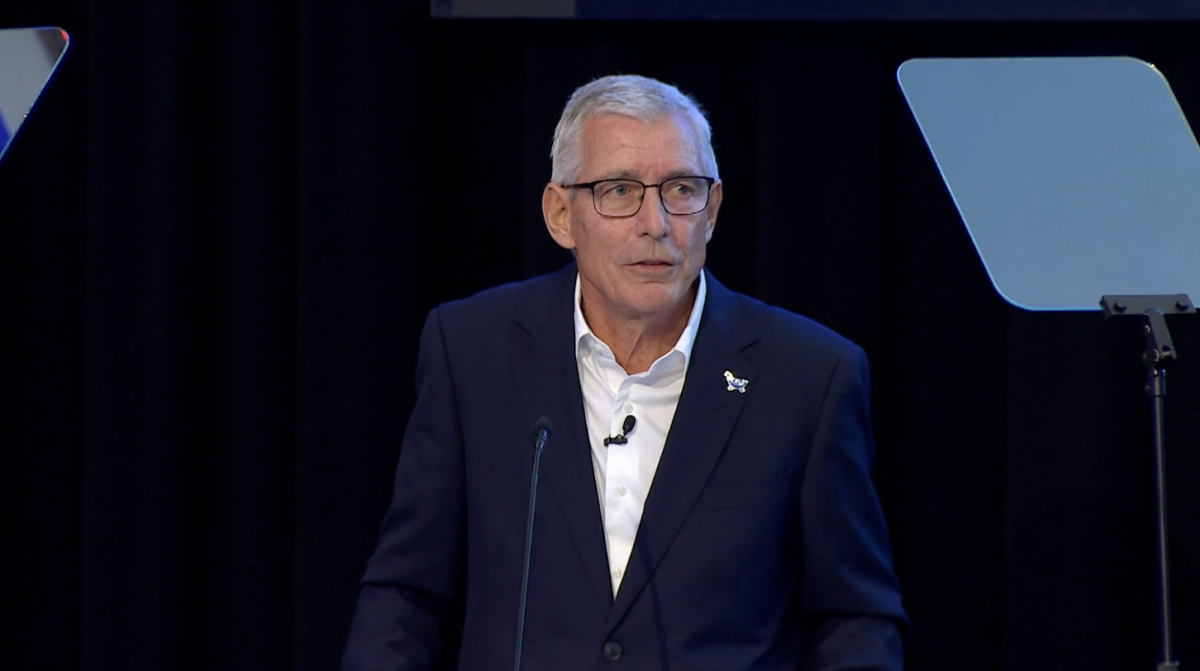
Kroger CEO Greg Foran laid out a three-part plan to make the company “America’s favorite grocer” at its 2026 Investor Update in New York, setting new long-term targets of approximately 3 percent comparable sales growth, excluding fuel and pharmacy, in 2029.
“I’ve been in retail my whole life. I can tell you when I was considering my next professional move, Kroger was the best job on the planet,” said Foran, who noted he took the role 250 days earlier. “People want fresh food; they want it close to home, and they want it at a price that works for them.”
Foran pointed to assets few in retail can match: approximately 2,700 stores in 35 states, a roughly $18 billion e-commerce business, a $40 billion Our Brands portfolio, large-scale manufacturing and supply chain assets, and approximately 95 percent of sales tied to a Kroger loyalty card. Americans spend approximately $2.5 trillion a year on food, including more than $1 trillion on food at home, a market that remains fragmented.
“Let me be clear: the ingredients to win are already inside Kroger,” he said. “Our job is to bring the teams together and execute our strategy consistently and with excellence.”
‘We lost share. We own that.’
Foran offered a candid diagnosis of how Kroger got here. First, execution became inconsistent: “The store experience varied too much. Since I joined, I’ve walked stores nearly every week,” he said, describing the standard the best stores hit daily: inviting entrances, right sightlines, fresh produce, full shelves, fast checkout. “Others are not there yet, but we know what great looks like.”
Second, operating costs grew faster than sales, reducing the ability to invest in customers and protect margins at once. Third, the value position didn’t keep pace: “The promotions became overly complicated. Customers had to work too hard to take advantage of them, and the perception of our price position weakened.” And finally, capital investments didn’t produce expected returns while the company built too few stores as competitors expanded. “The result is we lost share. We own that. The good news is that Kroger can address these issues.”
The culture is changing with the strategy, he said: “Try things, move quickly. When something works, scale it fast. When it does not, end it fast.” Kroger is stepping away from non-core activity, strengthening store and division leadership “because the best decisions are often made closer to the customer,” and launching the Kroger Capability Center to move repeatable work into a scalable model.
Three priorities and new targets
The plan’s three priorities: win with the customer through sharper everyday prices, simpler promotions, higher fresh standards and approximately 110 new stores in high-return markets through 2029; drive profitable digital growth in first-party e-commerce and high-margin retail media; and modernize operations, targeting $4 billion in annualized cost savings by 2029 to self-fund the investments. Kroger is also targeting 3 to 6 percent compound annual growth in adjusted EBITDA and 7 to 11 percent in adjusted net earnings per share from 2027 through 2029, a framework Foran called “ambitious, and realistic.”
‘Now we execute’
Foran closed with the signals that tell him a strategy is working, describing an unannounced visit to an Indiana store where department managers walked him through a nearly perfectly in-stock fresh department. Seafood sales in the division were up more than 80 percent, rotisserie chickens more than 50 percent, and the store was selling remarkable volumes of its $3-a-dozen cookies.
“More than any associate engagement survey that we might run, when I start turning up unannounced in stores and seeing that on a consistent basis, I know from experience that we’re starting to get it right,” he said.
“The balance from here is simple: less time talking about the plan, and more time delivering it. Now we execute.”
In the next installment: Mary Ellen Adcock talks pricing, promotions, store formats of the future
With the planned growth will the hourly employees of the stores be paid livable wages? Will incentives for employees be provided? Currently, the Front End of the Krogers stores is the first experience of the shoppers and the last as they leave out. Working with the general public is a difficult task for the cashiers in particular. Subsequently, the tools needed to work efficiently are is disrepair or not available to the workers and the work stations are dirty. How do you arrive at the customers favorite place to shop and simultaneously the workers are NOT supported. The shoppers notice this issue concerning the workers and inquire as to why these problems are not addressed
Koger needs to taylor their sales to their customers by changing some pricing policies. Example; the digital price program is worthless for a lot of people who dont have a phone, or know how to use it. Just put your best price out there. Another one is the buy 5 program. I dont have $30 for 6- $5 items. But I would have $5-$6 for 1 of them. Plus a lot of times the shelf will only hold 10. So 2 customers ruin it for thè rest of us. Different comment, a person almost needs a loan to purchase meat. I like the pre stickèred packages. I end up probably paying more price per pound but it ends up costing us less per with no wasted leftovers . Us paying more per pound should increase your gross% and possibly increase sales. Imagine putting an end display out with the big pre priced red stickers!!!
As a regular Kroger shopper, there are two things that are tangible impacts on consumer desire to shop their brand. The freight crew is still blocking aisles at 10:00am which should never happen. Apparently they are accepting the fact they can’t get aisles cleared by early morning and their staff allows it – should not happen. The second issue is the massive carts that their e-commerce personal shoppers lug around the store. They are constantly blocking aisles and cooler doors making it an unpleasant shopping experience – thus making me take my $200/cart shopping trip elsewhere