
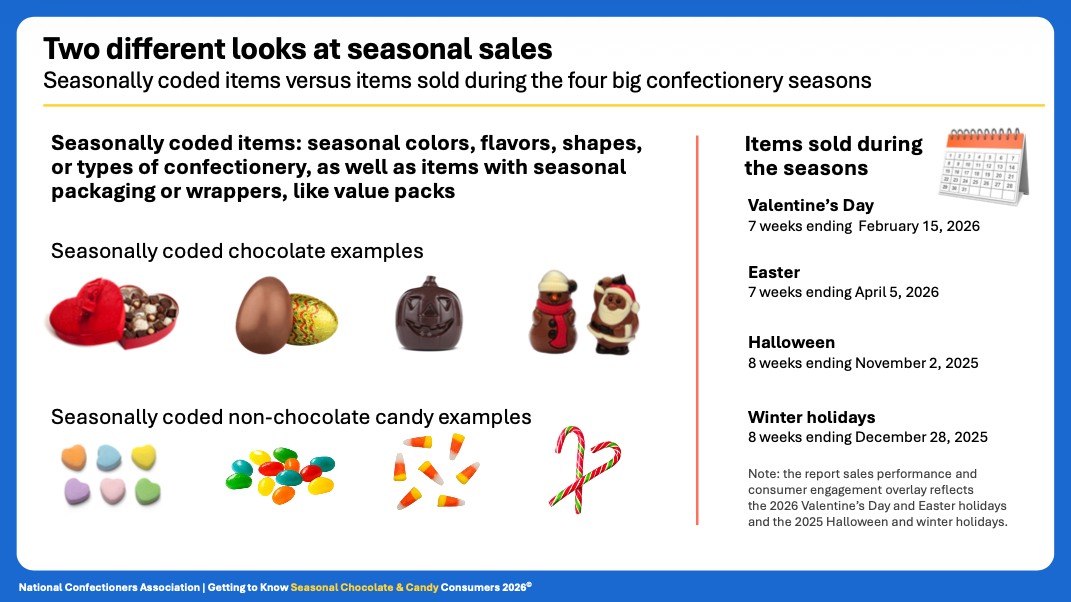
The four major confectionery seasons, Valentine’s Day, Easter, Halloween and the winter holidays, account for 64 percent of annual chocolate and candy sales, but consumers are increasingly buying treats for additional occasions, according to a new report from the National Confectioners Association.
More than nine in 10 consumers purchase seasonal chocolate or candy at least once a year, per the Getting to Know Seasonal Chocolate & Candy Consumers 2026 report, though inflation and budget pressure are reshaping participation, with baskets smaller in both dollars and units. The report also points to opportunities for confectioners and retailers as younger generations develop traditions around occasions such as Galentine’s Day, Summerween and Friendsgiving, along with summer road trips, barbecues and beach vacations.
“Chocolate and candy connect people to traditions they’ve always loved and provide opportunities to create new memories,” said John Downs, president and CEO of NCA. “The four major seasons remain essential, and now consumers are also bringing treats to more occasions throughout the year, from Friendsgiving gatherings to game-day celebrations.”
Key findings
- The winter holidays are the largest confectionery season, generating $7.9 billion in 2025, followed by Halloween at $7.7 billion.
- Seasonal non-chocolate candy is growing in both dollar and volume sales, while seasonally coded chocolate declined in dollars, units and volume over the latest 52 weeks. Non-chocolate’s share of Halloween volume has grown 6.2 points since 2022.
- Price is reshaping behavior: three-quarters of consumers perceive chocolate and candy as more expensive than a year ago, 83 percent at least occasionally look for seasonal specials or promotions and eight in 10 buy extra confectionery on post-holiday markdown.
- 89 percent say seasonal chocolate and candy are an affordable part of holiday celebrations, and 95 percent agree it is fine to enjoy confectionery during the holidays; 89 percent like treats that reflect the holiday through flavors, shapes, characters or packaging, and 84 percent say limited-time offerings push them to buy before they’re gone.
- Shoppers increasingly combine seasonal needs: 29 percent frequently buy all their seasonal items (candy, food, gifts, decorations) in one trip, up from 22 percent in 2023. Supercenters and supermarkets remain the leading seasonal channels.
- E-commerce sales of seasonally coded chocolate and candy grew 20.6 percent year over year. Online household penetration remains low at 6 to 8 percent by season, but online transactions run substantially larger than in-store ones.
- Younger consumers over-index for non-chocolate candy, online and social media shopping and new-item discovery; about 20 percent of seasonal purchases made for others involve a trendy new item, rising to roughly 28 percent among Gen Z.
- Secondary holidays, including Thanksgiving, the Super Bowl and St. Patrick’s Day, have all grown substantially since 2023.
Promotions drive real incremental volume
The report makes a case for quality seasonal merchandising: during Valentine’s Day, 44 percent of promoted volume was incremental rather than base business shifted into promotion, and all four major seasons generate volume trade efficiency above 50, a benchmark associated with best-in-class incremental growth. Combined feature-and-display support typically delivers the highest incrementality, per the report.
The report was developed by 210 Analytics for NCA, with an online survey of 1,550 consumers ages 18-75 conducted Aug. 25-Sept. 8 (margin of error plus or minus 2.5 percent) and sales and household panel data from Circana’s expanded MULO-plus-convenience universe.
Washington-based NCA represents the U.S. confectionery industry, whose companies drive $55 billion in retail sales.
Related: NCA Relaunches Website With New Data Tools Ahead Of Nutrition Policy Push