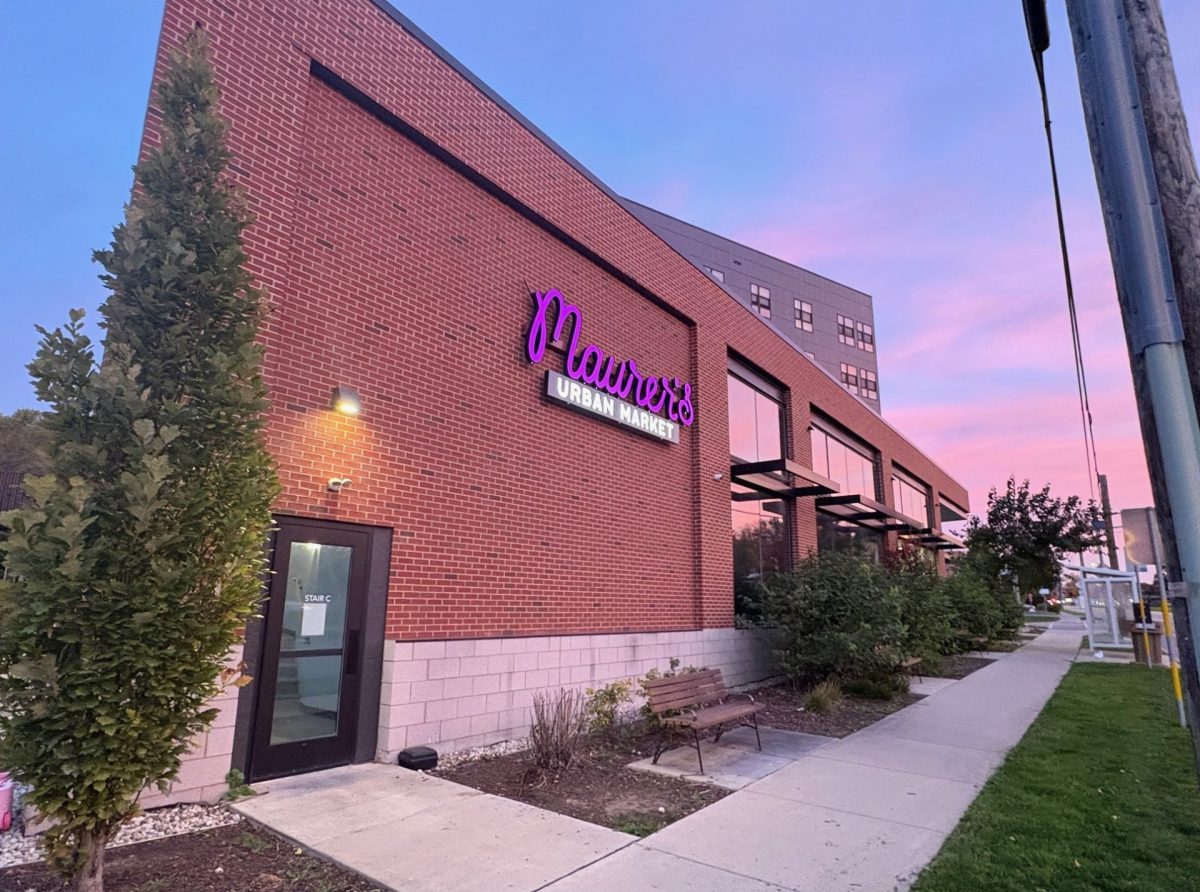
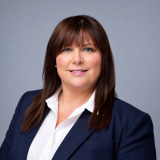
When Kristie Maurer opened the doors of Maurer’s Urban Market at 801 Cedar St. in Madison, Wisconsin, on Oct. 10, it was the culmination of a project she had been working on since 2018. She had stepped in after another grocer decided not to follow through on the store.
The neighborhood showed its support at the opening. “We had many from the neighborhood come in and thank us for being here and for staying committed to the project,” Maurer said. “It was nice to see a lot of people from the neighborhood in and about.”
“The project took a lot of turns and twists along the way,” Maurer told The Shelby Report a few days after the opening. “It’s been a long several years to get this project going.”
Structural challenges
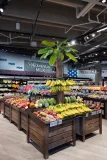
The 25,000-square-foot store occupies the ground floor of a building with 150 units of affordable housing above, 60 spaces of covered parking and a major transit stop outside. It is located in a South Madison neighborhood that sits at the intersection of an urban corridor and residential streets.
Maurer had a clear vision for how the store should feel, even as the building fought her on it.
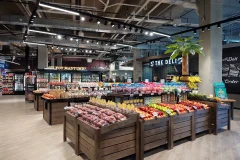
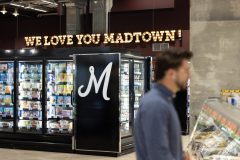 “I had a vision for a warm store that has departments that feel different, but yet feel connected,” she said. “The bakery department has a different style but synergizes with the coffee shop, that synergizes with sushi. Some stores get a little too cold, focusing more on the modern aspect and less on the warmth. This store really focuses on some unique elements, some fun decor features that cause you to kind of want to shop around the corner and wonder what’s next.”
Lighting carries much of that warmth. “The lighting in here is really lovely,” she said. “I have a lot of different lighting features that just make the store feel warm and bright and vibrant.”
The building itself was not designed for a functioning grocery store, Maurer said, even though it was supposed to be, and it took a long time to get the design right while fitting all the departments in place and keeping them operationally efficient. Half the store has 8-foot ceilings and the other half 19-foot ceilings, a challenge for both lighting and HVAC.
“When people come in the store, they have these lower ceilings, and then by the time they get to the perimeter, they go, ‘Oh goodness, this is so much bigger,’” she said. “There’s that wow feature, and that’s really what we were going for.”
Daughter of a grocer
Maurer joined her father, Jeff Maurer – a grocer for 50 years – when he bought his first store in 2010 in downtown Madison on a university campus. (He had worked for other grocers until that time.) The two worked together at Maurer’s Market in Wisconsin Dells, purchased from the third-generation family owners.
For years she balanced the Madison project against her work in Wisconsin Dells. “For a long while I had two jobs, trying to keep momentum going on this project while not losing sight of my ‘day job,’ if you will,” she said.
She and her dad also purchased, opened and closed a couple of grocery stores throughout Wisconsin over the 15 years they worked together. There were lessons along the way about how operations differ based on the locale.
“As I sit here today and open this store, I kind of have the best of both worlds. I know what high-volume urban looks like, but I also have a background in rural neighborhood grocery stores,” she said. “What I’m hoping to do is really blend the marriage here in this new Urban Market, so that it has that neighborhood grocery store feel, that we-know-everybody’s-name type of vibe.”
Perimeter first
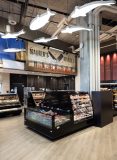 Maurer said the perimeter is where independent retailers “really shine,” and Maurer’s Urban Market gives it a lot of attention. The store has a hot bar, pizza program, full-service deli counter supplied by the store’s own kitchen, a Caribou Coffee counter, sushi, a Picadeli salad bar and seafood and meat counters. The center store carries traditional groceries alongside gluten-free, Asian, Hispanic, Indian and Mediterranean items, reflecting the communities the store serves.
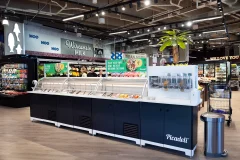 “Whether they’re coming for lunch or whether they’re coming to do their grocery shopping, we’re hoping to hit them at both times,” she said.
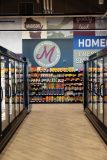
The store sells beer, wine and spirits – with an emphasis on local producers – and dedicates 12 feet to nonalcoholic beer, wine and spirits “to really highlight the changes in consumer shopping behavior,” Maurer said.
And the store being in Wisconsin, Maurer said cheese makes a strong showing. “At some point I might have said I think this might be a cheese shop, not a grocery store, because we have so much cheese in here,” she said. “You can’t have a Wisconsin grocery store without selling cheese.”
In the bakery, one of the unique features is a partnership with a well-known local business, Lane’s Bakery, that moved out of South Madison when ownership changed. The new owners turned it into a wholesale bakery that occasionally does pop-ups. But Maurer’s Urban Market customers can get the bakery’s Wisconsin Kringle and cakes at the store, restoring a beloved source of baked goods to area residents.
Technology for efficiency
In terms of technology, the store runs Caper Carts and electronic shelf labels, and Maurer is working toward connecting point-of-sale, scales, carts and ESLs into one synchronized system. But it’s not technology for technology’s sake.
“I wanted to use technology to make us operationally more efficient. I would say we’re not there yet, but we’re getting there,” she said. “I really wanted to focus on technologies that would benefit the customer in a positive way and make my staff’s lives a little easier along the way.”
Staff with an independent spirit
Maurer’s Urban Market staff members were all hired from the Madison area, and market changes worked in the new store’s favor. Some of her staff once worked for independent grocers that were purchased by corporations, and some of them longed to return to working for an independent.
“The majority of the managers that I brought on here were [with] independent retailers in the past and wanted to go back to being an independent retailer and working for someone who wasn’t part of a corporate chain.”
“Something I’m always looking for is department managers and other managers who are looking to build sales,” she continued. “As I always tell people, it’s hard to be an independent retailer. You’ve got to use your brain, and you have to understand how to merchandise and do ordering and supply chain and pricing and all things technology. A computer just doesn’t do it for you and tell you to stock the shelves.”
“It takes a lot of brain power to be an independent retailer, all the way down to a department manager and assistant manager,” Maurer says. “I was looking for individuals who wanted to use their brains, who were interested in going back to making decisions for themselves and focusing on the sales and the customers, not worrying about spreadsheets and reports, which are important, but at the end of the day, the importance is on the customer and making sure that they feel seen and heard and building sales.”
Family business, chosen twice
Maurer calls herself “a grocer by accident.” Before joining her father at Maurer’s Market, she was director of risk and safety for a nursing home company and, before that, a mediator for the state of Indiana.
“Grocery retail is a weird addiction, and once you get it, you get it, and you can’t really shake it,” she said. When the frustrations of the business threaten to overwhelm her, “I have to tell myself I actively chose this.”
One COVID-era Thanksgiving went uncelebrated when sales surged and she got the call to come in while the turkey was in the oven.
A family business in groceries “is not made for the thin skinned,” she added. At the new store’s opening, her veteran grocer father began asking questions that felt like criticism. Her mother intervened, explaining that “this is not the moment for that.”
Leading Women Grocers of America
Maurer became president of Women Grocers of America in February, after five or six years with the organization including prior board service. In September, the association hosted a sold-out symposium in Minneapolis in partnership with Ecolab.
“My goal, and what I told the women who came to the symposium, is my goal is for all of us to continue to build and work our network,” she said. “Being a woman grocer in this industry is not more difficult, it’s just a different kind of complexity in an industry that has been previously dominated by a different gender.”
Building that network is itself a skill to be taught, she said. “It’s not just about saying you’re building your network, it’s also learning how to use your network and how to network, actually. Networking and making connections is a learned skill. I was not very good at it when I first started. … When you’re in this industry, you very quickly realize how many people know each other from a past life, and that can be very intimidating. And that can be very intimidating for younger people who are also trying to join this business.”
That everybody-knows-everybody dynamic shapes who ends up in leadership, Maurer said.
“I think all too often when we are looking at store leadership or ownership, there’s often this ‘I know this person from a past life,’ and women aren’t always sitting at the table. That has changed dramatically, at least in the last 15 years, but I want to make sure that we’re calling it out and saying we need to be sitting at the table,” she said. “Because we can’t make the change if we’re not there saying change needs to be made.”
Her goal for herself as president is to keep asking the questions: “How else can we support women in this industry? How else can they support each other? And how else can we continue to be part of the conversation?