
Food-at-home prices held flat in August, but the reprieve could be short-lived as higher energy costs work their way through the supply chain, food economists said during a Sept. 17 media briefing hosted by FMI – The Food Industry Association.
The August Consumer Price Index, released Sept. 11, showed headline inflation up 0.4 percent month to month and 3.4 percent year over year, said Andy Harig, VP of tax, trade, sustainability and policy development at FMI.
Grocery inflation slowed to 2.2 percent year over year from 2.7 percent the prior month, and the fruit and vegetable index declined 0.4 percent month to month, while most other categories posted modest increases.
“So there’s some good news in there – a ray of sunshine amidst some really difficult situations on the overall picture of inflation,” Harig said.
Measured across a 20-year span, he added, inflation is lower in several categories, including eggs, cereal and bakery and dairy, than those long-run averages.
Ricky Volpe, professor of agribusiness at Cal Poly, said the flat reading conceals wide differences across the store, with beef and produce prices easing while poultry, fats, oils, butters, preservatives and dairy moved higher.
“Depending on where you’re shopping, you may not have been receiving price relief in the past month,” Volpe said. “I’m not here to be all doom and gloom, but I do want to make sure everyone’s aware that higher energy costs are absolutely hitting the food supply chain.”
The August Producer Price Index showed jumps in crude oil, diesel and industrial electricity, as well as in the warehousing, cold storage and long-haul trucking sectors that hold the food supply chain together, Volpe said. He pointed to the USDA food dollar as the clearest way to understand how those costs travel.
“Technically, energy is about 3 or 4 percent of the retail food dollar, which does not sound like a lot,” he said. “But that means that if energy prices double, we can expect to see food prices increase by three or four percentage points. And also, it’s important to remember that there is a compounding effect because agricultural production is energy intensive.
“So as energy prices go up, those agricultural commodities become more expensive. Then the food manufacturers are dealing with higher energy costs themselves, plus higher commodity prices.” 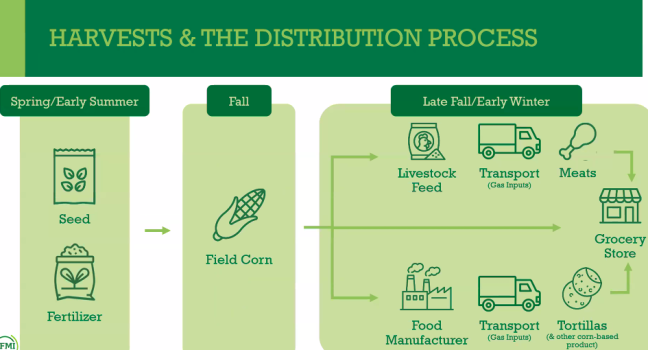
The pattern has played out before. Energy producer prices spiked in February and March following the start of the conflict in Iran and the closure of the Strait of Hormuz, and by April the food-at-home CPI had climbed 0.7 percent, Volpe said.
Field corn is another factor to be considered. Volpe said it is a direct or indirect component of at least three-quarters of the products in the supermarket, and that corn, wheat and soybean growers across the Midwest and Great Plains reported fertilizer shortages and cost increases of 25 percent, 50 percent and in some cases 100 percent when the strait closed.
Those costs entered the system during spring planting, he said, and the latest USDA corn reports point to lower yields and stocks and higher corn prices ahead.
“It takes time for the higher corn prices to translate into higher wholesale prices, which then in turn become higher retail prices,” he said, noting that contracting, storage, packaging and marketing can stretch that lag to six, nine or 12 months.
Diesel moves faster. Transportation costs from distribution centers to stores show up within weeks, Volpe said, while cold chain, warehousing and manufacturing costs take longer. “Even if the creep stopped and reversed today, we should see impacts on food prices, marginal though they may be, for the next at least three months as a result of this spike in diesel prices,” he said.
USDA’s food price outlook carries a midpoint estimate of 2.5 percent for food-at-home prices this year, which Volpe called about average. He expects the final figure to land higher. “It would not surprise me if we end up somewhere 2.7, 2.8 in the year,” he said.
Shoppers heading into the holidays still have room to work the deals, he said, because retailers price aggressively on turkeys, hams and other anchor items to build baskets.
“Consumers who are savvy about that sort of pricing, about promotions, deals, loyalty cards, that sort of stuff, can still do very well during this holiday season, despite the fact that inflation will probably be ticking up,” Volpe said. “Because there’s a real chance that Q4 of 2026 is going to be the most inflationary of the year so far.”
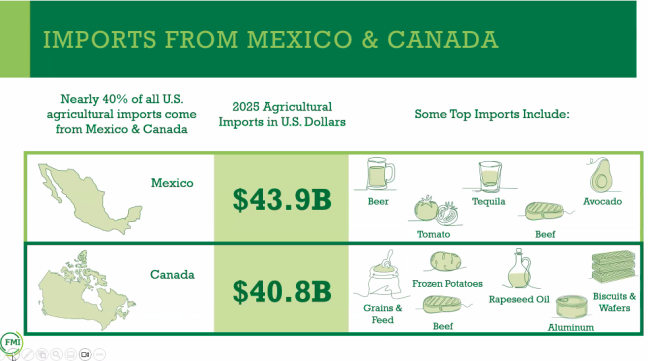 Trade remains another pressure point. Harig said nearly 40 percent of U.S. agricultural imports come from Canada and Mexico, with Mexican agricultural imports totaling $43.9 billion in calendar year 2025 and Canadian imports reaching $40.8 billion. Canada recently put tariffs into effect on U.S. dairy, molasses and baking and dough kits, levies that touch about 5 percent of U.S. exports to Canada.
Through all of it, grocery has stayed a thin-margin business. Since January 2020, food-at-home prices have risen more than 30 percent while food retailers averaged a net profit margin of 2.3 percent, never topping 3 percent, according to FMI. The high mark came in 2020, Harig said, when restaurant meals were harder to come by.
“So again, while we talk about price increases, it’s really important to remember this is not going to corporate margins or business margins,” Harig said. “This is really a result of supply chain challenges and shocks that we are facing, and the data makes that very clear.”
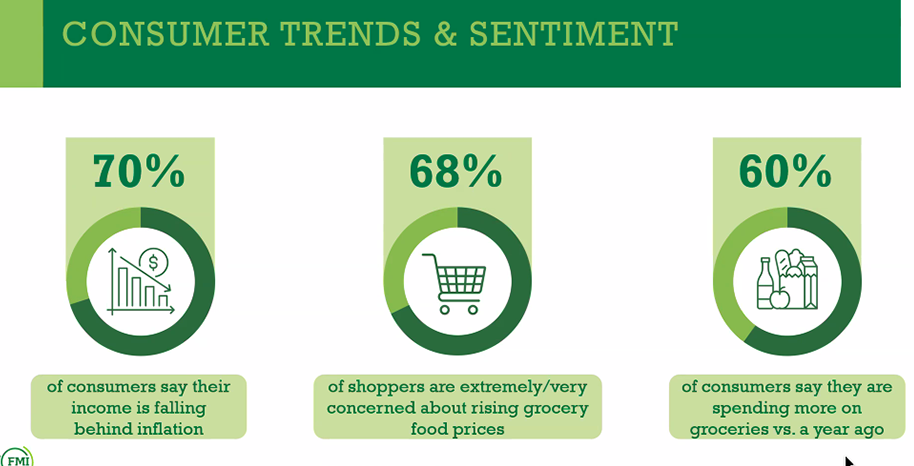
Shoppers are feeling the squeeze, said Heather Garlich, SVP of communications, insights and education at FMI. The association’s “U.S. Grocery Shopper Trends: Return to Routine” found 70 percent of consumers say their income is falling behind inflation and 68 percent are extremely or very concerned about rising food prices, with those concerns centered on affording preferred foods rather than basic needs. Shoppers’ sense of control over grocery spending has slipped about five points since February, Garlich said, though both measures sit on par with August 2025, suggesting a cyclical pattern.
Six in 10 shoppers say they are spending more on groceries than a year ago, and at least half worry that tariffs, conflict in the Middle East, foodborne illness, limited food safety information and severe weather could affect the availability, price or safety of food.
Those pressures are pushing meals back into the kitchen. Nearly half of shoppers report eating more meals at home over the past year, more than a third say they cook more than they did a year ago and half are eating fewer meals out. The CPI supports the math: Food at home rose 2.2 percent year over year in August, compared with 3.4 percent for food away from home.
Retailers are meeting shoppers with discounts and loyalty offers, Garlich said, and the industry is marking National Family Meals Month in September. Two-thirds of shoppers credit their stores with helping them maintain their budgets, 60 percent of grocers run voluntary opt-in loyalty programs, 86 percent of consumers say loyalty programs matter to them, and 59 percent use them on a regular basis, including while planning a trip.
Garlich also addressed produce demand in the wake of the cyclospora recall, saying sales across the board have been down since the recall was announced, though shoppers are returning to more typical purchase patterns.
Volpe said fruit and vegetable supply chains have grown more flexible since the pandemic, with food manufacturers, product makers and institutional providers moving product into frozen, cut, canned and jarred forms when fresh demand softens.
One measure has not moved. FMI’s U.S. Grocery Shopper Sentiment Index sits at 69, consistent with where it has been since the organization began tracking it in 2020.
“We often talk about grocery shopping as a routine task, but for many Americans, it’s something they genuinely enjoy,” Garlich said.