
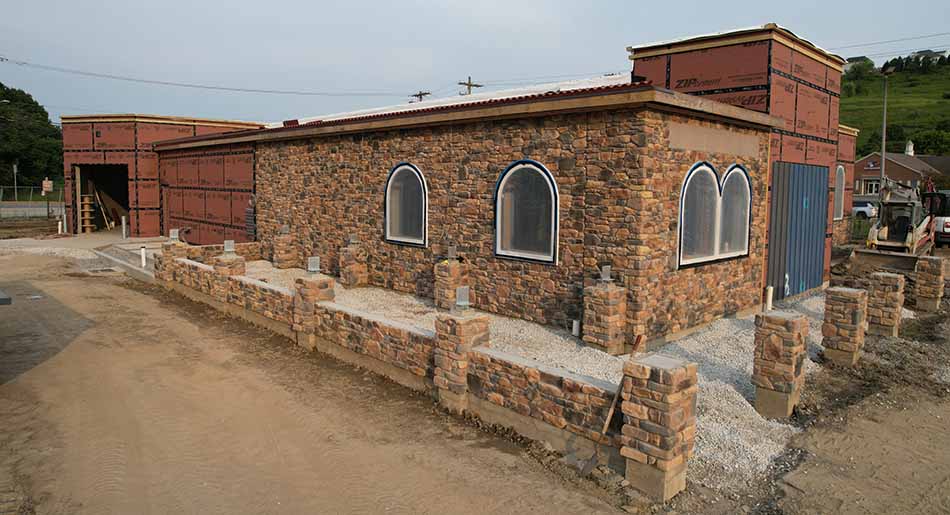
Leonard Labriola Jr. is in his 80s, and he still makes the rounds at all four Labriola Italian Markets locations – with a fifth on the way.
“He still goes to all of our four store locations. We’re building a fifth store location, and he’s still hands-on running the business,” said his daughter Leanne Labriola, SVP and board member of the Pittsburgh, Pennsylvania-based family company.
The new store extends a story that began nearly a century ago, when Leonard Labriola Sr. started selling produce and groceries to his neighbors on Pittsburgh’s Larimer Avenue.
“It started 97 years ago, 1929, right before the Great Depression. Was good timing on my grandfather’s part,” Leanne Labriola said.

The second generation grew the business into stores in Penn Hills, Aspinwall, Monroeville and the North Hills. Labriola’s carries specialty Italian products, house-made sauces, fresh deli meats and imported goods.
“Labriola’s expanded because of family. I have a brother and two sisters that were with me all the way, but now they’ve retired and we’re turning it over to my children – Leanne, Lenny, Joanne and Suzanne,” Leonard Labriola said.
“I’ve been fortunate through life. My mom and dad gave me a good start, and my children are carrying it on here, so that’s why we’re having a fifth store being built now as we speak. We anticipate the opening [soon],” he said.
Modernizing in a pandemic
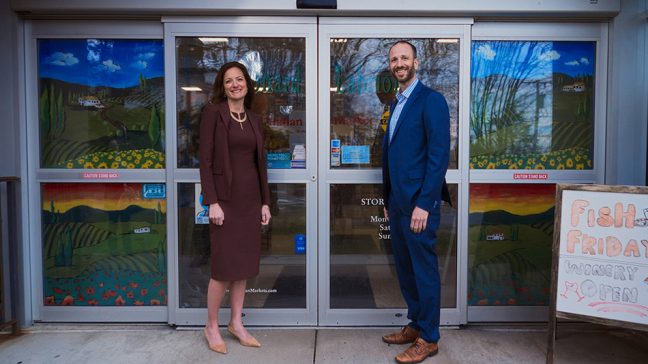
Behind the company’s expansion is a technology partnership that began during the COVID-19 pandemic, when grocery stores found themselves on the front lines. Leanne Labriola was working as an ophthalmologist at the time and returned to help the family business.
“My dad has four children – three of us went into medicine. But COVID happened and we came back, and we started looking at how can we protect the workers and help them be able to be the essential service they were, and still deliver what we needed,” she said.
The first thing she found was a phone line that gave callers a busy signal. “We updated to a virtual phone system, and I started to look at, well, what else [we could] modernize to make this new world of online delivery and ordering possible,” she said.
A good fit in several ways
The search led to e-commerce company Mercato, which recommended point-of-sale vendor Markt POS, a Quilt Software solution designed by multigenerational grocers and trusted by more than 1,000 customers, according to the company. Luke Henry serves as its general manager.
“What stood out immediately was that they were also family-owned, that they were very involved with different generations of their family in the business, and that there were actually software engineers as well as grocers,” Leanne Labriola said.
“So they really, truly understood our needs and that reflected in onboarding that technology to be specifically what was beneficial to a small grocery store, not a chain store.”
There was plenty to modernize. “We at our store had no technology before we met Luke, so we were really manual processing,” she said.

Henry recalled that the first step was to remove all the old technology.
“And you can use your phone now to change prices on the fly, to receive inventory. So instead of having a ton of extra devices, you could just use what you have,” he said.
The checkout saw the biggest change. Henry said the company moved Labriola’s off an old cash register where clerks entered prices by hand. “There’s imported products but then there’s also random weight products, so just making sure that the scanning of the entire store works properly, significantly reduces lines,” he said.
The timing mattered, according to Leanne Labriola, because independent grocers have absorbed constant price changes over the past five years.
“We’ve seen price changes frequently – a lot of geopolitical inputs that are changing the price points, environmental inputs that change price points, and so being able to have that automated in a point-of-sale system – previous to this system we were hand marking prices on every single product that came through the door, so that was difficult,” she said.
The same is true of inventory. “We can monitor the inventory levels from home, we can check what they’re ordering, we can check the substitutes that we need to because of supply chain shortages, and again, that was all done manually, and now the automation has helped,” she said.
Trading busy work for customers
For Labriola’s, the payoff is not the technology itself. It is what the technology gives back – time for the customer service that has defined the stores for three generations.
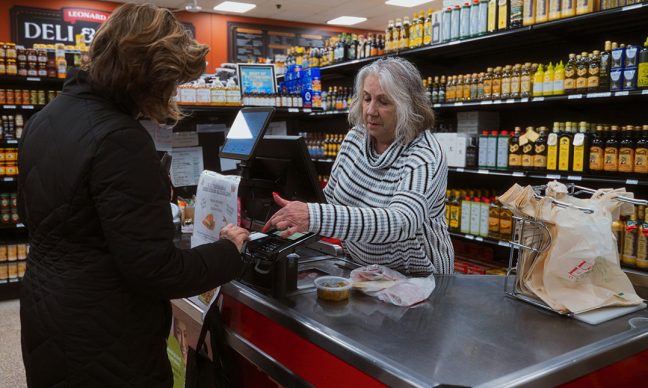
“We have people who know what your order is when you come in to order it. Our baggers carry the groceries to the car. The kids stocking the shelves can answer questions about the difference in olive oil choices for the customer,” Leanne Labriola said.
“That customer service sets us apart from chain stores or box stores. And because of that, the more customer-facing interactions we have, that’s great, and the less busy work we have to do. So in essence, that has decreased manual work and increased more customer-facing interactions.”
Tradition in the kitchen
Nowhere do tradition and technology meet more directly than in the stores’ prepared foods, where the kitchens turn out lasagna, stuffed shells, soups and traditional greens and beans from family recipes.
“With the husband and wife both working, they don’t have the time … It’s much easier to go into a store and pick up whatever you need that day,” Leonard Labriola said.
“We use our Italian food recipes, such as lasagna and stuffed shells and the soups and the traditional greens and beans – we make it. We offered it to our customers, so that’s what’s expanded the prepared foods. That’s going to be a prominent part of the food industry going forward.”
Cheese ravioli, meatballs and lasagna top the best sellers list, according to Leanne Labriola.
“Selling Italian food is a niche, because the quality that we can offer with a fresh, homemade store-made product really aligns with what they’re looking for. And if it holds well, it packages well, it can feed families for multiple days in a row,” she said.
The point-of-sale data now guides the kitchens.
“What we have been able to use is tracking those entrees, so we can look back now and it helps our kitchen prepare. How many did we sell last May?” she said. “We can help our kitchen just plan the orders better, and make sure that we’re always keeping things super fresh, that they’re made daily.”
The transition reached employees who had spent entire careers without the technology.
Eyeing electronic shelf labels
The next frontier may be electronic shelf labels.
“There’s a massive opportunity of just updating prices, and the labor cost there is so high,” said Henry, adding that ESL adoption has lagged among independents.
“In the independent space there’s just been a lapse, or like a slowness to adoption, because the price has been so prohibitive.”
For Labriola’s, the appeal is keeping every price point in sync.
“One of the efficiencies that we see with moving to technology in our store is linking the scale to the shelf tag to the register to the e-commerce platform … Having technology that can address all those settings and keep prices consistent, that is what’s really meaningful to our business, because we operate on small margins and we have to keep that really tight,” Leanne Labriola said.
Leonard Labriola has been pleased with the new technology. “It gives you better inventory control, the turnover, what sells, seasonal items.”
The system, he said, “can be implemented anywhere.”
Past, present and future
Through all of it, Leonard Labriola sees his role in the company’s history with clear eyes.
“I’m the link between the mom-and-pop store and what we have now. We’re going into like a corporate structure behind the scenes but maintaining the mom-and-pop feel inside the store,” he said.
For Leanne Labriola, the proof is the timeline itself. Her father opened his first store in the 1960s and his last in 2010. Store No. 5, the South Hills location, at 80 McClelland Road in Canonsburg, is expected to open after Labor Day.
“Because we’ve been able to bring on these efficiencies with technology and have the transparency and are able to use a cloud-based system and have a good home office for us, we’re opening our fifth location this year in a new region,” she said. “So I do think that was possible because of the technology we have.”
Why Cannonsburg? How about a store in the North Huntingdon- Irwin area. Maybe you could compete with De Lallos Market which is way over priced. They’re the only Italian market in the area.
I am so delighted that your new store is coming to my area. I don’t enjoy going to the Strip to shop. Looking forward to your opening.