
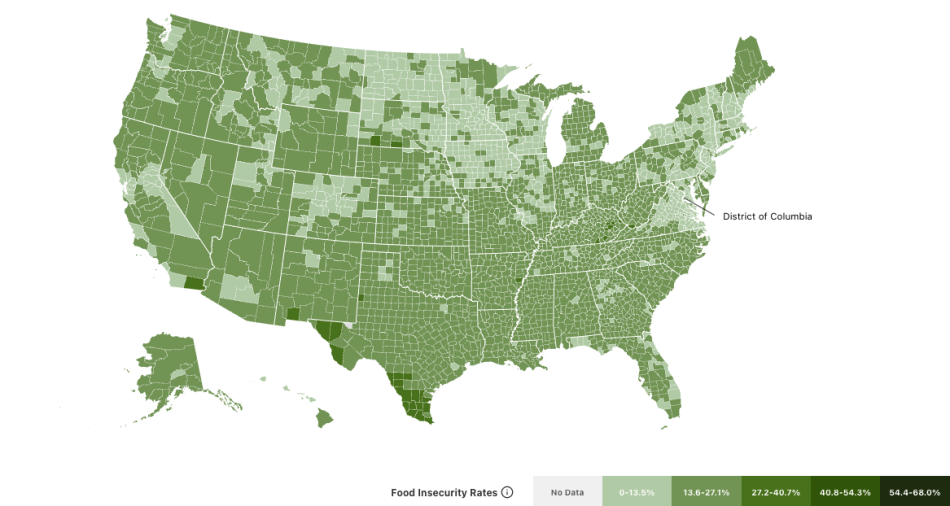
The annual study, released July 28, estimates local food insecurity and meal costs. It found that roughly 25 million people, nearly half of all those experiencing food insecurity, had incomes too high to qualify for federal nutrition assistance. According to the USDA, nearly 48 million people, including 14 million children, experienced food insecurity in 2024.
“Food insecurity is not a distant problem. It is present in every community in America,” said Denis McDonough, CEO of Feeding America. “Behind every number is a child, a family, a senior, a veteran, a neighbor working hard to make ends meet.”
National key findings
According to the study, the national food budget shortfall surpassed $33 billion, with people in food-insecure households reporting they needed an additional $23.16 per person per week to cover their food needs.
Other findings include:
- Child food insecurity affected every county and district, reaching as high as 45 percent in Lee County, Arkansas.
- More than 12 million seniors and older adults experienced food insecurity, including 7.7 million ages 60 and older.
- About half of people facing hunger had incomes above the threshold to qualify for federal nutrition assistance.
Texas leads nation
Texas remained the most food-insecure state for the third consecutive year, surpassing California. The North Texas Food Bank and Tarrant Area Food Bank shared the regional findings.
- Texas has a food insecurity rate of 19.4 percent, with 6.06 million people facing hunger, up from 17.6 percent and 5.4 million the prior year.
- The state’s child food insecurity rate is 26.1 percent, or nearly 2 million children, up from 22.2 percent.
- Texas has the largest population of food-insecure seniors age 60 and older in the nation, at 900,941.
Dallas-Fort Worth high in hunger
The greater Dallas-Fort Worth area ranks fourth in the nation for the number of people facing hunger, behind Los Angeles, New York and Houston, with a food insecurity rate of 16.2 percent, up from 15.7 percent.
- An estimated 1.4 million people are food insecure across the 25 DFW counties served by the two food banks, an increase of 81,370 from the prior year.
- Children account for 36 percent of those facing hunger, with 506,050 food-insecure children, roughly 1 in 4, an increase of 64,190.
- The cost per meal in DFW is $3.46, above the Texas average of $3.17.
- About 54 percent of those facing hunger in DFW have family incomes above the SNAP threshold.
- Dallas County has the sixth-largest and Tarrant County the 14th-largest food-insecure population by county in the country.
“As the cost of living continues to outpace household incomes, families across every ZIP code in North Texas are increasingly having to make tough decisions about whether to buy the groceries they need or pay for other essentials, such as gas, rent, medication or utilities,” said Trisha Cunningham, president and CEO of the North Texas Food Bank.
Julie Butner, president and CEO at Tarrant Area Food Bank, added that the continued rise in child food insecurity is especially concerning. “The latest Map the Meal Gap data confirms what our partners, schools and community organizations are seeing every day: too many children and families are still facing difficult choices as household costs remain high.”
SNAP cost shifts loom for Texas
The food banks flagged federal changes under H.R. 1 that shift more SNAP costs to states. Beginning Oct. 1, 2026, Texas must cover 75 percent of SNAP administrative costs, up from 50 percent, an added $117 million a year, according to Texas Health and Human Services.
A second change set for Oct. 1, 2027, would tie benefit costs to a state’s payment error rate; at Texas’ current 9.34 percent rate, the state would need to fund $709 million annually in benefits. The North Texas Food Bank, Tarrant Area Food Bank and Feeding Texas are urging lawmakers to delay that change by two years.
Through their network of more than 1,000 partner pantries and organizations, the two food banks provided access to 186 million meals last year. Both are members of Feeding America, a network of more than 250 food banks nationwide.
Georgia, metro Atlanta figures
Georgia mirrored the national pattern, with 1 in 6 people and 1 in 5 children experiencing food insecurity in 2024, according to figures from the Atlanta Community Food Bank, which serves 29 metro Atlanta and North Georgia counties. About 64 percent of food-insecure Georgians had incomes too high to qualify for federal nutrition assistance.
Other findings shared by ACFB:
- More than 900,000 people, including more than 293,000 children, were food insecure across the food bank’s 29-county service area.
- Food insecurity ranged from a low of 10.2 percent in Henry County to a high of 20.9 percent in Heard County.
- Child food insecurity in the service area rose to 19.2 percent from 16.5 percent in 2023.
- More than 68 percent of people facing hunger in the service area may not qualify for SNAP, up from 61 percent, and 40 percent of food-insecure children may not qualify for free or reduced-price meals, up from 32 percent.
- The average meal cost in Fulton County is $4.68, above the national food-secure average of $3.70.
- Food insecurity rates in Georgia showed racial disparities, affecting 27 percent of Black residents and 19 percent of Latino residents, compared with 11 percent of White residents, according to the study.
“More of our neighbors are having to make difficult choices to make ends meet and are struggling to put food on their tables,” said Kyle Waide, president and CEO of the Atlanta Community Food Bank. “The Map the Meal Gap numbers help us understand the scale of this crisis as we work with lawmakers, donors, suppliers and our partners to ensure that Georgia residents have access to healthy, nutritious food.”
The Map the Meal Gap study is supported by the Conagra Brands Foundation, NielsenIQ and the Enterprise Mobility Foundation. With the USDA having stopped collecting food security data, Feeding America said it will continue estimating local food insecurity and is exploring alternative data sources for 2027 and beyond.