
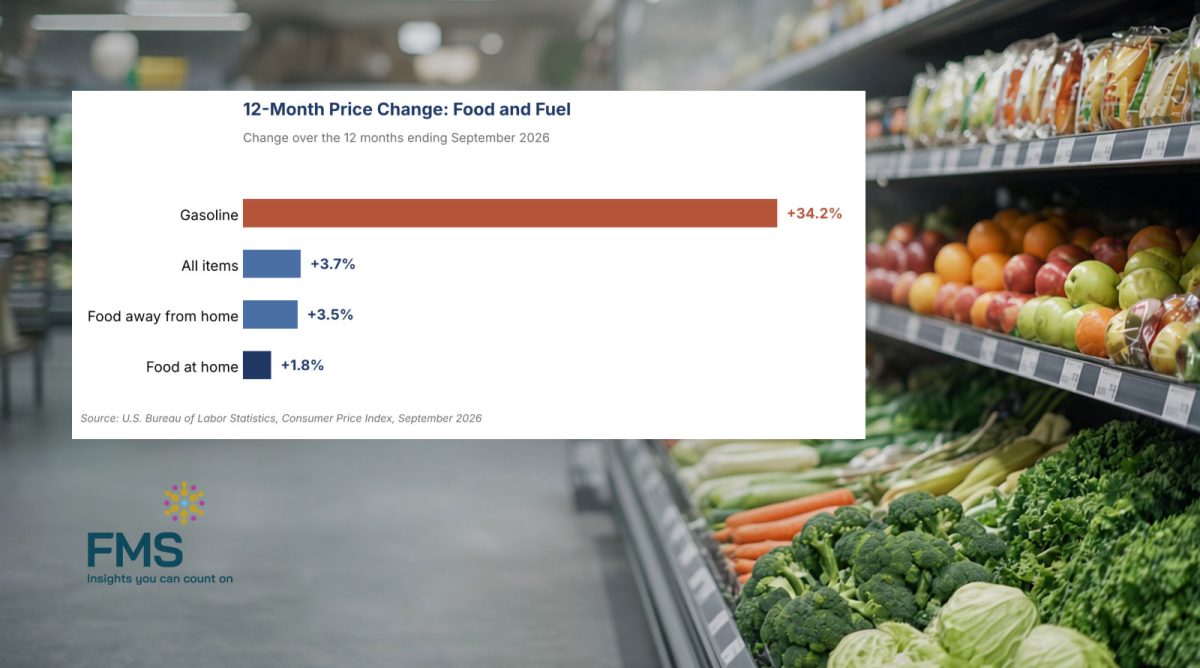
Grocery prices fell 0.1 percent in September while overall inflation climbed, according to an analysis of U.S. Bureau of Labor Statistics data from FMS Solutions. Gasoline drove most of the increase.
Food-at-home prices are up 1.8 percent from a year ago, the smallest annual increase of 2026. Overall inflation rose to 3.7 percent over 12 months, up from 3.4 percent in August. Gasoline rose 9.1 percent in September alone, accounting for more than half the monthly increase, and is up 34.2 percent from last year.
Independent grocers’ sales
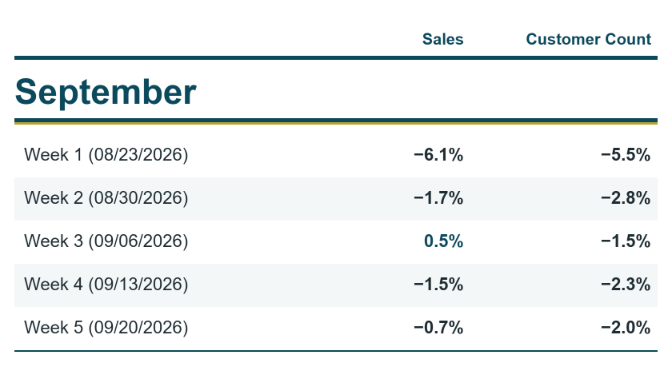
The pressure showed up in independent grocers’ sales. FMS also reported that sales among its independent grocery clients fell 2.1 percent in September compared with a year ago, an improvement from August’s 2.6 percent decline. Sales have trailed year-ago levels every month since October 2025, with a 12-month average decline of 2.4 percent.
Customer counts were down every week of FMS’s September reporting period, ranging from 1.5 percent to 5.5 percent below last year. In four of the five weeks, customer counts fell more than sales, suggesting shoppers made fewer trips but spent more per visit. The only week with a sales gain was the week of Sept. 6, which included Labor Day, when sales rose 0.5 percent.
Price changes by food group
- Three of the six grocery food groups declined in September.
- Dairy fell 0.9 percent for the month, led by a 2 percent drop in milk, and is 0.7 percent below last year.
- Meat, poultry, fish and eggs fell 0.5 percent, with beef down 1 percent.
- Fruits and vegetables rose 0.5 percent and are up 3.7 percent over the year, the fastest increase of the six groups.
- Food-away-from-home prices are up 3.5 percent over the year, nearly double the increase for food at home.
Meat leads September sales
Citing Circana data from Anne-Marie Roerink of 210 Analytics, FMS reported that total food and beverage sales in September ran 2.1 percent above year-ago levels, while units were nearly flat, up 0.1 percent. Labor Day brought 1 percent unit growth.
Meat led the rebound with $8.7 billion in sales, up 1.5 percent. Fresh meat reached $6.3 billion, up 2.5 percent in dollars and 1.6 percent in pounds. Frozen and refrigerated were also among the strongest departments. Produce improved but remains behind last year, with dollars down 1.8 percent and pounds down 0.5 percent.
What it means for retailers
FMS advised retailers to compare units against dollars when reading their comps, since a 2.1 percent sales gain on 0.1 percent unit growth is mostly price. It pointed to fresh meat as a category earning display space this fall, since its pound growth reflects real volume rather than price.
FMS also noted that higher fuel costs could change shopping trips. When gas prices rose this summer, 210 Analytics found that shoppers became more selective, and impulse and snack items took the first hit.
FMS Solutions provides accounting and decision support services to independent grocers.