
High-pressure processing (HPP) is gaining ground beyond food safety. At a recent Hiperbaric Global Roadshow workshop at Oklahoma State University (OSU), speakers said the technology may also support cleaner labels, better product quality and new value for products ranging from ready-to-eat meats to raw pet food. Those are trends that increasingly shape what grocery retailers find on their shelves.
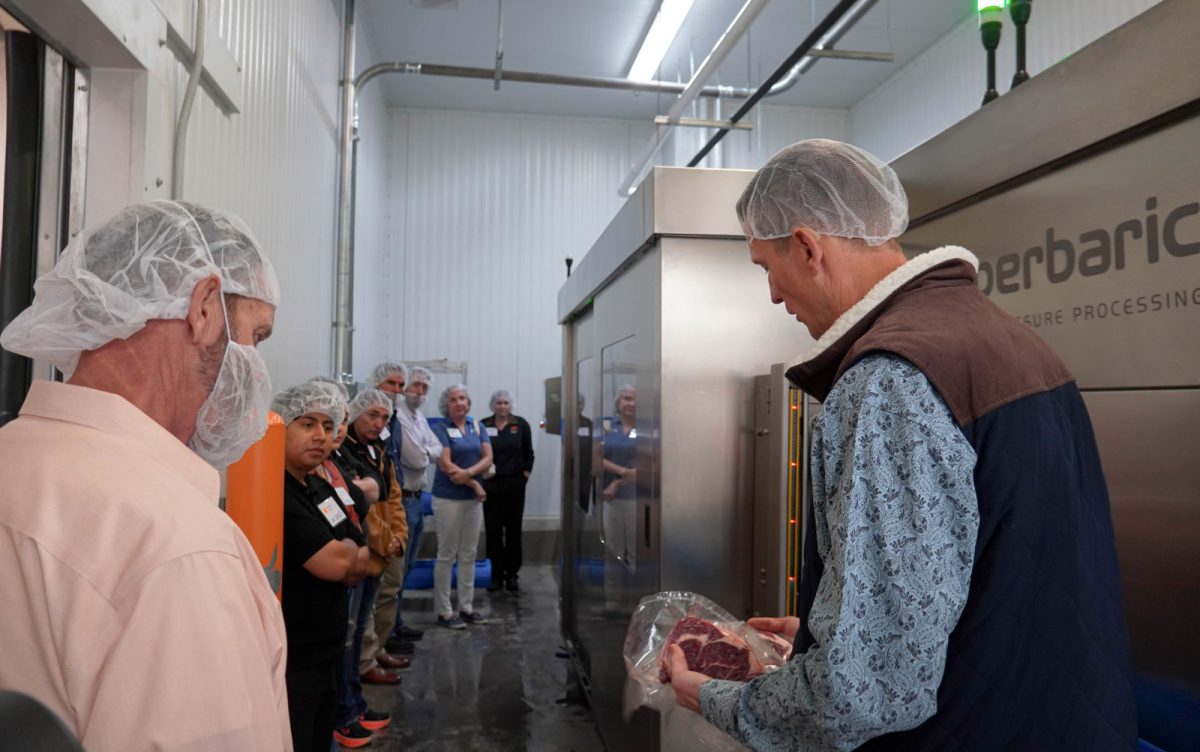
The workshop, held at OSU’s Robert M. Kerr Food and Agricultural Products Center (FAPC) in Stillwater, brought together processors, researchers, equipment specialists and industry partners. Attendees heard technical presentations and saw hands-on demonstrations on FAPC’s Hiperbaric 55 HPP system.
Pressure instead of heat
HPP uses pressure rather than high heat to pasteurize food. Daniela Castro, applications specialist with Hiperbaric, said the nonthermal process can help keep a product’s flavor, texture and quality while meeting food safety goals. She added that it can support cleaner labels and safer products.
Industry demand for cleaner labels, fewer preservatives and longer shelf life led FAPC to add HPP capability, said Rodney Holcomb, interim director of the center.
“The fact that we had the opportunity to bring that technology here for use with meats, non-meat and even pet products seemed like the perfect opportunity to do things that Oklahoma processors have had limited exposure to and show them the options that are available as they move forward in the marketplace,” Holcomb said.
The HPP system is part of a broader FAPC modernization. In 2024, the Oklahoma Legislature approved $7 million for it: $6 million for facility and equipment upgrades and $1 million in recurring annual funding.
Food safety for ready-to-eat and pet products
Grace Danao, research associate professor at the University of Nebraska-Lincoln, talked about how HPP can help control pathogens in ready-to-eat foods, especially Listeria monocytogenes, which can contaminate products after cooking. She said high pressure weakens bacterial cells and makes them more vulnerable to other factors in a product, such as acidity, antimicrobials and cold temperatures. She also noted that validation and regulatory requirements vary by product category.
Susy Tejayadi, president and founder of Tailored Pet Food Solutions, described HPP as an important pathogen-control step for raw and fresh pet food. She noted that results can vary with formulation, water activity, moisture and fat content.
From clean label to commercial scale
Derrick Thivierge, director of quality assurance for GoodHeart Brand Specialty Foods, said the company uses HPP to support food safety while reducing preservatives, phosphates and salt. He added that the technology played a role as GoodHeart expanded into broader foodservice and retail markets.
Christian Calix, executive VP of Universal Pure, said companies moving from product testing to commercial production need validation studies, food safety plans, documentation and coordination with tolling partners. He described commercial HPP as a collaborative process that should start with careful planning and pilot work.
Recovering value in dark-cutting beef
Researchers at Nebraska and OSU are studying whether HPP can improve the color of dark-cutting beef. That beef is often discounted because its darker appearance can turn off shoppers.
Gary Sullivan, professor of animal science at the University of Nebraska-Lincoln, said the opportunity may look different depending on processor size. Larger processors could apply the technology in-house, while smaller ones might work with third parties that consolidate product from multiple plants. He said companies have been optimistic about the technology as research continues.
FAPC’s Hiperbaric 55 system lets food companies test products and processing conditions before they commit to larger production, outsourcing or capital investment.
“We can work with it not only for research purposes but also give our processors in the state an opportunity to try it out for themselves and see how it benefits their industry,” Holcomb said.
The Robert M. Kerr Food and Agricultural Products Center at Oklahoma State University provides technical assistance, research, training and pilot-scale processing support to food and agricultural businesses.