
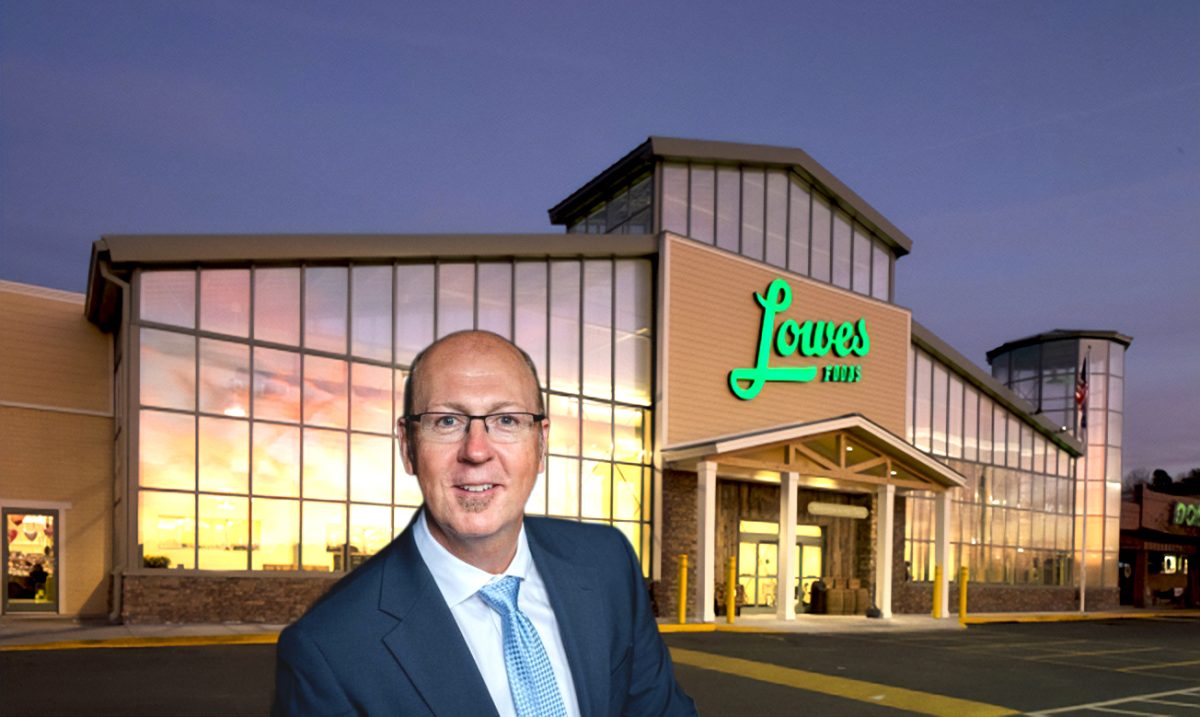
Lowes Foods is on pace to open or convert six stores in its current fiscal year, but President and CEO Tim Lowe is just as focused on a shift he believes will reshape grocery retail in only a few years: consumers handing their shopping decisions to artificial intelligence.
Lowe sat down with The Shelby Report at the Carolinas Food Industry Council’s 2026 gathering to discuss the Winston-Salem, North Carolina-based grocer’s growth, its response to a value-driven consumer and how a regional player stays visible as AI begins to mediate the path to purchase.
Six stores and counting
Earlier this year, Lowes Foods converted a former KJ’s Market location on Johns Island, South Carolina, a roughly 40,000-square-foot store, to the Lowes Foods banner. A new ground-up store in Kannapolis, North Carolina, just north of Charlotte, opened a few weeks ago, and a store in Lyman, South Carolina, in the Greenville market, is set to open in August. That location also is a KJ’s conversion.
“Our fiscal year runs October through, and we’ll have opened and or converted six,” Lowe said. “It’s been fairly busy with new stores and keeping things moving along.”
While the new stores do not carry new concepts, Lowe said work is underway on store design efficiencies that will show up in locations several years out. That work is informed by a recently completed round of ethnographic research. An outside consultant conducted interviews with shoppers throughout North Carolina and South Carolina, including loyal Lowes Foods guests, lapsed shoppers and those who have never shopped the banner.
“We got some really great insights that came out of it,” Lowe said. “It’s really about how the brand has continued to evolve and how do we continue to inject new flavor into it to keep the guest at the center of what’s most important to them.”
Value without the race to the bottom
Lowe was direct about the pressure on consumers. “There’s a shift to value for sure in the consumer right now,” he said, noting the company has lowered prices throughout its stores and continues to lean on promotion, with guest surveys responding favorably.
That value focus is showing up in fresh departments. The grocer moved its Pick and Prep cut fruit and vegetable program to solid price points by platform to make value easy to see. A new sub sandwich program built around a $7 sub every day is rolling out now. In bakery, a tw0-pound sourdough loaf sells for $5, sliced or whole, with a one-pound version at $3. A protein-based sandwich on high-protein, low-carb bread is in the works.
In prepared foods, Lowe said protein is the biggest trend the company is chasing, with fiber second. That means rethinking the deli case beyond the mayonnaise-based salads typical of the category, adding protein-plus-two-sides offerings in both hot and cold formats, and leaning on the chain’s smokehouse program. Comfort still matters, too: the croissant program continues, and a new cinnamon roll program is coming.
But Lowe warned against competing on price alone. “That’s a fool’s errand, because the bigger folks will always win on that,” he said. “You have to have the value equation in total done right. Base price is more important to the consumer now than it ever has been. But people are also still looking for experiences. How do you make sure you’re still letting people go on a journey when they come into your stores?”
When AI does the shopping
The most animated stretch of the conversation came when Lowe turned to how AI is changing shopping behavior, and what it means for retailers who are not preparing for it.
He offered a scenario: a consumer asks an AI assistant to build a spaghetti recipe, find the best price on the ingredients and place an order for delivery by 3 p.m.
“At that point, you’ve given the AI the permission to order from whoever, and they’re going to base it on the criteria you tell it,” Lowe said. “How do you make sure that you’re in the consideration set? Because consumers will migrate away and they won’t even know it.”
Lowe said Lowes Foods believes that within a few short years, shopping apps “will be a thing of the past for the most part,” replaced by conversational AI that simply executes the shop. He pointed to Walmart, Amazon and Kroger as the large players moving fastest into that space, with Walmart, by his read of industry reporting, currently outpacing Amazon.
For a regional grocer, staying in the consideration set means understanding what signals AI systems read. Pricing consistency matters: if AI pulls a retailer’s prices from a third-party delivery site where they run higher than in store, that alone can knock the retailer out of contention on a price-driven search. Quality ratings, guest reviews and markers for attributes such as local sourcing and sustainability all feed the machine as well.
“It’s utilizing the ability to look at every aspect of your business to make sure that you are sending the right signals so that you get correctly represented within that ecosystem,” Lowe said.
He cited figures suggesting 60 to 70 percent of shopping experiences already start online, whether with a recipe search, ingredient research or coupon hunting. As digitally native generations become the primary decision-makers, he expects that number to climb sharply.
The best defense, Lowe argued, is the relationship a retailer builds now. “The better we can identify and know our guests now, and communicate to them now, while we have that connection, the better off you’re going to be in the future,” he said, describing a shopper who one day tells a voice assistant to build a list specifically from Lowes Foods.
Internally, the company is applying AI to labor efficiency, finance, HR, inventory controls and an upgrade of its computer-generated ordering system, all with the goal of removing tasks from store hosts so they can focus on serving guests.
Summing up, Lowe returned to where he started. “The consumer is stressed right now. We know it, we feel it, we see it across the entirety of the industry,” he said. “As retailers, we’ve got to meet them where they’re at. And we’ve got to pay attention to how AI is changing the way people shop and interact with us, so that it allows us to be the purveyor of choice as they make decisions. It’s up to us to figure that out.”