
As my colleague Peter Cooke and I travel the globe assisting food retailers large and small, there is one thing we see with both the most profitable and the not-as-profitable locations – choices. Benchmarking thousands of stores, we have learned how these choices are made.

There is no single choice we see that is inherently good or bad. Choices are a function of time, people and capital. We believe that food retail leaders make the best choice with the best available data at that time.
Over time, those choices prove to be more – or less – successful. Sometimes, the best choice for today is known to not be as successful over time. However, it was made based on the available resources.
Over the last 10 years, we have categorized and benchmarked different aspects impacting the operations of food retail. Traditional practices targeted energy efficiency because it was the low-hanging fruit to reduce costs and improve profitability.
However, energy costs account for only about 1 percent of total sales. Whereas food waste, labor and operational practices can represent at least 20 percent of sales and often can impact energy efficiency for a multiplier effect.
It is in the benchmarking and data collection where we determined the lost sales equivalent opportunity within a typical meat lineup.
How we calculated the total impact came at the behest of a Mid-Atlantic retailer wanting the total impact of converting its meat lineups to new refrigerated cases with doors. Yes, the two-decades-plus debate whether a retailer should put doors on medium temperature display cases. Again.
Peter and I do not advocate for doors. We provide facts and data to retailers to help them make the best decision for themselves.
But back to the facts. The retailer in question asked us what the impact to its meat lineup would be for new cases with doors. Buried in the question were financial concepts – terms and values such as total cost of ownership, return on invested capital, net present and future value, inflation, compounding interest and regulatory concerns.
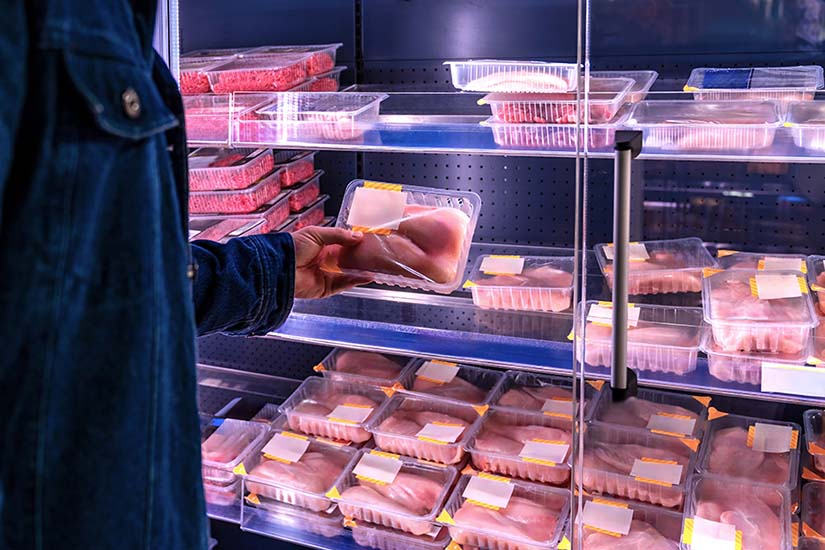
Here are three facts and two observations of putting self-service meat behind doors. One, BTU load of the display case is more than 70 percent lower for a case with doors. Thus, it is more energy efficient. For an existing system, converting to doors can give the overall system more capacity.
Two, the temperature of products behind doors is held more consistently. For meat, this provides an extra day of display as the original cut and an extra day when ground. Thus, up to two days are added to sell a cut of meat.
We have data showing that shrink in the meat category is cut in half or more when displayed behind doors. This increases average gross margins in the meat department.
Three, meat department labor becomes more efficient. Reducing the need to remerchandise, remove product to grind, pull product for spoilage, relabel, disposal and tracking is reduced commensurate with shrink reduction.
More than 10 years of data shows the value of gross margin improvement and labor improvement is worth as much as double the energy savings.
Observation one: Meat lineups with doors have lights illuminating the front of product versus the top. This reduces glare and improves the overall appearance for shoppers.
Observation two: Lineups with doors are more comfortable for shoppers and associates. Anecdotal stay-time testing shows shoppers spend more than three times the amount in a space with doors. Thus, more opportunities to impact average basket size improvement.
Summing up facts one through three: A 40-foot lineup of meat with doors provides equivalent profit improvement to more than $2.4 million of sales over the life of the lineup.
How does a retailer figure this out to determine if doors are right for them? Where does all process improvement start? Benchmark the store.
Grocery PoP! is a consultancy built on decades of hands-on experience inside grocery stores, warehouses and cold-storage facilities. Founded by Peter Cooke and Jonathan Tan, who have collectively benchmarked thousands of locations, Grocery PoP! specializes in uncovering rapid, meaningful operational improvements – often identifying tens of thousands of dollars in profit opportunities within minutes.