
Food prices are changing how 77 percent of U.S. Thanksgiving hosts and guests build their shopping lists this year, but new data from NielsenIQ (NIQ) show they still plan an abundant holiday meal.
Prices on several Thanksgiving items are up. In the 52 weeks ending Sept. 5, cranberry sauce prices rose 15 percent, and turkey breast rose 12 percent compared with a year ago, according to NIQ.
Fruit juice was up 6 percent, and green beans, carrots, soft drinks, dinner sausage and appetizers each rose 4 percent. Pie crust was down 2 percent.
Pressures abound
The pressure on household budgets extends beyond the grocery store. CPG inflation reached 2.6 percent in August, while overall inflation climbed to 3.4 percent, driven by a surge in gas prices. Consumer confidence has fallen 8.4 points year over year, according to NIQ.
“Consumers want the same Thanksgiving they’ve always wanted: a table full of favorite foods, enough leftovers for the next day and a memorable experience with family and friends. The difference is that they’re working harder to make that happen,” said Chris Costagli, VP of thought leadership and food and beverage insights lead at NIQ.
“We saw the beginnings of this in 2025, but in 2026 it looks less like a reaction to inflation and more like a new holiday shopping playbook.”
NIQ’s Thanksgiving ’26 survey of 2,017 respondents found that, because of food and beverage prices, 36 percent of people hosting or attending a Thanksgiving meal will search for deals, 32 percent will use what they have on hand, and 31 percent will plan their menus with care. 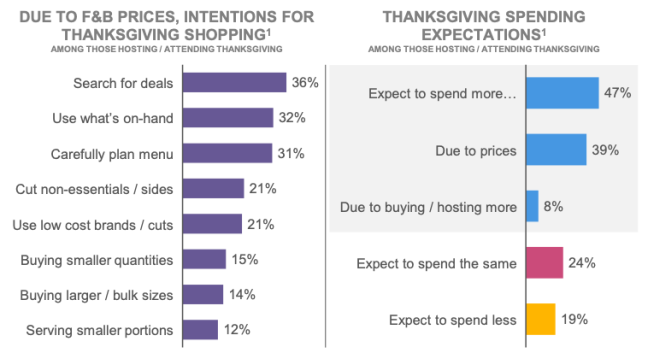
Another 21 percent will cut non-essentials or sides; 21 percent will use lower-cost brands or cuts; 15 percent will buy smaller quantities; 14 percent will purchase larger or bulk sizes; and 12 percent will serve smaller portions.
Among those hosting or attending, 47 percent expect to spend more on Thanksgiving. Of those, 39 percent cite prices and 8 percent say they are buying or hosting more. Twenty-four percent expect to spend the same, while 19 percent expect to purchase less.
“When consumers encounter double-digit price increases on staples like cranberry sauce or turkey breast, they’re often encouraged to become more flexible, whether that’s switching brands, purchasing private label alternatives, shopping promotions or reallocating spending elsewhere in the basket,” Costagli said.
More store brands buys planned
Forty-six percent of respondents plan to buy more store brands than they did last year, 46 percent expect no change and 8 percent plan to buy fewer.
“Side dishes, baking ingredients, canned vegetables, cranberry sauce, dairy and pantry staples are all natural opportunities for private label because they’re often purchased in larger quantities and play a supporting role in the meal,” Costagli said. “Categories that are viewed as central to family traditions, signature recipes or holiday indulgences may be more insulated, although even those categories are seeing greater private label consideration than in the past.”
He said there is strong evidence the shift will stick.
“Consumers didn’t suddenly discover store brands this Thanksgiving,” Costagli said. “If a store brand delivers the quality, taste and value consumers want, many will continue buying it long after the holiday season is over.”
Budget planning
Shoppers also have decided ahead of time where they would cut back. Seventy-five percent of Thanksgiving participants already know where they would cut spending if needed. Decorations, alcohol and specialty foods face greater scrutiny, while fresh produce, beverages and the main protein remain more protected.
Forty-one percent of Americans plan to host Thanksgiving this year. Compared with all respondents, hosts are more likely to come from higher-income households, live in larger families, have Gen Alpha children and use GLP-1 medications. According to NIQ, they sit at the center of more purchase decisions and influence more holiday spending than the average shopper.
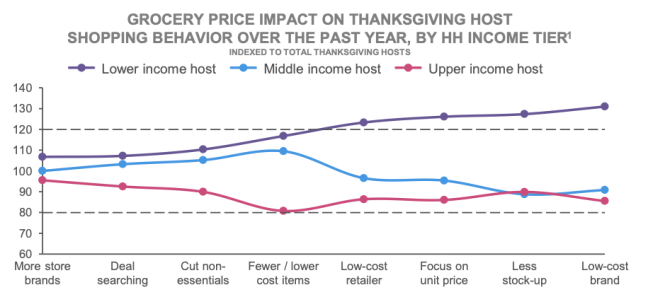
Consumers who will both host and attend gatherings are more likely to buy prepared foods from the grocery store. Of that group, 73.3 percent are likely to purchase grocery store prepared foods, compared with 27.7 percent of host-only consumers and 28.1 percent of attend-only consumers.
“For many shoppers, the value of prepared foods isn’t avoiding cooking altogether, it’s avoiding the most time-intensive parts of holiday entertaining,” Costagli said. “The opportunity for retailers is to position prepared foods as a way to save time and reduce stress while still delivering a holiday experience that feels special.”
Excess allowed
Even as consumers manage every dollar, Thanksgiving remains an exception where excess is part of the experience, according to NIQ.
Among those hosting or attending, 38 percent overcook to avoid running out, and 36 percent do it to have leftovers. Just 2 percent would prefer no leftovers. More than one in four hosts say they waste more food at Thanksgiving than at a typical meal, and upper-income hosts expect to waste more than their middle- and lower-income counterparts.
Many have plans for the extra food. Forty-four percent plan to make leftover sandwiches or wraps, 40 percent will send food home with guests, 34 percent plan a next-day meal and 26 percent will freeze or vacuum-seal leftovers.
“If consumers are intentionally buying extra food, retailers can help them preserve it, repurpose it and extend its use,” Costagli said. “Storage products, meal-prep items, leftover recipe solutions and cross-merchandised ingredients for second-day meals can all help retailers stay part of the consumer journey well beyond Thanksgiving dinner.”
For grocers finalizing their Thanksgiving pricing, promotions and assortment, Costagli said the goal goes beyond price.
“Retailers should focus less on selling products and more on delivering outcomes,” he said. “The focus shouldn’t simply be on offering the lowest price. It should be on helping shoppers feel that every item they put in their cart earned its place.”