

Cargo ships stalled in the Strait of Hormuz. Fertilizer prices that have effectively doubled for American farmers. A Sierra Nevada snowpack that never materialized. The pressures bearing down on the U.S. food supply chain in 2026 are coming from multiple directions at once – and according to experts from FMI – The Food Industry Association, consumers should expect to feel the effects later this year and into 2027.
FMI hosted a media briefing May 14 on the state of food prices, with Andrew Harig, FMI’s VP of tax, trade and sustainability and policy development, and Ricky Volpe, professor of agribusiness at California Polytechnic State University. The pair discussed the latest Consumer Price Index data, key indicators to watch and what lies ahead for grocery prices as global conflicts continue to disrupt trade.
CPI signals inflation on the move
The April CPI, released May 12, showed an all-items increase of 0.6 percent from March. Food at home posted an increase as well, as did indexes for meats, poultry, fish and eggs, and dairy products. Energy prices – a critical input at every stage of the food supply chain – rose 5.4 percent in the gasoline index, down from March’s 21.2 percent increase but still significantly elevated year over year.
Volpe called April’s report a turning point. 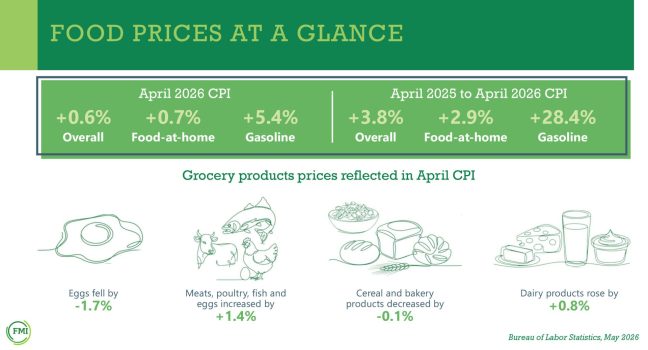
“This … was sort of the first time that we started to see the convergence of these factors moving towards inflation,” he said.
The USDA Economic Research Service is currently forecasting grocery price inflation at or slightly above the historical norm, but Volpe said he expects that forecast to keep climbing.
“My best guess – I do think that food price inflation is probably going to tick up above the rolling 20-year average, and probably closer to around 4-4.5 percent,” he said.
For context, Volpe noted that food at home CPI hit 11 percent and 8.5 percent in back-to-back years during the pandemic. He was clear that a repeat of that scenario is not what he’s projecting.
“We are not looking at runaway food price inflation, nothing comparable to what happened during COVID,” he said. “We’re also not looking at widespread food shortages.”
Conflict in the Gulf compounds supply chain stress
The military conflict and blockade in the Strait of Hormuz has jammed cargo shipping in the region, disrupting the delivery of both energy and fertilizer – two of the most fundamental inputs in the food supply chain. Harig noted that the April CPI data is just beginning to reflect those effects.
“The impact of any one factor in food prices can take at least a month or more to track through the supply chain,” Harig said. “Some of these impacts will have ripple effects that are evident now, but it can also be felt later in the year and even into 2027.”
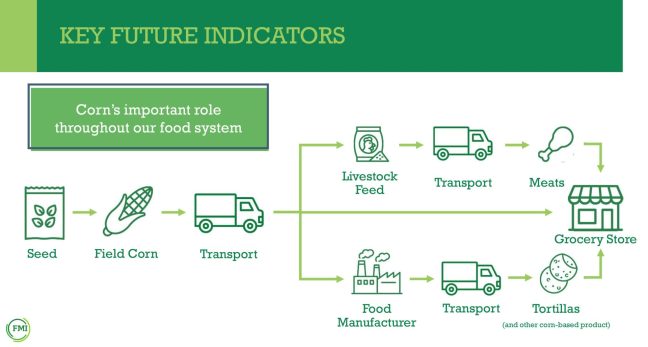
Fertilizer has emerged as a particular concern. By some industry estimates, Volpe said, its price has effectively doubled for American agricultural producers – a development with outsized consequences for row crops.
“Corn is No. 1, and these higher fertilizer costs really aren’t going to have a significant or substantial impact in commodity prices until it’s time for harvest and storage and distribution and manufacturing and processing, which means we’re looking at months down the road,” Volpe said.
He added that farmers also are making difficult decisions about acreage application levels, with some potentially shifting from corn to soybeans – a move that carries implications for energy and food prices.
The United States, Harig noted, does not produce enough fertilizer to meet its domestic needs and has been reliant on imports from the Middle East that now face shipping disruptions through the strait.
“These international conflicts that we’ve seen right now, obviously we’re focused on Iran, but the Ukraine-Russia conflict as well … have an impact on international trade beyond fuel; it also affects the shipping of food and fertilizer and other key inputs,” Harig said.
Tariffs adding to cost pressures
Volpe pushed back on the narrative that tariff-related food inflation has proven to be much ado about nothing.
“It is the case that a lot of the food-related tariffs that were discussed a year ago were either exempted or drawn down or reduced, but we are still dealing with – across the board – 10 percent tariffs on most foods,” he said.
He pointed to canned and frozen fish and seafood, fruits and vegetables and non-alcoholic beverages as categories already showing significant CPI increases – a reflection, in his view, of the higher cost of imported goods and the added burden on packaging materials.
Aluminum is of particular concern for the seafood category, where canned tuna, salmon and pouch products make up a substantial share of the market.
The canned seafood CPI, Volpe noted, is 6.2 percent above where it was a year ago – more than double the 2.9 percent increase for food at home overall.
Harig flagged additional packaging concerns beyond metals.
“Lumber tariffs have an impact on paper packaging as well. We’ve already seen the U.S. paper packaging industry having some mills closed,” he said.
“Rubber has been impacted by some of these closings in the Strait of Hormuz. We use that in refrigeration materials … So you’re seeing multiple levels to where these, both tariffs and these energy-related fluctuations, are playing out.”
Plastic packaging – dependent on oil as both a manufacturing input and raw material – is another cost pressure Volpe said the industry needs to start watching more closely.
“I can’t think of a single food department or category that doesn’t rely on plastic to some extent,” he said.
Seafood particularly exposed
Harig, who recently attended the Boston Seafood Show, called out seafood as one of the most vulnerable categories in the current environment.
“Depending upon the commodity, anywhere from about 73 to about 80 percent of the seafood we eat in the United States is imported,” he said, noting that domestic aquaculture capacity is constrained by permitting challenges and cannot expand quickly.
Tariffs were not suspended on seafood imports, and fuel costs – including jet fuel for airfreighted product – have compounded the pressure at every step.
“It’s really facing some cost pressures that I think are extraordinarily challenging,” Harig said.
California drought adds another layer
The absence of Sierra Nevada snowpack this year is setting up what Volpe called a “double whammy” for specialty crop production in California, which supplies much of North America’s fruits, vegetables, tree nuts, greenhouse commodities, herbs and spices.
“The Central Valley, the San Joaquin Valley, Sacramento – they’re not going to be getting that runoff from the Sierras over the next few months that typically keeps the ground nice and wet and leads to a positive growing season,” Volpe said.
Drawing groundwater for irrigation is energy-intensive, he added, meaning that rising energy costs will simultaneously reduce supply and increase the cost of compensating for it.
Specific supply chain issues also are affecting leafy greens and citrus. Fusarium wilt and related problems are affecting vegetable and leafy green production in the West. Citrus greening remains an unresolved structural problem for Florida citrus production.
“These supply chains are dealing with structural problems, and we really shouldn’t expect prices in these categories to come down anytime soon,” Volpe said.
He also raised a concern about alfalfa – a low-profile but important crop throughout the western U.S. – which serves as a primary, relatively affordable source of animal feed. Limited alfalfa production this year will require substitutions with more expensive feed sources, adding to already elevated beef prices.
“For anybody who’s been looking at beef prices and wondering if we’re ever going to see any relief there – are we going to see the cattle herd expand? Are we going to see inventory grow? I don’t think so.
“I don’t think anytime soon, because we’re looking at a few significant pressures: higher feed costs, higher water costs, land values continue to go up, transportation remains very expensive and challenging – and when we talk about cattle ranching and hog ranching, those are some of the most problematic industries for labor in terms of turnover, attracting and retaining younger workers,” Volpe said.
Harig added that drought conditions in the Southeast and early wildfires present additional weather-related challenges for the year.
The PPI: a forward-looking tool
Both Harig and Volpe pointed to the Producer Price Index as a valuable resource for understanding where food prices are heading. Unlike the CPI, which measures what consumers pay, the PPI tracks costs further up the supply chain – and tends to predict retail price movement by a month or more.
“The PPI is a really powerful tool for looking forward,” Volpe said.
He also highlighted long-haul truck rates as an indicator that has long outpaced overall inflation and remains a significant cost driver.
“Trucking is literally the glue that holds the entire food system together,” Volpe said. “There is really no such thing as a truck-free process in the food system. Even when food is moved on container ships or barges or rails, you need trucks at the beginning, and you need trucks at the end.”
Grocery shopper sentiment holds — for now
Despite the external pressures, consumer confidence in grocery shopping remains notably strong. FMI’s soon-to-be-released 2026 U.S. Grocery Shopper Trends Report found that the U.S. grocery shopper sentiment index reached an all-time high of 73 percent, with shoppers continuing to find value at the store even as restaurant prices climb, Harig said. 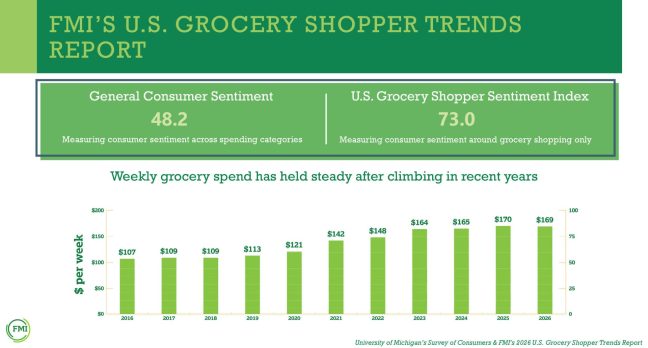
The average weekly household grocery spend is now $169 – on par with spending levels since 2022 – suggesting stabilization after years of increases. Shopper satisfaction with their primary grocery store registered at 8.6 out of 10.
The report also found that 80 percent of consumers surveyed feel they have control over their grocery household spending – a number Harig called significant.
“That sense of control, I think, goes a long way towards mitigating a lot of the anxiety we see out there,” he said.
Food retail operates on an average profit margin of 1.7 percent, and industry members are expected to work to hold prices as long as possible, Harig said, even as upstream costs mount.
“I think they’re going to do the best they can to try to hold the line,” he said. “But again, this is a significant input. It’s very difficult to just sort of have everyone take a little bit of a haircut and move on.”
Technology and transparency as tools for resilience
Looking ahead, both Harig and Volpe pointed to industry investments in renewable energy, artificial intelligence and automation as longer-term stabilizing factors.
Volpe, who described himself as a “long-run optimist” for the food supply chain following the industry’s performance during the pandemic, identified three broad areas of progress: renewable energy adoption that helps food companies decouple from volatile global crude oil prices; AI tools for data analysis, logistics optimization and food waste reduction; and mechanization and automation that is filling labor roles in sectors with persistent workforce challenges.
“From my perspective, all of these needles are moving in the right direction, and it’s going to lead to an even more resilient food supply chain that’s less reliant on these transportation, energy and labor shortage issues that we keep talking about,” Volpe said.
Harig noted that AI already is helping grocery retailers reduce food waste by improving inventory systems and waste prediction – a benefit both financially and environmentally.
On the communication front, Volpe urged greater transparency from food companies when prices rise.
“Usually, food companies are dealing with just as much pain as the customers. They’re dealing with a large series of challenging upstream costs that are bigger than them, sometimes external to even the U.S. I encourage more communication about that. I don’t do marketing … but I know there are effective ways to let consumers know that, hey, we’re in this together. We’re doing our best,” Volpe said.