
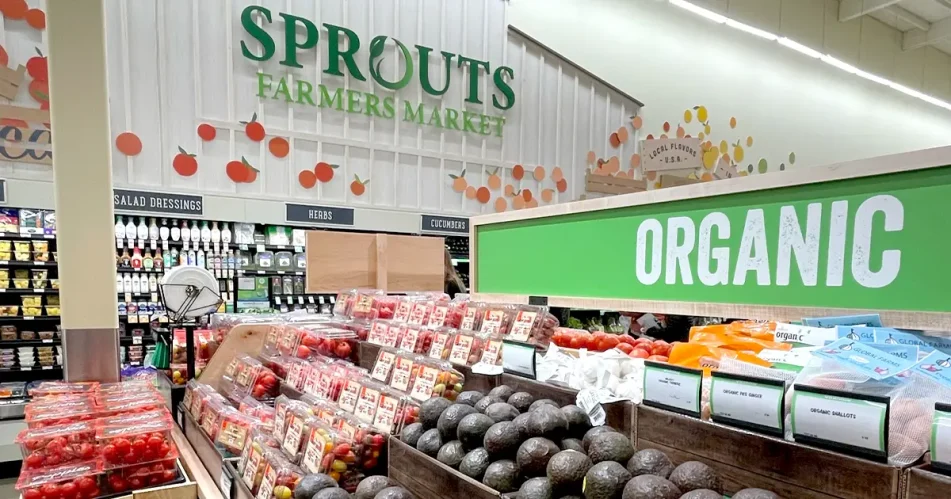
Sprouts Farmers Market reported second-quarter net sales of $2.3 billion, up 5 percent from a year earlier, though comparable store sales slipped 1 percent as the specialty grocer lapped a year-ago surge and worked to move value-conscious customers in a cautious spending environment.
The Phoenix, Arizona-based retailer’s net income was $129 million for the quarter. It opened seven stores during the period, reaching 490 locations in 25 states.

“Our second quarter results were in line with our expectations, and the core elements of our strategy remain strong,” said Jack Sinclair, CEO and board director at Sprouts, during the quarterly earnings call. “New stores continue to perform well. Our differentiated and attribute-based assortment continues to resonate, and our teams are moving with urgency to sharpen value, improve communication and support customers in the areas that matter most.”
Sinclair added that customers continue to make “thoughtful choices around the healthy grocery spend, and we continue to face difficult year-on-year comparisons.
“With that said, our most difficult prior-year comparisons are behind us and become more manageable as the year progresses.”
Comp cadence and the June dip
The 1 percent comp decline marks a reversal from the outsized growth Sprouts posted through 2025. Comps improved sequentially through May before June, the quarter’s weakest month, when the grocer lapped a strong prior-year produce season and a natural and organic supply chain disruption that had sent extra customers to its stores last year, said CFO Curtis Valentine during the quarterly earnings call. Those tough comparisons are now behind the company, and July returned to slightly negative results in line with guidance.
Valentine said the back half faces no comparable year-ago disruptions, so month-to-month comparisons should ease as the year progresses. Management expects sequential improvement in traffic and units, but not from average unit retail.
The company also flagged an emerging factor: a cyclospora outbreak affecting lettuce and salad items over the prior two weeks, which has shifted some customers from fresh to frozen. Sprouts added that it has had no product recall impact in its stores.
E-commerce and Sprouts brand outperform
E-commerce sales grew more than 12 percent and represented about 16 percent of total quarterly sales, a bigger driver of the quarter than expected. Sprouts brand products continued to outperform the rest of the business at 26 percent of sales, and organic offerings now exceed 30 percent of total sales, including more than half of dairy and produce, the grocer said.
Gross margin was 38.7 percent, down 12 basis points year over year, reflecting loyalty investments and elevated fuel costs partially offset by self-distribution benefits and vendor participation.
Shopper behavior
Executives offered their insights on a customer under pressure. Across the board, shoppers are managing the last item in the basket, with produce – the largest unit category in the average Sprouts basket – taking the biggest hit. President and COO Nick Konat said the company’s less engaged, lower-income customers have been the hardest to move and are spreading out their trips, while the core customer has remained resilient.
A first-half affordability test produced mixed results, improving unit movement more than traffic. Konat detailed a three-pillar response centered on assortment, including $29.99 family meals and fresh-made salads priced under $9; Sprouts brand innovation such as seed oil-free frozen potatoes and $4 organic sourdough; and price, promotion and personalization efforts the company is still refining.
The grocer launched about 1,300 new items in the quarter, emphasizing organic, seed oil-free, fiber, gut health and protein, and said recent innovation is significantly outperforming the overall store.
Accelerating store growth
Sprouts raised its 2026 opening plan to 42 net new stores, slightly ahead of original guidance, reflecting 43 openings and one closure of an underperforming store with an expiring lease. It expects to open at least 15 stores in the third quarter – its largest quarterly cadence to date – supported by a pipeline of more than 110 executed leases and 155 approved sites.
New stores continue to outperform, with the last four vintages comping positive even as the core is challenged, Valentine said.
The company is pushing into newer Northeast and Midwest markets, including Long Island and, in 2027, Chicago, where it aims to reach 10 stores within 12 to 18 months of entry to build density faster.
Sprouts also completed its meat self-distribution rollout with the opening of its Northern California distribution center, which now supports fresh meat to nearly 85 percent of stores, and is beginning to bring select Sprouts brand items in-house.
Outlook
For the third quarter, Sprouts expects comparable store sales of negative 0.5 percent to positive 1.5 percent and more new store openings than a year ago, company officials said.
For the full year, on a 52-week basis, the company guided to net sales growth of 5.5 to 6.5 percent and comparable store sales of negative 0.5 percent to positive 0.5 percent. Sprouts noted that fiscal 2026 is a 53-week year, with the extra week in the fourth quarter, which it estimates will add about $200 million in sales.
Leave a comment