
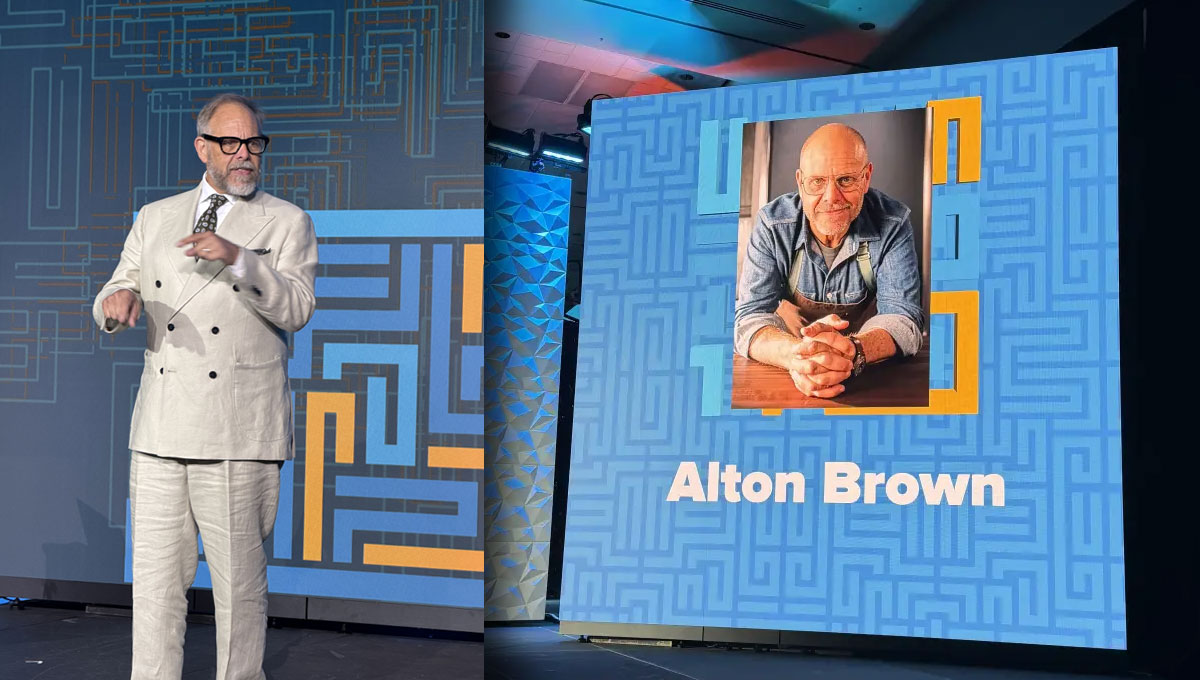
The chef, author and filmmaker told dairy, deli and bakery pros that “Survivor,” Facebook, the iPhone and PowerPoint rewired how Americans relate to food, and that the fresh perimeter is positioned to rebuild the connection technology stripped away.
ORLANDO, Fla. — Alton Brown took the General Session stage at IDDBA 2026 with a deceptively simple question: How did the world of food get to where it is now? His answer, delivered with the showmanship of a touring performer, traced four cultural forces he only half-jokingly called the riders of a “changepocalypse,” then turned them into a road map for grocery’s fresh departments.
Brown, the Peabody and James Beard Award-winning creator of “Good Eats” and host of “Iron Chef America” and “Cutthroat Kitchen,” appeared at the International Dairy Deli Bakery Association’s annual show, held June 7-9 at the Orange County Convention Center. The event drew more than 10,000 industry professionals and 1,000-plus exhibitors under IDDBA’s refreshed “Thinking Outside the Aisle” brand.
The four riders of the ‘changepocalypse’
Brown argued that four developments, none of them obviously about food, reshaped the way people cook, shop and think about what they eat.
The first was “Survivor.” The reality competition, adapted from a Swedish format, gamified daily life and normalized tribalization, he said. For Food Network, this development pushed programming away from instruction and expertise toward competition, and it trained audiences to treat food as a performance to be judged rather than something to be enjoyed.
The second was Facebook, which Brown noted arrived in the U.S. only around 2006 yet reordered society faster than the printing press once did. Social media turned ordinary lives into timelines under constant observation, he said, and made food a marker of identity, taste and even morality. Rather than uniting people, food online tends to splinter them into thousands of small communities defined as much by what they reject as by what they share.
The third was the iPhone, which Brown said delivered never-ending connectivity and turned everyone into a media company.
“The camera eats first,” he told the room, describing how the image of a dish can now matter more than the dish itself.
He recounted that his wife, a restaurant designer, sees operators worry less about flattering lighting than about whether a phone will cast a shadow over a plated photo. Customers pay money, Brown said, but audiences pay attention, and no business today can keep the former without tending to the latter.
The fourth, and the one he framed as the hidden culprit, was PowerPoint. Its bullet-point hierarchy strips out nuance and reduces communication to a deck, he argued. Food product positioning now follows the same template: a problem, an insight, a solution, proof points and a takeaway that promises to help the shopper become a more authentic version of themselves.
How shoppers changed
From those four forces, Brown drew a series of shifts he said anyone in the food business should understand.
- Authority has given way to influence. Expertise alone no longer commands attention, he said; shoppers follow people they find relatable. That, he argued, is an opening for retailers, because every employee who interacts with a customer has a chance to build a relationship and shape behavior.
- Preference has given way to identity. Brown said he has met shoppers, many of them young, who buy foods they do not even like because doing so signals who they want to be. People no longer buy only what they enjoy, he said, but what says something about them.
- Value has given way to values. Price is now only one side of the scale, Brown said, describing consumers who will wait in line for an expensive doughnut while buying the cheapest toilet paper they can find. National brands, increasingly read as corporate and therefore suspect, are losing ground, while signature and house brands give retailers a way to share values and earn trust.
- Gourmets have given way to foodies. For the first time, Brown said, a generation has more taste than skill. Younger shoppers know a great deal about food but rarely cook day to day, leaning on grab-and-go even as they prize quality. Selling a commodity such as onions means little to them, he said, but a knowledgeable cheese clerk who can speak their language is a genuine draw.
From claims to narrative
Brown said the old branding formula of “declare, display and dominate” has been replaced by what he called the three Ps: promise, prove and participate. A brand must make a promise, back it with proof and then stay present in the customer’s life because shoppers now expect to be treated as an audience and not just a transaction.
Closely tied to that, he said, the industry has moved from making claims to telling a narrative. A product once needed only to assert that it tasted good or was good for you. Now it needs a story that is transparent, passionate and reflective of the maker’s values because people respond to narrative far more than to claims. Even a maker of prepackaged salad, he said, needs one.
Underlying all of it is a shift from aspiration to authenticity.
“We used to crave things,” Brown said. “Now we crave what the thing says about us.”
Ownership, and even flavor, increasingly take a back seat to the story a purchase tells about the buyer.
Brown went further, rejecting the popular notion of a generational shift. What is happening, he said, is closer to species-level evolution accelerated by technology, and he warned that the day artificial intelligence learns to taste food will be a turning point for everyone in the business.
Food’s ‘only magic power’
For all the disruption, Brown closed on an optimistic and pointed note for his audience: Food’s only magic power, he said, is bringing people together, and that is precisely where grocery’s fresh departments hold an advantage.
The reason shoppers gravitate to the deli and bakery, he said, is the human connection: someone making food by hand and passing it across the counter, still warm. With fewer families cooking at home and fewer shared meals, the store has become one of the few remaining places where that connection happens. He said he would rather sell more kitchen tables and see people eating together at home, but he will take the connection wherever it can be found.
“You guys are in a wonderful place to make that happen,” Brown told the room.