

Financial pressure isn’t killing perimeter sales – it’s reshaping them. Gen Z and Millennials are about to become the top spenders. And protein, artificial intelligence-driven shopping lists and “mental load of the menu” solutions are the new battlegrounds. Here are the data-backed takeaways from 210 Analytics’ Anne-Marie Roerink at this year’s IDDBA show.
The pace of change in the perimeter is not slowing down – and that, said Anne-Marie Roerink of 210 Analytics, is exactly why grocers need to understand it.
“Over the last five years, we have seen an unprecedented amount of change in our industry,” Roerink told a packed room during the Industry Trends Presentation at the IDDBA show. “The next five years are going to have an equal amount of change.” The better retailers understand it, she said, the more they can shape their own opportunities rather than let the market dictate them.
The research behind the session – IDDBA’s 2026 trends report, “From Brie to Brioche: The Top Trends in Dairy, Deli and Bakery” – paired what shoppers say with what they actually do: a May 2026 survey of 1,555 consumers, retail sales data from Circana’s MULO+ universe, and merchandising examples from more than 100 stores across 15-plus countries. The program was made possible by Tyson.
Beneath the category swings, Roerink pointed to three undercurrents. The first is financial – sustained inflation has shoppers in a constant balancing act, though “it is not a race to the bottom.” The second is demographic, a “tidal wave” shifting spending toward Gen Z and Millennials. The third is the redefinition of health, now a continuum running from functional benefits all the way to pure indulgence.
Where the growth is hiding
Most of the store is posting higher dollars, but much of that lift is inflation, not demand – units tell the real story. Total-store dollars rose 3.1 percent to $964 billion in the 52 weeks ending March 29, while units grew just 0.8 percent.
On the perimeter, meat and deli were, in Roerink’s words, “the MVPs of the grocery store.” Meat led all departments in dollar growth at 6.5 percent, while the deli department, at $56 billion, posted the strongest perimeter unit growth at 2.1 percent.
Bakery and seafood were the only departments to lose units. The bigger lesson, she stressed, is that every department holds pockets of growth for those willing to dig deeper.
| Category | L-52-week sales | Dollars vs. year ago (percent change) |
Units vs. year ago (percent change) |
|---|---|---|---|
| Dairy | $90 billion | +0.7 | +1.7 |
| Bakery | $49.3 billion | +0.7 | -1.4 |
| Deli meat | $8.6 billion | +0.3 | -1.9 |
| Deli cheese | $9.1 billion | +4.0 | +2.6 |
| Deli prepared | $31.7 billion | +3.7 | +3.3 |
Source: Circana, Integrated Fresh, Total U.S., MULO+, 52 weeks ending 3/29/2026
Dairy: protein powers the gains
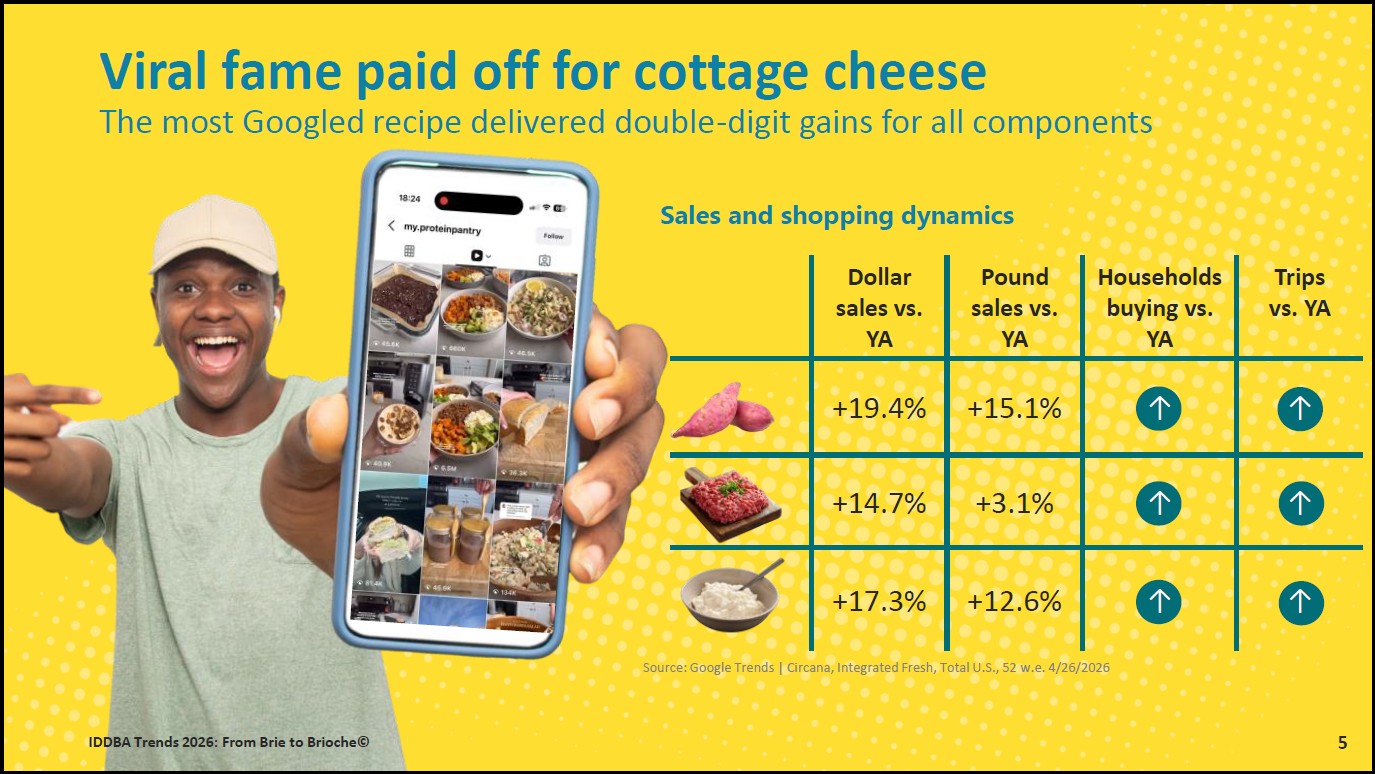
Dairy reaches virtually everyone – 99.4 percent of households buy it – so growth comes from getting shoppers to reach for more. Units rose 1.7 percent, powered by protein: yogurt added 214 million units (up 4.9 percent) and eggs 48 million (up 1.8 percent), but the standout was cottage cheese, up 12.9 percent.
The reason was social media, Roerink said. Cottage cheese-and-avocado toast was among the year’s most-Googled recipes, and it delivered double-digit gains across its components. “Try to find them as early as possible, because it is working,” she noted.
Bakery: soft units, bright spots on the perimeter
Bakery is the category she flagged for attention, with units down 1.4 percent. But every winner sat on the fresh perimeter, tied to breakfast or celebrations.
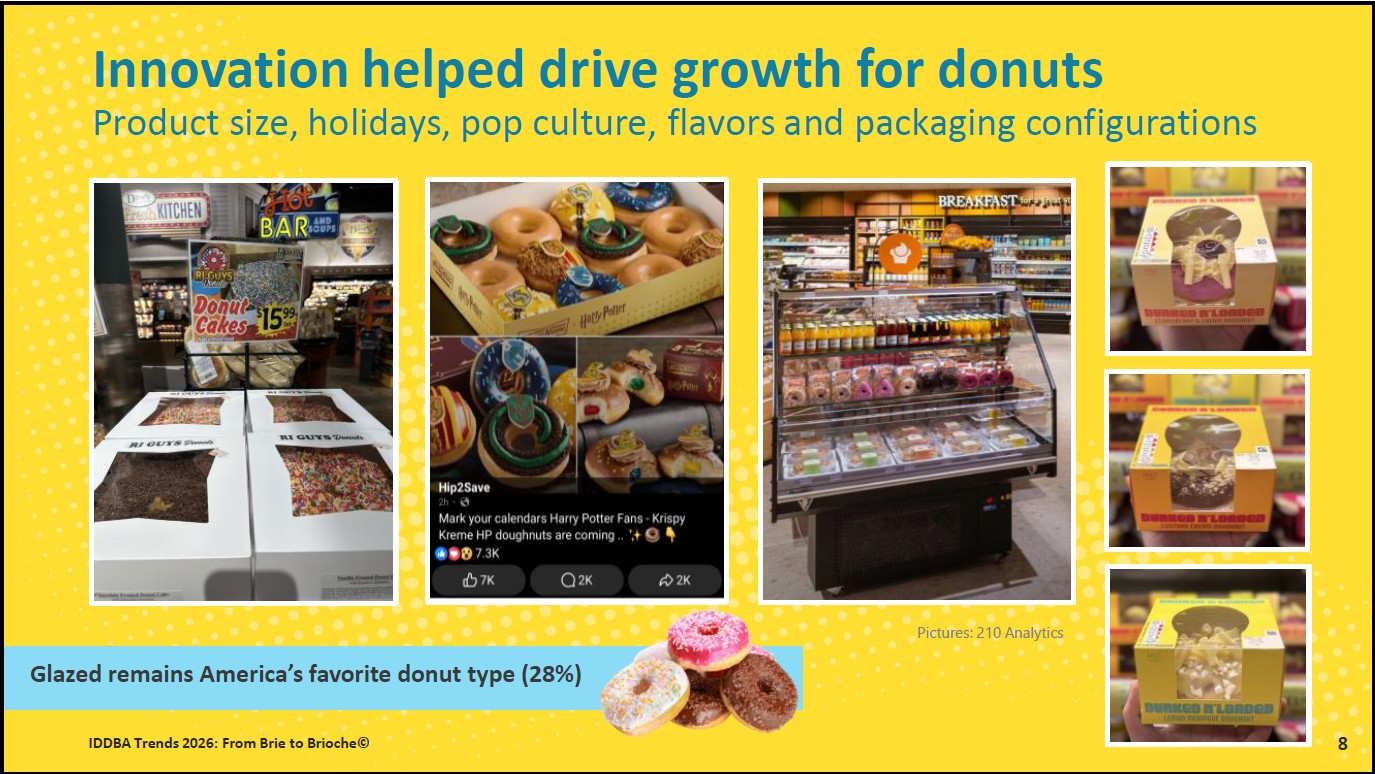
Cake led, and doughnuts – though small – added nearly 15 million units on the strength of innovation: doughnut cakes for weddings and showers, pop-culture tie-ins and unboxing-ready packaging. Glazed remains America’s favorite doughnut type at 28 percent.
Deli meat: convenience is the lifeline
Deli meat remains under pressure, with units down 1.9 percent, and the growth is all in convenience. Grab-and-go ham (up 7 percent) and grab-and-go pepperoni (up 20.5 percent) led.
Roerink pointed to high-protein sandwiches and all-in-one sandwich kits as a way to win back younger shoppers, who under-index on deli meat but love sandwiches.
Deli cheese: the growth powerhouse
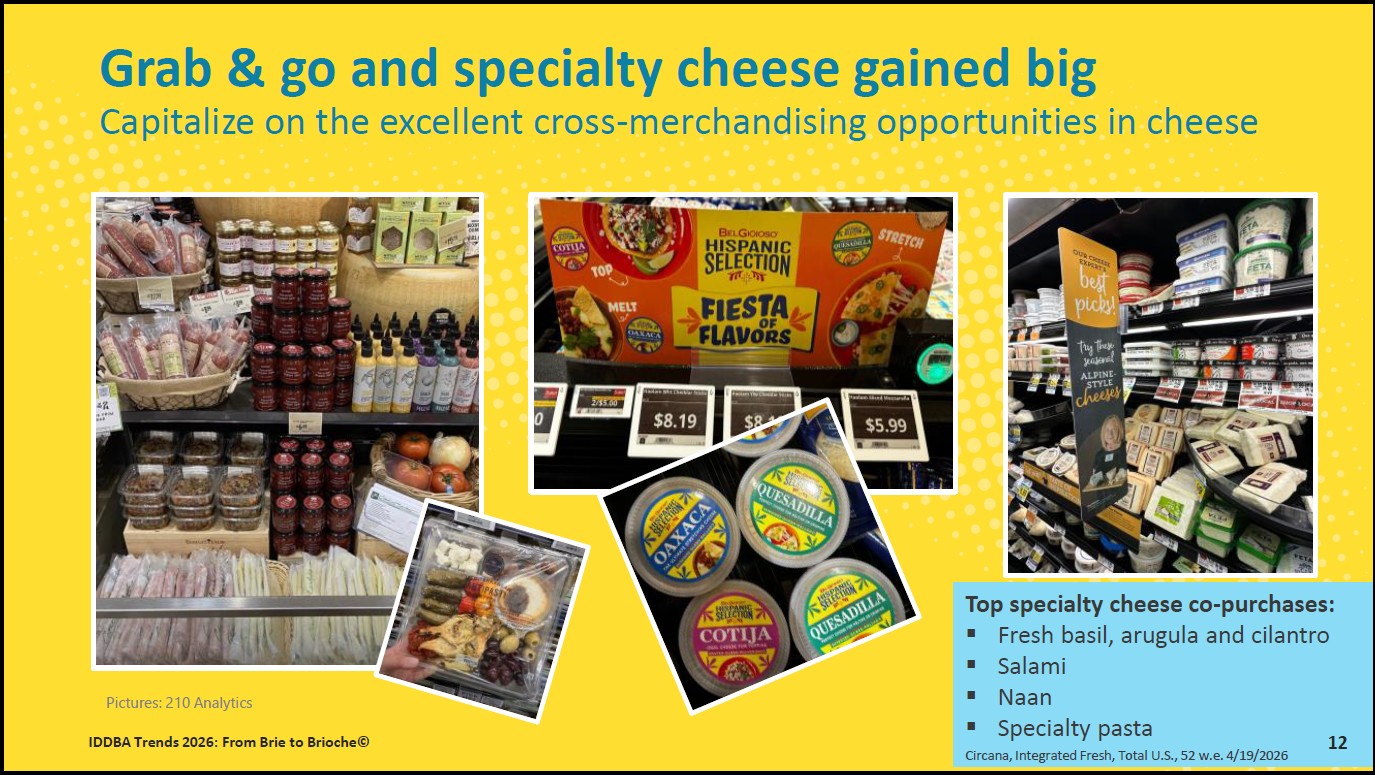
Deli cheese was the growth powerhouse, with dollars up 4 percent. The charcuterie trend many assumed had peaked “continues to be huge,” fueled by protein and at-home entertaining, with specialty mozzarella, Hispanic and parmesan leading.
Roerink called it the store’s best cross-merchandising category, with top co-purchases including fresh herbs, salami, naan and specialty pasta.
Deli prepared: the restaurant replacement
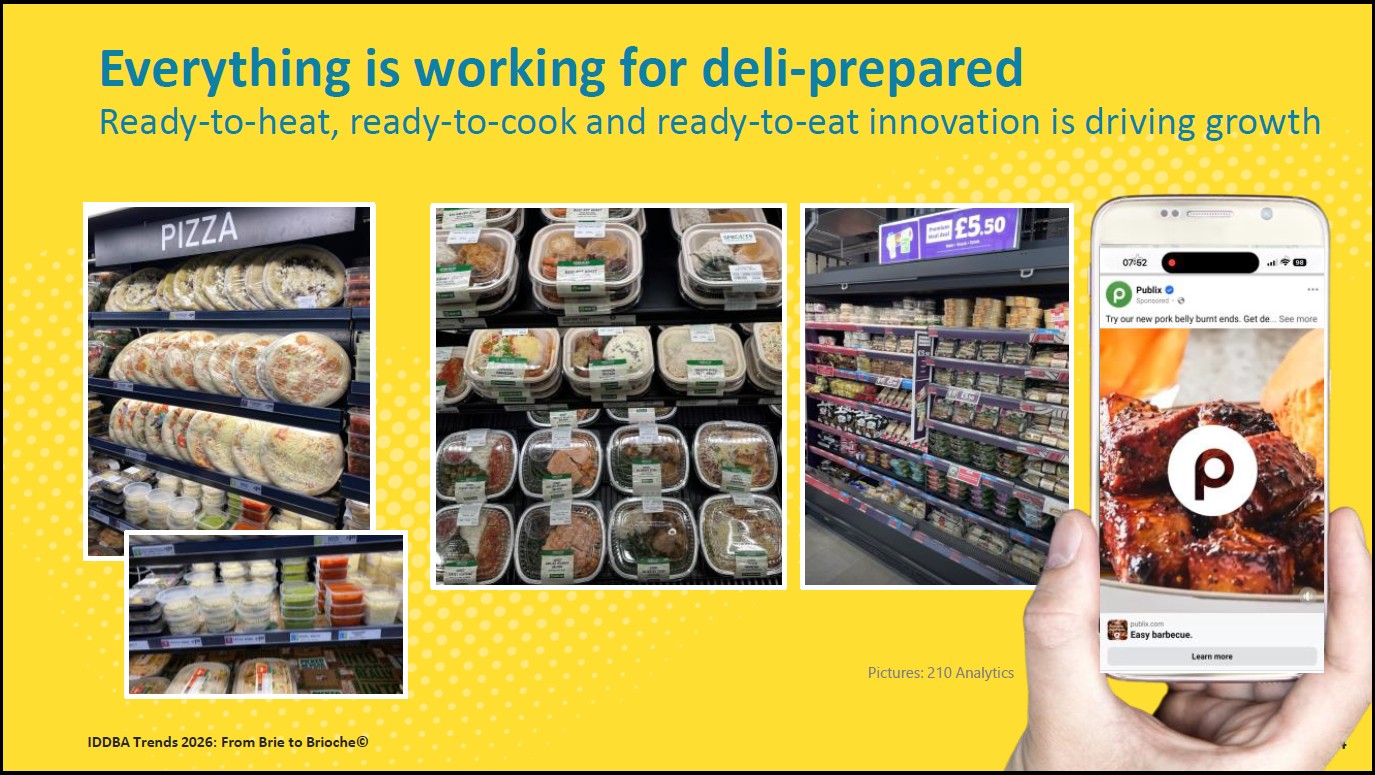
Deli prepared delivered the coveted “stair-step” in dollars and units as it cements its role as a restaurant alternative, with entrees, sandwiches and appetizers all posting strong gains.
The momentum is generational – 18 percent of consumers are buying deli-prepared more often than a year ago, rising to 33 percent of Gen Z. And the top driver isn’t price. “Ultimately, every single purchase is driven by taste,” Roerink said.
Great taste and great value tied as the leading reasons, each at 47 percent.
Spending with purpose
The average price per unit across food and beverage now runs about 40 percent higher than in 2019, and 52 percent of shoppers are concerned about the cost of living.
But pressure hasn’t meant elimination – consumers are recalibrating what they buy (64 percent), how much (62 percent), where they shop (57 percent) and which brands they choose (67 percent). On pack size, the market splits down the middle: 55 percent trading up to family packs for long-run value, 45 percent trading down for a lower price point.
Promotions remain powerful. Before a trip, 83 percent check promotions at their main store, while 85 percent say they buy only what and how much they need – driving more trips with fewer items each, and putting the burden on merchandising.
The counterpoint: 92 percent of shoppers can be persuaded to spend a little more than planned, most often for a brand they like (42 percent) – a reminder, Roerink noted, not to count manufacturer brands out even as private brands gain ground.
A new chapter
After three decades of boomer dominance, Gen Z and Millennials are poised to become the top spenders within two to three years – Millennials, Roerink noted, will qualify for AARP in four to five.
Boomers still hold the largest share of unit sales at 33.4 percent, but the growth is at the bottom of the age curve, with Gen Z units up 6.2 percent while the Silent Generation fell 8.3 percent. Because younger shoppers favor different products and formats, that transfer is reshaping demand category by category – cottage cheese and tortillas surging, processed cheese and center-store bread declining.
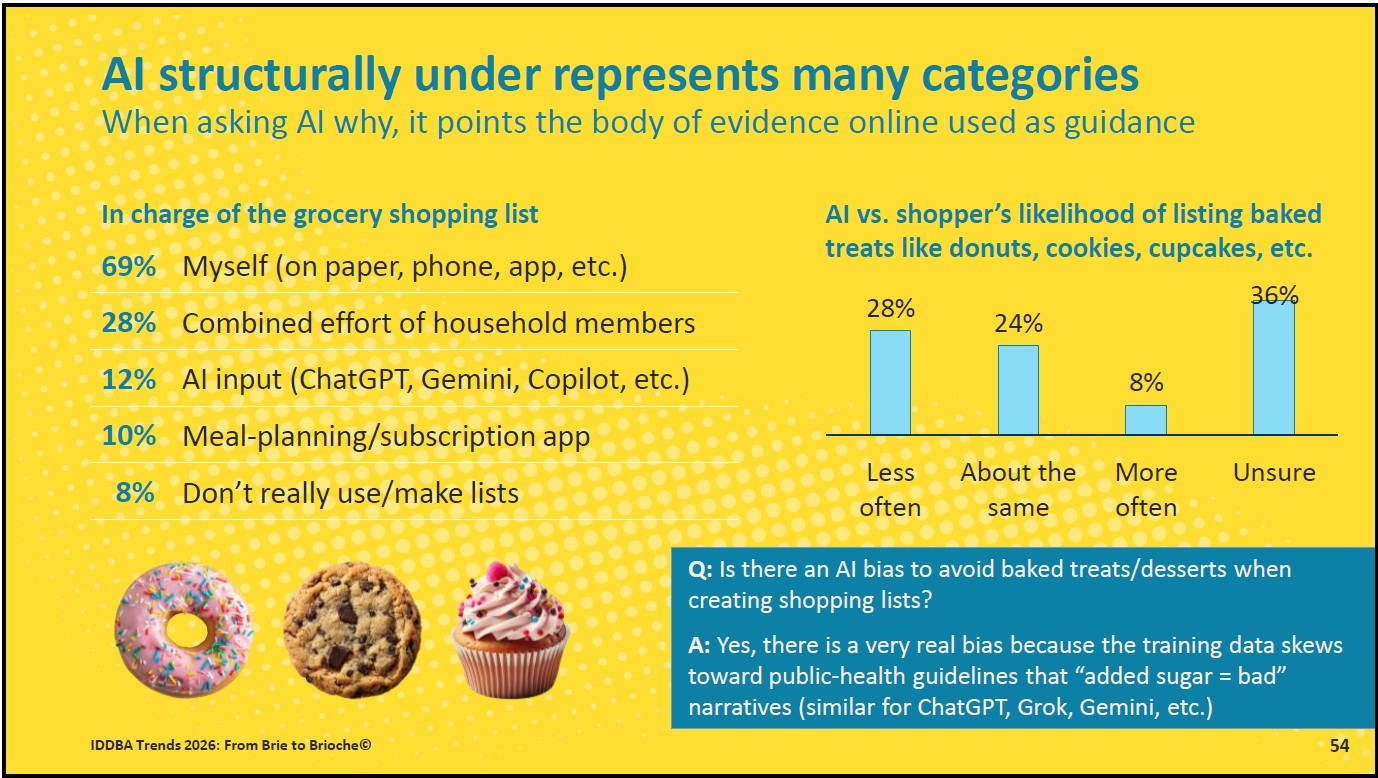
Their habits diverge, too. Boomers run on routine and print; Gen Z lives in digital, with 55 percent drawing inspiration from social media. AI also is making fast in-roads – 13 percent of shoppers now use AI tools for meal planning, jumping to 27 percent of Gen Z.
That carries a warning: AI-built lists surface indulgent items like cookies and cupcakes far less often, a bias the tools themselves acknowledge stems from training data that treats added sugar as bad. Keeping treats in the basket will take a renewed permissibility story.
The pursuit of better
Health has been redefined, with 93 percent of consumers now seeing physical health and emotional well-being as interconnected, but that hasn’t crowded out indulgence.
Some 88 percent say it’s fine to occasionally enjoy a treat, and 89 percent view baked treats as a holiday tradition. The opportunity, Roerink said, is to stock the full continuum, from “wellness by the bowlful” to “new decadent cookies.”
Protein is the loudest signal. Six in 10 consumers follow a lifestyle diet, high protein chief among them, and protein-claim units are up 27.5 percent in deli and a striking 80.4 percent in bakery.
With about 15 percent of consumers now using GLP-1 medications, demand is tilting further toward protein, smaller portions and nutrient density. Two more shifts are building – 30 percent of shoppers say removing artificial colors is extremely important, and 28 percent seek clean-label products.
Underpinning it all is transparency – 91 percent want to know more about how and where their food is made, with the package label the most-wanted source.
Five ways to win
Roerink closed with a framework for what’s ahead:
- Financial pressure has few consumers eliminating categories, but many recalibrating across types, cuts, brands and stores.
- The demographic tidal wave is reshaping meal and channel choices, with millennials likely to be the top spender within two to three years.
- Health has become a major sales driver, with room for pure indulgence alongside a functional focus on protein, GLP-1s, whole foods and the MAHA movement.
- Continue to educate and provide choice in areas such as animal welfare and environmental sustainability.
- Celebrate taste – help shoppers create permissible, nutritious and delicious treats and meals that keep them coming back.
Perhaps the most resonant line of the session came from a shopper describing the daily grind of feeding a family as “the mental load of the menu.” For Roerink, that is the whole opportunity. “We have an opportunity to be the answer to the mental load of the menu,” she said.
The full IDDBA Trends 2026 report is available through the IDDBA conference app or at the website here. Questions can be directed to Anne-Marie Roerink at 210 Analytics.