
by Brian Numainville / principal,
The Feedback Group
Supermarket retailers watching loyalty scores climb steadily with shopper age could be forgiven for assuming the pattern is a straight line.

Findings from our new Supermarket Experience Study 2026 shows it isn’t. There’s a dip in the middle, and it’s easy to miss.
Net Promoter Score, a measure of how likely someone is to recommend a supermarket, rises from 52 among Gen Z shoppers (ages 18–29) to 65 among Baby Boomers and 70 among the Silent Generation.
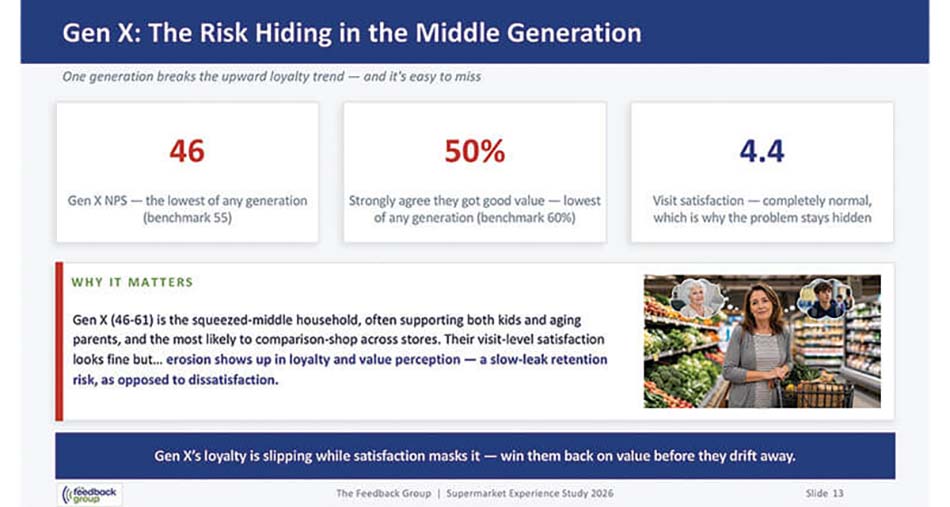
Millennials sit at 52 as well. But Gen X, shoppers ages 46 to 61, breaks the trend, posting an NPS of just 46 against a study-wide benchmark of 55. It’s the lowest score of any generation measured, and it sits in a generation most retailers aren’t watching closely.
Satisfaction looks fine; loyalty says otherwise
Here’s what makes this finding tricky: Gen X shoppers rate their most recent visit at 4.4 on a five-point scale, essentially in line with other generations. If we were tracking only visit-level satisfaction, it would look like nothing is wrong.
However, value perception tells a different story. Just 50 percent of Gen X shoppers strongly agree they got good value from their visit, the lowest of any generation and well below the 60 percent benchmark. That gap between “the trip was fine” and “I received a good value” is where the erosion is happening.
Consider that Gen X is, generationally speaking, the household most likely to be supporting kids and aging parents simultaneously. They’re stretched financially in ways younger and older shoppers typically aren’t and, like other shoppers, are visiting multiple stores and formats.
That combination – financial pressure plus comparison-shopping – means dissatisfaction doesn’t show up as a bad visit. It shows up as a slow drift toward a competitor down the street.
Why this segment hides from view
Retailers tend to build service recovery and loyalty programs around visible dissatisfaction, including complaints, low visit scores and negative comments. Gen X isn’t generating those signals. Their visit satisfaction looks good, which is why the problem stays hidden until they just stop coming back.
This is a retention risk rather than a service failure, and it calls for a different response. Fixing a bad checkout experience is straightforward. Fixing a perception that prices aren’t a fair trade for what’s in the cart requires a harder look at pricing communication, promotional relevance and private label visibility for a shopper who’s watching every dollar.
Further, this generation is large enough that the erosion compounds. Gen X represents a meaningful share of grocery spending, particularly as heads of households shopping for their families, often with kids, as well as guiding shopping for aging parents.
What retailers should do
A few starting points worth testing in your shopper base:
- Audit value communication specifically targeting Gen X: Are promotions, loyalty offers and private label messaging actually reaching this group or defaulting to marketing channels that skew older or younger?
- Track value perception, not just visit satisfaction, as a leading indicator. A satisfaction score alone won’t catch this.
- Pay attention to comparison-shopping behavior. If Gen X shoppers are splitting trips across your store and one or more competitors, understand what’s driving the split before it becomes permanent.
In the end
Loyalty doesn’t always erode the way retailers expect. A shopper can walk out satisfied with the visit and still be quietly checking out.
Gen X’s numbers present a clear example of that gap in this year’s data, and it’s a reminder that visit satisfaction and long-term loyalty are related but not the same measurement.
Retailers need to win over Gen X’ers before they walk out the door for the last time.
Brian Numainville is a principal with The Feedback Group, a firm specializing in consumer and employee research for food retailers and distributors. He can be reached at [email protected].