
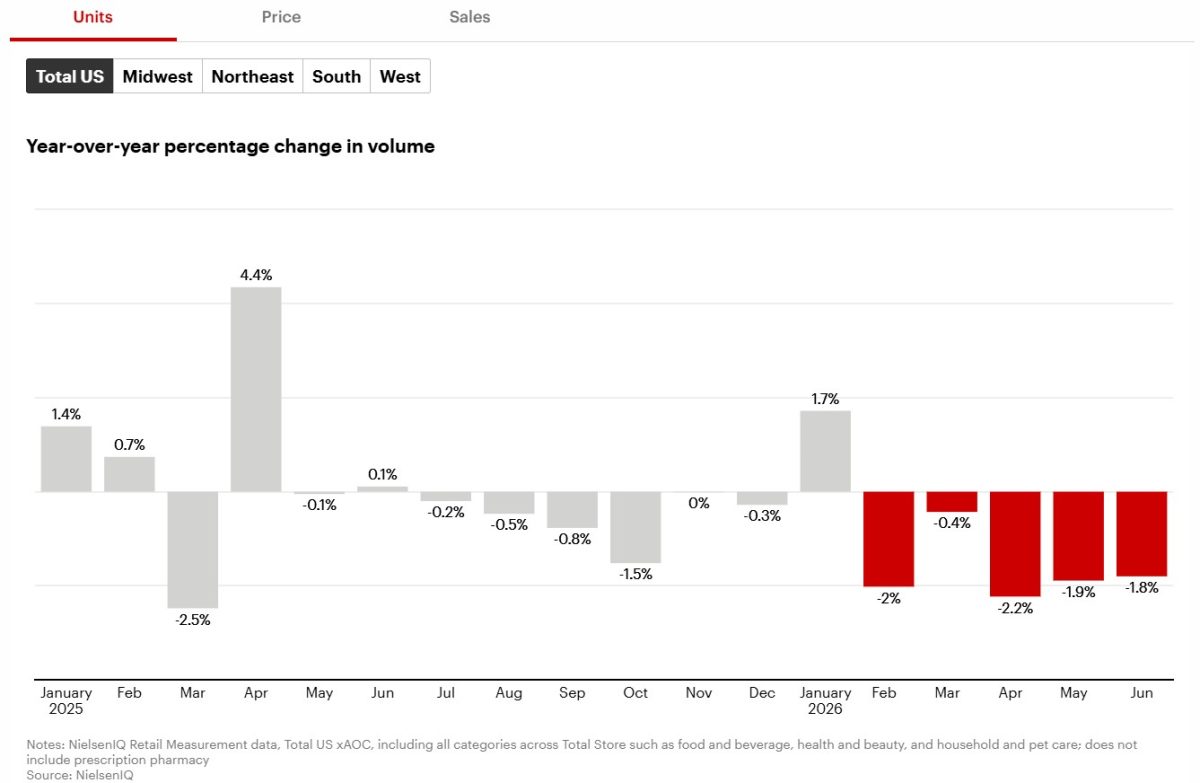
The U.S. grocery slowdown has entered a new phase of falling unit sales as stretched consumers pull back and purchase fewer items, according to a new analysis from Bain & Company and NielsenIQ.
The slowdown began in mid-2025 with negative unit growth but has accelerated since February. Units sold have dropped by around 2 percent year over year in most of the four months through June, consistently across U.S. regions. In June, units sold were down 1.8 percent year over year, marking a nearly two percentage point deterioration in a single year. The declines come even as grocery prices continue climbing at a rate of 2-3 percent annually.
No single cause
Bain’s analysis concludes that no single shock is to blame, but rather steadily building pressure on consumers that intensified this year. A sharp drop in Supplemental Nutrition Assistance Program (SNAP) participation late last year added stress on lower-income households, while gas prices climbed 20 percent in March. Those pressures compound a 33 percent cumulative rise in grocery prices since 2019 and slowing growth in disposable incomes.
In Bain’s latest Consumer Lab pulse survey, 80 percent of Americans reported trying to cut spending, with 28 percent actively trying to reduce grocery costs. Among those trimming grocery bills, 56 percent are trading down to lower-priced brands; 49 percent are buying fewer items; and 44 percent are leaning harder on coupons and promotions. The shift of some grocery shopping online, where shoppers typically opt for smaller baskets, and rising use of GLP-1 weight loss medications also are contributing to the pullback.
A share game
The consumer shift has turned grocery retailing into a share game, Bain found. Value players, including discounters, dollar stores, mass and club retailers, appear to be gaining trips as shoppers trade down, though the unit problem does not disappear even for them.
“The data is unambiguous: U.S. grocery is in a genuine volume contraction, and the path back to growth is not just about low prices, but a value story that shoppers believe in and come back for,” said Kurt Grichel, head of Bain & Company’s Americas Retail practice and co-author of the report. “Retailers that respond with precision, on assortment, promotion and private label, will be best placed to capture the trips that are still up for grabs.”
Bain said the grocers that pull ahead will be those that sharpen their value proposition, price competitively on the products that shoppers and AI shopping agents notice most, and use promotions, loyalty and private brands with precision.