
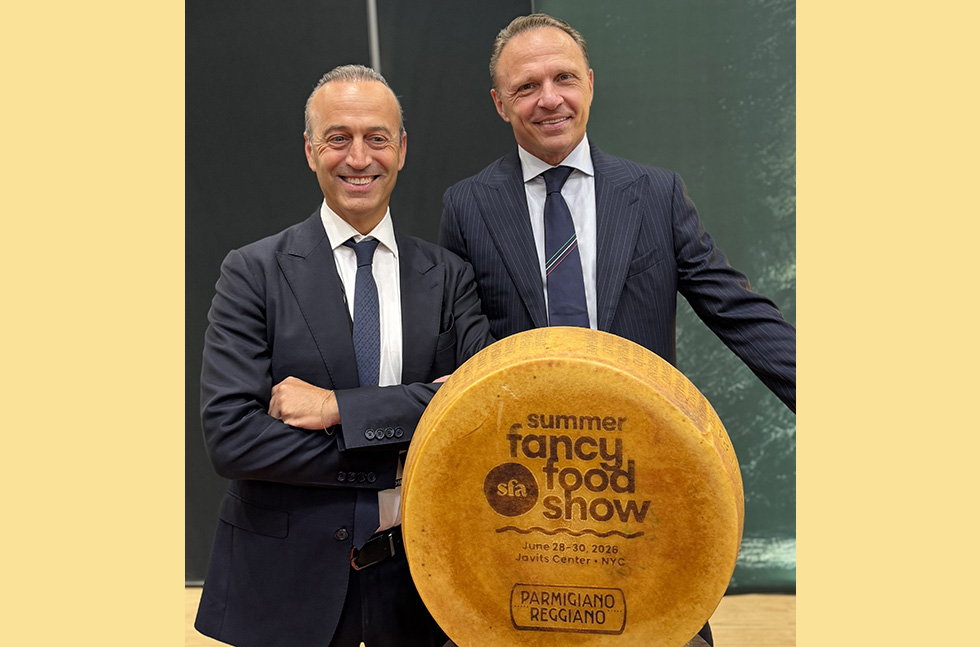
Parmigiano Reggiano’s growth in the U.S. will depend on more than increased sales; it will require the cheese to become part of the everyday culture of American people. That was the key message from “Inside Parmigiano Reggiano’s U.S. Growth,” an institutional and public relations panel hosted by the Parmigiano Reggiano Consortium on June 28 at Summit One Vanderbilt in New York City.
The discussion, led by Consortium President Nicola Bertinelli and moderated by journalist Francesca Forcella, brought together representatives from retail, distribution, media, sports, institutions and the Italian-American business community to explore the next phase of growth for the Protected Designation of Origin (PDO) cheese in North America. The panel focused on how Parmigiano Reggiano can evolve from a well-known imported cheese into a culturally relevant premium icon embedded in American lifestyle, and on the role that retailers, distributors and industry partners can play in helping shoppers better understand, find and enjoy the product, according to the Consorzio Parmigiano Reggiano’s USA press office.
A daily cheese habit
 Recently released data from the Consortium shows that the U.S. remains the PDO’s primary foreign market, with exports up 2.5 percent in the first five months of 2026 vs. the previous year – totaling about 7,000 tons. Parmigiano Reggiano’s international growth continued in 2025, with exports exceeding half of total sales for the first time, reaching 50.5 percent (74,980 tons), up 2.7 percent year over year.
The U.S. further strengthened its position as the leading export market, with shipments increasing by 2.3 percent to 16,800 tons, accounting for 22 percent of total exports.
“The question we want to ask ourselves is not merely how to increase awareness, but how to become part of Americans’ habits, actions and daily lives,” Bertinelli said.
“How do we transition from being an ‘imported specialty product’ to becoming a culturally relevant premium icon? How do we build an emotional – rather than just commercial – connection with the consumers? We must invest in communication and strengthen our presence at the point of sale. That’s why we have doubled our investment in communications across the U.S. market. We need to help retailers articulate what makes the product unique. We need to train the people who cut, portion, present, serve and recommend the product. We need to establish Parmigiano Reggiano as a recognizable protagonist of contemporary American food culture.”
Cheese as economic engine
The evening emphasized how Parmigiano Reggiano can enrich not just Italy, but also the U.S.
Each wheel introduced into the American market generates economic activity throughout the entire supply chain: importing, distribution, logistics, retail, foodservice, training and communication, creating jobs and opportunities. Speakers included representatives from the National Italian American Foundation and the Italian Trade Agency. Closing remarks were delivered by Bertinelli, together with Marco Peronaci, Ambassador of Italy to the U.S., and Francesco Lollobrigida, Italy’s Minister of Agriculture.
The event gathered more than 100 representatives from American and Italian retail, distribution, trade associations, institutions, media, importers, distributors, and industry stakeholders.
About Parmigiano Reggiano
For nearly 1,000 years, Parmigiano Reggiano has been produced exclusively in the Italian provinces of Parma, Reggio Emilia, Modena and parts of Mantua and Bologna. The cheese is made with three ingredients: cow’s milk, salt and rennet. Aged a minimum of 12 months – most available in the U.S. is aged 24‑36 months – the cheese is naturally lactose‑free with no additives or preservatives.