
Circana recently released its 2025 New Product Pacesetters research and top 200 list, recognizing the most successful product launches across food, beverage and nonfood consumer packaged goods sectors. The class of 2025 generated a combined $6.2 billion in year-one multi-outlet sales.
Now in its 31st year, the Pacesetters program tracks new product launches that achieve at least 25 percent distribution within total U.S. multi-outlet plus, measured across 13 quad weeks. The 200 products on the list represent just 1 percent of total store dollars but are driving 21 percent of the dollar growth contribution to total store sales in 2025. 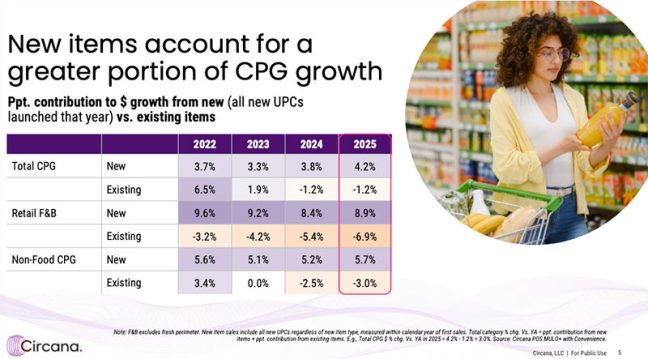
In a recent webinar, Sally Lyons Wyatt, EVP and global advisor for Circana, said the stakes around innovation have never been higher.
“Innovation isn’t optional anymore, it’s universal,” she said. “The biggest risk in CPG today isn’t a failed launch – it’s failing to launch. Innovation isn’t just a strategic priority – it’s the growth engine.
“The brands breaking through are the ones meeting consumers where they are: balancing health with enjoyment, fusing brand equities through smart collaborations and showing up in digital spaces where discovery now begins. The playbook has fundamentally changed, and the companies that recognize that are the ones on our Pacesetters list.”
Circana data shows that in 2025, new items contributed 4.2 percentage points of growth to total CPG while existing items dragged by negative 1.2 points – meaning the existing base would have produced a net decline without new product contributions.
Earnings reports underscore the industry’s commitment: 92 percent of food manufacturer quarterly reports in 2025 mentioned innovation, up four points from the prior year.
Median year-one sales across both food and beverage and nonfood Pacesetters stood at $19 million, within the 10-year range of $14 million to $19 million. Circana noted this reflects a continued industry focus on targeted, personalized innovations rather than solely pursuing blockbuster launches.
Top 10 lists
Kendamil Infant Formula ranked No. 1 among food and beverage Pacesetters, delivering more than $300 million in first-year sales.
The U.K.-based organic infant formula brand’s U.S. entry demonstrated that high-frequency repurchase can offset low trial rates – less than 1 percent of consumers tried the product in year one, but three quarters of them purchased again, reflecting both the frequency of feeding a newborn and a formula that doesn’t cause digestive issues.
The other top 10 food and beverage Pacesetters are Bloom Sparkling Energy, Red Bull The Pink Edition, Canada Dry Fruit Splash Cherry Ginger Ale, Oikos Pro Drinks and Oikos Pro Shots, Sprite Chill, Sparkling Ice Starburst, Topo Chico Sabores, Fruit Riot and and King’s Hawaiian Soft Pretzel Bites.
Luvs Platinum Protection landed the No. 1 nonfood spot, with $230 million in first-year sales. The other top 10 nonfood Pacesetters are: Gain Happy and Relax, Mr. Clean Antibacterial 2X Concentrated Cleaner, Huggies Skin Essentials, Downy Comfy Cozy, e.l.f. Glow Reviver Lip Oil, Secret Whole Body Deodorant, Pampers Swaddlers 360, Flowflex Plus COVID-19 and Flu A/B Home Test and Mr. Clean Magic Eraser Ultra.
The top 10 c-store Pacesetters are VELO Plus, C4 Performance Energy x Jolly Rancher, Zone Nicotine Pouches, Vuse Alto Prismatic Series, Gatorade Water Unflavored, BodyArmor Zero Sugar, Sprite Chill, Skittles Pop’d, Voodoo Ranger Tropic Force and MrBeast Feastables Chocolate Candy.
Four defining themes
Circana identified four themes across the 2025 Pacesetters class.
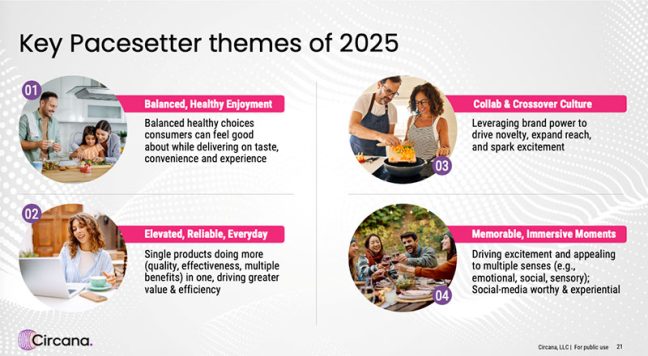 The first is balanced healthy enjoyment products. Taste or effectiveness ranked as the No. 1 purchase attribute at 80 percent, followed by price-value at 75 percent. More than a third of food and beverage Pacesetters are sugar-free introductions, with high sugar cited by more than 56 percent of consumers as the top ingredient they want excluded from new products.
Protein claims account for 6 percent of food and beverage dollars and 8 percent of total growth. Of the 200 Pacesetters, 21 carry a protein claim, representing more than half a billion dollars, or 15.5 percent of total Pacesetter sales.
The second theme is elevated, reliable everyday products delivering multiple benefits, quality and performance within a single item.
Lisa Maas, VP of innovation at Circana, noted that 25.3 percent of consumers cite added benefits as important when choosing new food and beverage products, and winning products deliver against that expectation without requiring consumers to change their behavior.
Third is collaboration and crossover culture. Co-licensed products now account for 10 percent of food and beverage Pacesetter sales, up from 7 percent a year ago. Just three co-branded nonfood Pacesetters represent 9 percent of total nonfood Pacesetter sales.
Licensing is a $365 billion global business, with the U.S. and Canada accounting for 59 percent of that total; within CPG food it represents approximately $18.5 billion and 11 percent of licensed unit sales.
The fourth theme is memorable, immersive moments – products engaging multiple senses to create experiences consumers share.
“This year’s Pacesetters class proves that winning innovation is about more than a great product – it’s about creating moments consumers want, share and come back to,” Maas said. “From Fruit Riot turning frozen fruit into a cultural candy moment to Red Bull Pink Edition bringing three million new households into the franchise, the most successful launches of 2025 engaged consumers on an emotional and sensory level.”
Discovery shifts
Circana’s research identified a fundamental shift in how consumers find new products. One in three consumers – 34 percent – now use artificial intelligence to explore new CPG options, while 25 percent have made a purchase based on a personalized AI recommendation. Forty-four percent use AI to find the best price, and 41 percent use AI-summarized reviews in place of scrolling individual reviews. 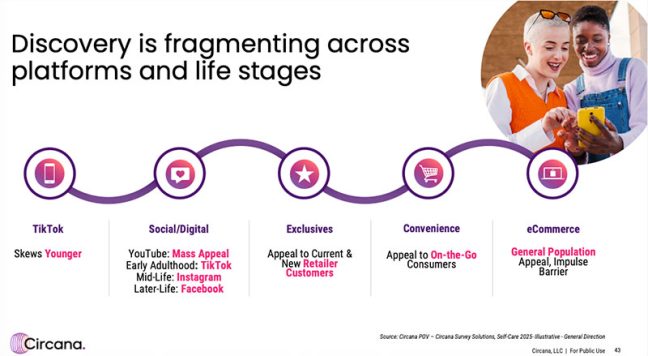
Gen Z and Millennials index highest as early adopters, at 140 and 126, respectively. Households with children also over-index in responsiveness to AI recommendations and influencer content.
Social commerce platforms, particularly TikTok Shop, are compressing the path from discovery to purchase. Maas described the current model as creator-led discovery driving in-app purchases, followed by proof-of-demand signals – sales velocity, repeat behavior and creator momentum – that brands then use to secure brick-and-mortar distribution.
Retailers are responding by using “as seen on TikTok” shelf tags as credibility builders with consumers, a dynamic Maas compared to the former “as seen on TV” era.
Fruit Riot, which generated $74 million in year-one sales, illustrated the model. The brand applied sour candy coatings to real frozen fruit, launching with high-traffic retailers and limited drops to create scarcity before expanding. The product was designed to provoke a reaction – something consumers would film, share and talk about.
Lyons Wyatt said the shift represents a reversal of the traditional launch playbook. Where brands once relied on the retail shelf as the primary point of discovery, the most successful new products today are discovered socially first, validated through online sales and reviews, and then scaled into physical retail.
E-commerce enables low-risk testing and rapid iteration, while social commerce compresses the entire funnel – a creator demonstration on TikTok or Instagram can move a consumer from awareness to purchase in a single scroll.
Among food and beverage categories, new product Pacesetters are generating about 22 percent more sales online than the category average, reflecting e-commerce’s outsized early role in driving trial and visibility before in-store scaling.
Long-term performance
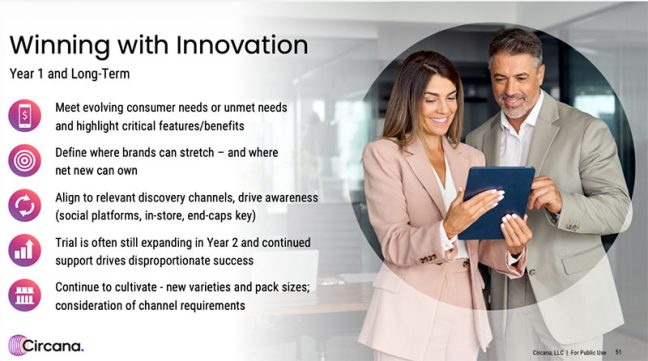 Maas cautioned that year-one success does not guarantee sustained growth. Looking at the 2023 Pacesetters class at the two-year mark, about 48 percent of products were still growing while 34 percent had already entered decline. By year four, about 38 percent remained in core growth mode while more than 50 percent were declining or barely holding steady.
Circana’s research shows that more than 30 percent of a new product’s trial potential continues to build in the second year and beyond, meaning brands that continue investing in media distribution and visibility after launch are better positioned to unlock long-term growth.
“Winning innovation requires ongoing cultivation. That means expanding into new varieties, formats or pack sizes and adapting to channel-specific needs to stay relevant,” Maas said. “The bottom line is that successful innovation is not a one-time event, it’s a multi-year strategy where continued investment, evolution and relevance are what ultimately separate short-term wins from sustained growth.”