
Fresh food sales are navigating a complex consumer landscape shaped by gas price pressures, affordability concerns and accelerating e-commerce adoption, according to insights shared during a recent webinar hosted by Circana and FMI.
The online session, “Fresh Perspectives: Demystifying Demand in the Digital Age,” brought together Jonna Parker, VP of fresh foods at Circana; Kelly Krumholz, perimeter client insights consultant at Circana; and Andrew Brown, senior manager of industry relations at FMI – The Food Industry Association.
Parker opened by framing the consumer environment heading into the second quarter of 2026, drawing on Circana’s most recent monthly shopper survey conducted in mid-April.
Eighty-six percent of U.S. households own gasoline-fueled or hybrid vehicles, and nearly half of primary grocery shoppers drive 100 miles or more per week – translating to an estimated $30 per week in additional household spending pressure.
“It is those key demos, younger households, especially those with children and low to middle income, who really are most affected by gas prices,” Parker said, “not just because they’re more cost constrained than Gen X and boomers, but because they drive more miles and are more likely to own gasoline-powered vehicles.”
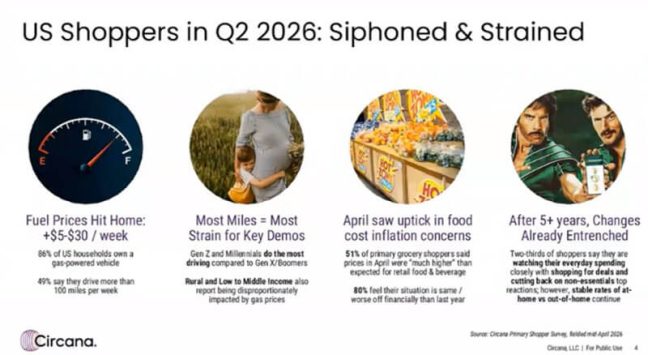
Fifty-one percent of primary grocery shoppers in April reported feeling that food and beverage prices at retail were much higher than a year ago, a notable uptick from Circana’s monthly tracking dating back to March 2020.
Parker noted that fresh foods, as among the most frequently purchased categories, are particularly visible targets for that perception. Despite the pressure, she said consumers are not reacting with the disruption response seen in previous economic cycles.
“After five-plus years post-COVID, consumers already know how to meet this moment of affordability,” she said. “Unlike a decade ago, or even five years ago, where a disruption like gas prices would have created a ripple effect in immediate and short-term change in retail food and beverage, we actually see this as yet another building point where consumers’ reactions to price changes will be colored by all of this.”
Traditional grocery losing ground
Total U.S. food and beverage represents a $1.6 trillion market; in the latest 52 weeks, up 3 percent. Retail commanded about 71 percent of dollars in the first quarter, bolstered in part by inclement weather. Parker noted basket size at retail has plateaued even as per-trip spending has increased, driven largely by higher prices in center store and frozen.
Traditional supermarkets have ceded five share points of the U.S. retail fresh foods market since 2022 to mass, club, dollar, specialty and value-format competitors. Categories where traditional grocery is gaining share – exotic meats, microgreens, broccoli cauliflower mixes, fresh-cut fruit, perimeter croissants and pies – total about $2.9 billion in available annual sales.
Categories where traditional grocery has lost five or more share points since 2022 – including beef, tomatoes, bananas, pork, deli-prepared entrees, deli-prepared meats and deli grab-and-go lunch meat – account for about $306 billion in annual value.
“Ultimately, we cannot stand for all things to all people all the time and expect consumers to keep rewarding us for it,” Parker said.
Among fresh demand growth leaders – categories increasing both sales and volume despite higher average prices – Parker highlighted beef, chicken, pork, dinner sausage, fin fish, deli specialty cheese and perimeter cakes. Perimeter cakes ranked as the fourth-largest dollar contributor to fresh foods in the latest 52 weeks, driven by consumers seeking affordable indulgence.
Categories showing softness included center-aisle sliced bread, packaged lunch meat and commercial buns and rolls – the bread and packaged lunch meat categories alone representing about $20 billion in combined sales.
Parker also noted a significant performance gap within traditional grocery on deli prepared foods. The top two deli prepared performers in the channel convert 72 percent of their shoppers to deli prepared buyers and generate nearly double the share of wallet of other traditional grocers, who average 44 percent conversion. A national limited-assortment value grocer, meanwhile, converts 54 percent of its shoppers to deli prepared buyers despite having no service counter or in-store made program.
Digital demand growing
FMI’s Brown said digital influence on purchase decisions extends well beyond the online cart. Among online shoppers, 84 percent also buy produce digitally and 77 percent buy vegetables online.
Nearly a third of shoppers buy some form of meat online at some point. Artificial intelligence-assisted shopping tool adoption has climbed 15 percentage points since FMI last measured it in 2023, with consumers using AI for restaurant ideas, recipes and food pricing research before entering the store.
“Even if the card isn’t swiped online, the journey starts there,” Brown said.
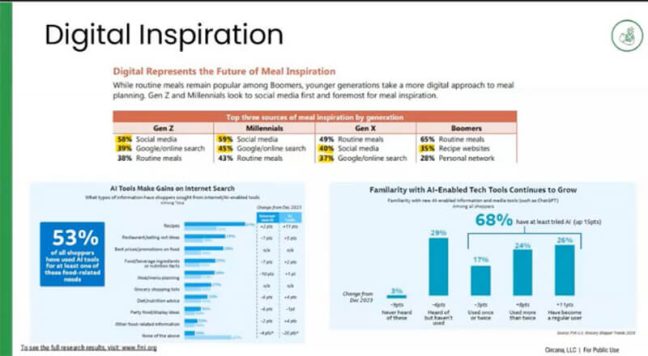
He outlined FMI’s five dimensions of consumer value – price, quality, relevance, experience and convenience – as a framework for where online shopping is gaining ground, noting that product attribution information available online can address quality concerns that have historically slowed fresh e-commerce adoption.
“For a lot of us in fresh, there isn’t a box to write all the attributions on or educate the consumer,” Brown said. “Online, there’s almost an unlimited amount of space for you to tell your story, give attributions to your products and things of that nature.”
E-commerce foundational
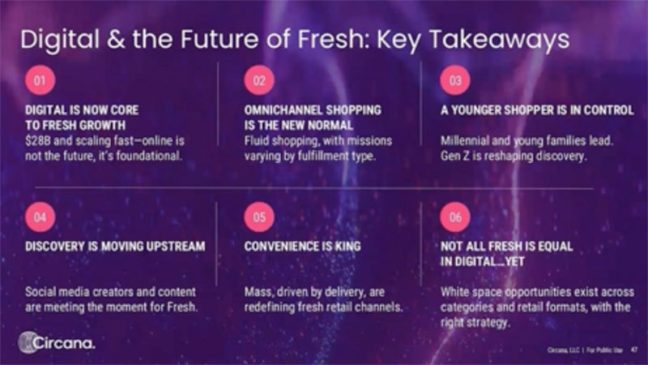
Krumholz described e-commerce not as an emerging channel but as a present-day retail reality. Food and beverage e-commerce totals $105 billion, up 20 percent versus a year ago, with one in every $10 in food and beverage now sourced online.
Fresh foods online represent about a third of those sales, with digital penetration in fresh at 8.5 percent of omnichannel dollars – compared to 14 percent for center store, indicating substantial room for growth.
“E-commerce is not the future; it is today,” Krumholz said. “It is foundational to the retail landscape as we know it.”
Meat, produce and bakery are leading fresh e-commerce adoption. Geographically, the Midwest leads digital adoption, at 11 percent of omnichannel fresh food sales online, with the South and Northeast each posting 23 percent year-over-year digital growth.
Thirty-two million households are now buying fresh meat online, gaining more than a million households per year. E-commerce fresh meat trips are up 17 percent year over year – driven by increased frequency rather than larger basket sizes – compared to just 2 percent growth in brick-and-mortar trips. Millennials and Gen X account for more than 70 percent of fresh meat e-commerce dollars, with millennials contributing disproportionately to overall growth.
“When you are becoming time-constrained because of other factors in your life, you are going to lean on other tools, solutions and platforms to make that life easier,” Krumholz said.
Within fresh meat, poultry and ground products lead digital adoption due to their versatility and consistent quality. Higher-consideration cuts like beef sirloin and ribeye lag, as consumers are more selective about those purchases.
Co-purchase data also revealed behavioral differences between channels: brick-and-mortar ground beef trips reflect immediate meal-occasion solving, while e-commerce trips show more pantry stocking across multiple proteins.
A significant channel dynamic: 62 percent of fresh food e-commerce dollars flow through mass retailers, representing a greater than 300 percent index versus grocery’s share, driven by mass retailers’ advantages in cost savings, one-stop shopping and loyalty-linked delivery and pickup programs.
Social media, AI shape discovery
Krumholz described social platforms as digital storefronts, particularly for Gen Z shoppers. Fresh food content on social media skews largely positive, focused on health, community and culinary discovery. She highlighted “granfluencers” – older-generation content creators whose authentic lifestyle content is driving product discovery – as a growing channel for fresh food engagement.
Limited-time produce varieties also are gaining traction through social media, with hybrid red berry grapes, red kiwis and distinctive pineapple varieties cited as examples driving above-baseline category sales.
On the AI front, Krumholz highlighted Amazon’s Alexa for Shopping – rebranded recently from its previous name, Rufus – and Walmart’s Sparky as retail chatbots personalizing the fresh shopping experience and guiding consumers through product selection.
Looking ahead
Wrapping up, Parker said she expects digital channels to produce fresh-category brands and varieties within a decade that rival major CPG brands in consumer recognition.
“I think 10 years from now there will be brands and varieties that we’re not even talking about yet who will be top of mind for consumers the same way Pepsi and Clorox are today, and those will come from digital, younger households driven by social media.”
Brown encouraged fresh suppliers and retailers to begin building out product attributions and storytelling online now. Krumholz said seamless integration between online and in-store experiences is the foundational requirement for sustained fresh growth.