
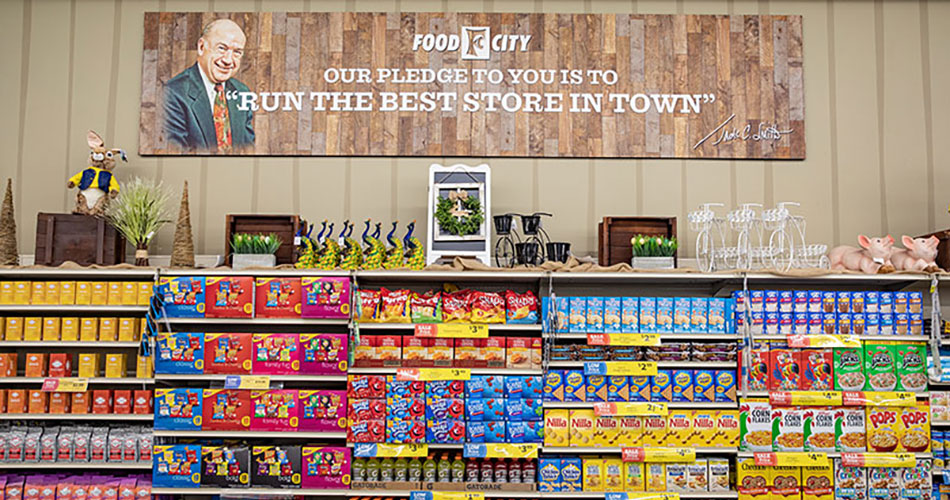
Walk into a Food City store and the first thing you see is a thank-you note.
A tribute to the town – whatever one it happens to be – right there in the lobby, where the company has made a habit of saying thank you to the community before asking anything of it.

“I just think it makes the community feel like, ‘Hey, this is my Food City,’ and have a little bit more ownership of the store,” said Katie Penny, EVP of store operations for Food City’s Knoxville Division. “Because we hear that a lot – ‘this is my Food City.’”
Penny would know. She grew up in this company. Her grandfather opened the first store. Her father, Steve Smith, is the president and CEO. And she has spent her career thinking seriously about what it means – practically, physically, philosophically – to run the best store in town.
That phrase, in fact, is displayed at the entrance of every Food City location, alongside a photograph of her grandfather, who said it first.
“We kind of look at it as we want to run the best store in town for our associates; we want to be the best place to work, be a great employer. We want to run the best store in town for our customers, and we want to run the best store in town for our community,” Penny said. “It just really helps tie that mission to the physical building where we’re operating.”
Designed to feel like something
In 2019, Food City launched a new store design built around a simple conviction: that every department should have its own identity, and the whole store should feel modern without feeling cold.
“We have a very standard look for each of the departments,” Penny said. “Really, the individual portion is just that lobby where we say thank you to the town.”
She describes Food City as an “experience-based retailer,” where every element of the store environment contributes to how customers interact with products and employees.
The foodservice area takes on a sleek, almost industrial look – at the Hardin Valley location in Knoxville, the department is split in a way that creates something closer to a food court, with separate stations for a hot bar, Asian wok, sushi, salad bar, sub station and a sweets area for specialty cookies, doughnuts and candy. 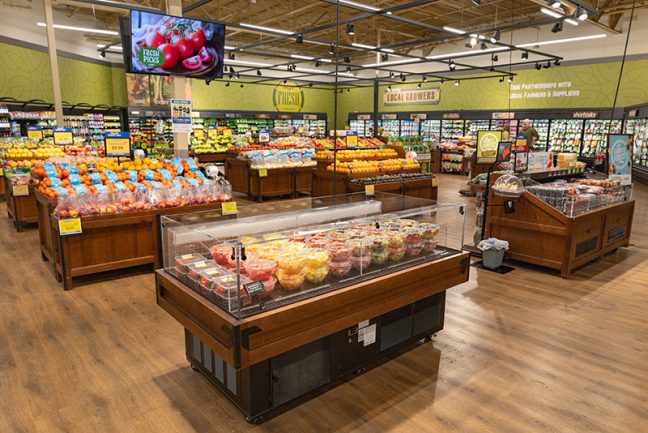
Produce goes green, for obvious reasons. The meat department takes on a brick aesthetic – “kind of gives you that feeling of being in a butcher shop,” Penny said. Dairy has a blue, rustic look, with a cow and a chicken on the wall. The pharmacy is designed with a clean, white aesthetic, which Penny said is very much intentional.
Throughout the store, closed-door refrigeration cases have become standard – a win for energy efficiency that also contributes to the cleaner look customers respond to. At the Gatlinburg location, which is undergoing a major remodel, the team made one deliberate exception: no doors on the dairy cases, because the store is 39,000 square feet and navigation matters more than consistency.
“We’ve got to kind of step away from what we typically do to make sure that we’re delivering on the customer experience,” Penny said.
Fixtures, flooring, refrigeration cases and layout all work together to guide the customer through the store.
“All of those items come together to create the customer journey,” Penny said.
A key priority in recent years has been simplifying that journey.
“When we went to this new look and feel and flow of our store, we really wanted it to be a brighter, cleaner, less cluttered look and feel,” she said. “That’s really what customers are looking for today when they go in and shop.”
A model store playbook governs the details – where in the foodservice department that specific bread rack goes, what the expectations are in every corner of the store – so that customers know what to expect regardless of which Food City they walk into.
Three ways of listening
Customer feedback plays a central role in shaping store operations and design decisions.
Food City collects customer feedback through three channels, and the one Penny prefers most is the simplest: in person, at store level, right now.
Store managers have their business cards at every register. Department heads have cards at their stations. “We really encourage our customers to engage with our people at store level, because we feel like we can make something right a lot quicker,” Penny said.
The company also conducts quarterly consumer surveys covering everything from departmental performance to parking lots.
“It really gives us great information about the entire store,” Penny said.
A third channel is digital, with the marketing team monitoring social media and Google reviews, routing feedback directly to district and store managers for follow-up, including outreach to customers who’ve raised concerns.
Heart, personality of store
None of it works, Penny will tell you, without the people who remain at the center of the Food City experience.
“Our teammates are a huge part of the shopping experience for our customers,” she said. “They’re the heart and personality of the store. They are the reason why our customers choose to shop with us. It’s not because of the can of green beans on the shelf being extra special.”
Every day at 2 p.m., stores hold what the company calls a Tune Up and Huddle – a brief all-hands gathering where the store manager covers sales, the ad, community news and team milestones. Associates then return to their departments and start preparing for the evening rush, adjusting production schedules based on what moved during the day.
“We sold a lot of salads at lunch today. We need to go add a couple more of those to our production sheet and get those ready for that evening-time business,” said Penny, illustrating how quickly the feedback loop turns.
A weekly corporate playbook gives store managers suggested topics for each huddle while leaving room for what’s specific to their store and community.
Embracing local partnerships
Local sourcing is another defining element of the Food City experience.
“We’ve got a focus on local products, and there’s a little bit in all parts of our store,” Penny said.
In produce, local farmers are featured prominently, both in product selection and in-store signage.
In the produce department of every Food City in the Knoxville Division, eight local family farms are featured as permanent elements of the store’s decor package. Penny called it one of her favorite parts of the store.
“We get to look up and see folks that we consider friends and neighbors,” she said.
She described those relationships as personal as well as professional.
The Stratton family is among the division’s largest local suppliers, bringing tomatoes, squash, cucumbers, peppers and corn. Luke and Logan Stratton deliver to the stores themselves.
 “I see them delivering to the store when I’m out and about, and it’s always a hug and, ‘How are you? How’s the family?’” Penny said. “It’s a pretty special partnership.”
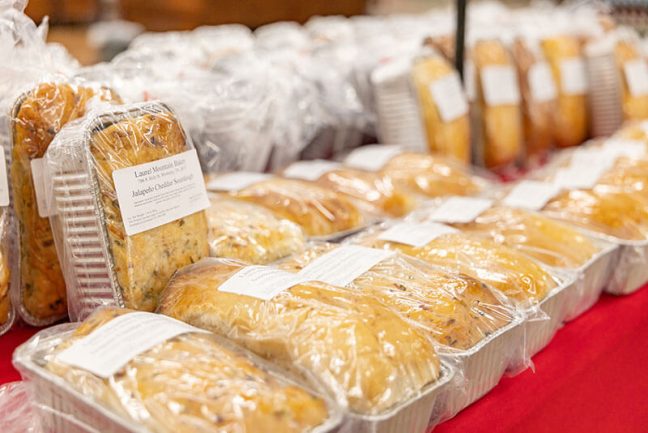
The Alcoa store’s foodservice department partners with Laurel Mountain Bakery out of Monterey, Tennessee. The bakery delivers direct to store, including a cheddar jalapeño sourdough that Penny described as amazing. Chattanooga-area stores work with a different local bakery.
The approach is deliberately hyperlocal: if a small producer’s reach extends to only a handful of stores, Food City works within that radius rather than asking them to stretch beyond it.
“We really look at how can we incorporate local as a company, but if there are partners that may not be able to stretch throughout the entire company, we kind of go a little more ultra-local when it comes to certain products like that,” Penny said.
Local strawberries return to Food City produce departments each spring, with the local produce season typically running from April through September – the kind of thing that gives regular shoppers something to look forward to every year.
Sushi contests, wing stations
Penny takes particular pride in Food City’s sushi program, which is run entirely in-house. While many retailers outsource their sushi operations, Food City’s sushi chefs are company employees. It has held internal contests for which chefs develop original rolls, submit them for judging and the winner’s creation rolls out companywide.
“It’s just something to keep it more engaging and encourage that creativity,” she said.
Engagement stations in the foodservice area have become another signature. Two recent weekends in a row, an associate-staffed wing station offered hot wings from a table set up inside the store, with associates building custom wing buckets on the spot.
For Valentine’s Day this year, the company expanded its traditional chocolate-dipped strawberry offering to include in-store made candy – customers chose and customized selections for their own gift combinations.
The bakery produces all doughnuts in-house, with bakers encouraged to get creative around the holidays. Bread is baked fresh daily. A pastry case features the work of in-store decorators. Signature items throughout the store – chicken salad, Neptune seafood salad, others made from scratch on-site – are called out with a small circular tag marked “FC.”
Weekend meal deals run Friday through Sunday nearly every week of the year. A recent chicken night package: four chicken breasts, a salad, a bag of petite potatoes and bagged vegetables for $14.99.
“It’s giving them another meal solution that isn’t necessarily a prepared foods option but something that they can take home and cook. [We] have all of those things right there together in our meat department at a great price,” Penny said.
Self-checkout has been redesigned in a corral-style configuration that lets associates assist multiple customers more efficiently – particularly when age verification is needed – and opens up new merchandising opportunities along the perimeter. At the Gatlinburg store, the company is testing souvenir-style merchandise in those spots rather than the traditional snack and beverage mix.
Store budgets, food donations
Community engagement at store level starts with a budget and a philosophy: store managers know their communities better than anyone at the corporate office does, so they decide how to spend it.
“They know their communities better than we do,” Penny said. “We think that’s a really great way to help encourage that community engagement at the store level.”
The Race Against Hunger fundraiser is Penny’s favorite companywide program. Since it began, Food City has donated more than 4 million pounds of food through the effort. Funds raised at each store stay local, and store teams participate in directing how the dollars are allocated.
In 2020, Penny was among the founders of Empower, an internal group built to support female leaders within Food City.
The program has grown to include outside speakers, internal leadership panels, community service days with Habitat for Humanity, United Way and Second Harvest and an annual recognition event honoring outstanding female leaders in categories including leadership, community involvement and a “Shero” overall award.
This spring, Empower is adding something new: a golf event pairing members with female professional golfers, supported by one of the company’s vendor partners.
“It should be a good time,” Penny said. “This will be our first … it might become a tradition.”
For Penny, everything – the design committee, the local farm partnerships, the sushi contests, the huddles, the community budgets, the Empower program – traces back to a phrase she grew up hearing and now sees displayed at the front of every store her division operates.
“We pride ourselves on being an experience-based retailer, that we’re focused on running the best store in town for our associates, our customers and our community,” she said. “Because those are really the three things in the grocery business that kind of make the wheels go ‘round.”