
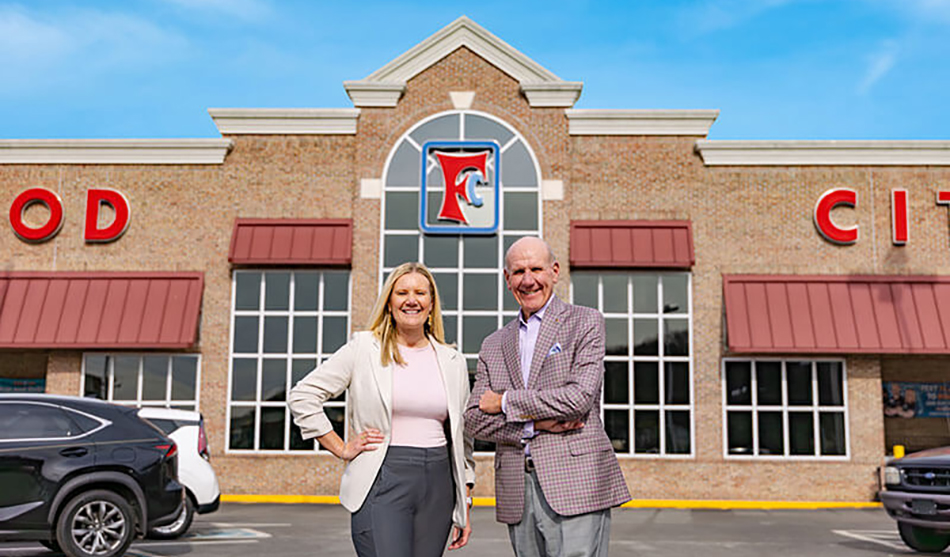
Having served friends and neighbors for more than 100 years, Food City is proud to be locally owned and operated. With 164 retail outlets spanning five states, the company’s dedicated team of more than 19,200 associates is committed to the mission it was founded upon: to “run the best store in town.”
That commitment to excellence has not gone unnoticed. The Shelby Report of the Southeast has named Food City its 2026 Retailer of the Year, a distinction that comes during a period of unprecedented growth, record-breaking charitable giving and a reinforced dedication to the people who make the wheels turn every day.
For Abingdon, Virginia-based Food City, being the “best” is a continuous pursuit. While 2024 was a record capital expenditure year for the company, 2025 was a significant year as well, marked by new market entries, store replacements and a deepening of the company’s roots across its five-state footprint.
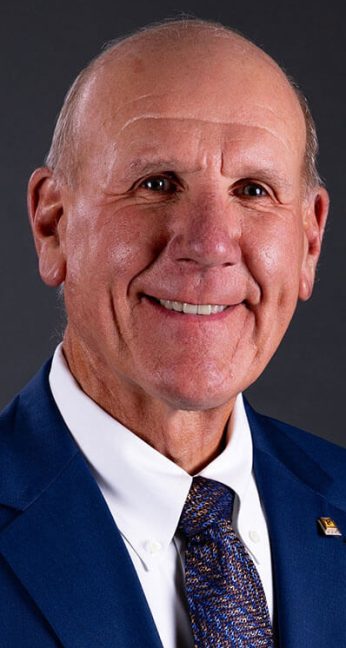
For Food City President and CEO Steven C. Smith, the grocery business is not simply a profession – it is a lifelong journey shaped by family, mentorship and decades of industry evolution.
As a boy, Smith did his homework in his father’s office at the Piggly Wiggly in Grundy, Virginia.
Every afternoon after school let out, he would ride home with his dad, who had built the 8,800-square-foot grocery store from the ground up – and spend the rest of the day surrounded by cardboard boxes, absorbing lessons about the grocery world.
“I learned a lot about business when I didn’t even know I was learning, a little osmosis,” Smith said.
His father had come to grocery in a roundabout way. A Naval Academy graduate and electrical engineer, he was living in San Diego with his wife and two young daughters in the 1950s (before Steve was born) and doing much of the family grocery shopping when he noticed what modern supermarkets in Southern California were becoming. He thought about his small hometown in Virginia and saw an opportunity.
“That’s what originally got him in the grocery business,” Smith recalled.
That store – opened in 1955 – was the beginning of what would become Food City.
Learning the business
When Smith came back to work at the store after college – he had considered other paths, but a summer on the operations side settled the question – he went to work for Claude Varney.
He credits Varney with shaping his approach to leadership, particularly in understanding how to motivate and manage people.
“Mr. Varney was a real people person,” Smith said. “He taught us to use strategic thinking to make sure we place the right people in the right positions to maximize their strengths.”
At the same time, Smith developed his financial understanding of the business through his father.
The combination shaped a leadership style he has carried for nearly five decades – one that shows up in how Food City trains its store managers, how it enters new markets and how it thinks about the relationship between a grocery store and the community around it.
Navigating industry change
Over the course of his career, Smith has seen the grocery industry undergo significant transformation, particularly as new competitors entered the market.
The arrival of Walmart supercenters stands out as a turning point – the moment regional grocers had to stop thinking about price alone and start thinking about what they were.
“I remember when we got our first Walmart supercenter and we knew that was certainly a different day, where we had to learn how to compete a little bit more, not only on price but certainly to differentiate ourselves,” Smith said. “I think that was the advent of differentiation in our perishable departments.”
That emphasis on differentiation – particularly in fresh and service-oriented offerings – continues to shape Food City’s approach today.
Full-service meat and seafood counters. Sit-down cafés. Large foodservice departments. A commitment to Certified Angus Beef. These are not add-ons but a way to differentiate and compete in today’s competitive landscape.
Five states and counting
In recent years, Food City has expanded its footprint into Alabama, marking a significant step in the company’s growth strategy.
The path there ran through Chattanooga, Tennessee, where Food City had established itself a little more than a decade ago and where Smith came to understand that northern Alabama was closer than most people realized.
“Places like Fort Payne, Alabama, are less than an hour away from Chattanooga,” he said. “They’re part of the TV market down there.” 
Smith noted that entering a new market requires a deliberate approach, particularly when introducing a new brand.
“I think we were a new entity, which presents some opportunities to introduce yourself to new consumers,” he said.
When a former Kmart site in Albertville was presented as a potential location, Food City moved. The store found immediate acceptance – and not just because it was new.
“It was a different store, probably a little more service oriented than what the consumers in Albertville had been used to, with the sit-down café, with the full-service meat and seafood, large foodservice department,” Smith said. “I don’t know that our competition really presented that in that market, so it was a differentiator to them.”
The success of that initial store encouraged the company to pursue additional opportunities in the region.
From Albertville, Food City set its sights on Huntsville.
Smith said the competitive landscape varies depending on the market, with different types of competitors present in different areas.
“When you get to Huntsville, you’ve got Publix, you’ve got Kroger … but there were a lot of independents we competed against in Albertville,” he said.
While those independent operators offered strong competition, Smith noted differences in store size and amenities.
“They just didn’t have a lot of the … bells and whistles that we did,” he said.
Four stores are now open in Huntsville, with a fifth groundbreaking imminent. Combined with other Alabama locations, the company is approaching 12 stores in the state, with two under construction.
In addition to organic growth, Food City also has pursued acquisitions to expand its footprint.
“Last year, we actually opened nine new stores,” Smith said, with three being brand new, three replacement stores and three acquisitions.
Those acquisitions included stores from Winn-Dixie, located on the outskirts of Birmingham, which the company has since integrated into its operations.
Those stores are in Jasper, Trussville and Fultondale. A groundbreaking is planned in Oneonta. Another six to eight sites are under active pursuit in the corridor between Huntsville and Birmingham.
“We’ve only had them for a few months, and we’re analyzing that market and making sure that we’re going to make the right moves,” Smith said of the former Winn-Dixie locations.
“So it really is a combination … we’ve grown a lot by acquisition but recently, we’ve started building more organic, ground-up stores,” Smith said.
Introducing yourself to a new market
Showing up in a new community is a process, Smith said – and it starts before the grand opening.
“First thing we want to do is go in and show we’re a good community partner,” he said. “We join the local chambers [of commerce], we participate with a lot of the community efforts that are going on, with some of the charitable organizations.
“When we enter a new market area, we listen closely to our associates to better understand the community’s needs and ensure our contributions reflect those priorities.”
In addition, Food City invests in marketing to introduce its brand to new customers.
“And then you market quite aggressively to introduce the Food City name,” he said.
At the same time, Smith noted that some customers already are familiar with the brand through travel or other experiences.
Many Alabama shoppers had encountered the chain during trips to Gatlinburg and Pigeon Forge, Tennessee – two of its highest-traffic markets.
“Some of the people say, ‘Hey, I remember you from Gatlinburg, had a good experience at your store,’” Smith said. “That gives us some foothold or a little foot in the door.”
The company’s sponsorship of NASCAR’s Food City 500 and the Food City 300 at Bristol Motor Speedway also has increased brand recognition.
The differentiators that worked in Albertville have traveled well. Food City’s fuel rewards program stands apart in a market where most competitors don’t offer one. Its commitment to Certified Angus Beef is another point of distinction.
“I can’t think of any competitors down there that do sell Certified Angus,” Smith said. “We sell Prime and Choice. We think that’s a real differentiator.”
Fresh seafood has connected with Alabama shoppers, too. Food City receives seafood into its warehouse every day – a logistical commitment that keeps quality consistent and product turning.
What keeps customers coming back
Ask Smith what retains a customer and he goes straight to people – not programs, not pricing, not loyalty apps.
“First it starts with the people that you have in the store – the quality, service, friendliness, courtesy, the attentiveness to what a customer’s needs may be,” he said. “I think that comes first.”
Clean stores and fresh product follow. Then value – and Smith is careful about what that word means.
“You don’t want to necessarily try and be absolutely the cheapest [store] in town,” he said. “You want to provide the best value for your consumers in town.”
Smith acknowledged that consumer behavior can shift during periods of economic pressure.
“When we had our inflation spike over the last two years, I think we saw a little bit of folks that were shopping around,” he said.
He noted that while shoppers today may be less likely to visit multiple stores than in the past, they still seek ways to maximize value.
Private label offerings play a role in addressing those needs.
Food City’s membership in the Topco buying cooperative gives it purchasing leverage comparable to some of the country’s largest grocers.
Its private label portfolio spans multiple tiers: Food Club as a national brand equivalent; That’s Smart as a value option; and Crav’n, a snack-focused line that extends to ice cream, nuts and frozen entrees. Health and beauty care falls under the TopCare name.
“It’s all about getting the right mix out of your merchandise,” Smith said.
Growth is about people first
Smith is direct about why growth matters.
“First and foremost, it’s about people and it’s about opportunities for our teammates,” he said. “We want people to really see the advancement opportunities – to be a department manager, to be an assistant manager, be a store manager or district manager.”
A growing company creates a pipeline that a static one simply cannot offer.
Each new store creates 150-170 jobs at opening. The mix of full-time and part-time positions creates what Smith sees as one of the grocery industry’s quiet strengths.
“A lot of people get their first job with Food City, and a lot of people get their last job with Food City,” he said. “Retirees make great mentors for young people. And then sometimes young people make great mentors for older people too – teach them a little bit about technology. They can help each other.”
That mix of experience levels contributes to the company’s culture.
“To have a good mix of that is a lot of fun,” Smith said.
Smith measures growth by square footage, not store count, targeting a 3-5 percent annual increase – a pace the company can largely fund through cash flow.
The store portfolio centers on a sweet spot of 55,000 to 56,000 square feet, with expansions typically directed toward fresh departments, foodservice and produce display space.
Food City’s distribution infrastructure is evolving alongside its store count. The company operates a 1.2 million-square-foot warehouse in Abingdon handling all company perishables.
It partners with Associated Wholesale Grocers out of Nashville for center store merchandise, dairy, frozen and dry grocery. A planned transition of health and beauty care to AWG’s automated facility in Hernando, Mississippi, will free up additional capacity in Abingdon.
Eventually, Smith said, continued growth will require either a deeper third-party commitment or a second warehouse.
“That’s already [something] we’re talking about and planning for,” he said.
Challenges ahead
Technology investment is a constant. On the financial side, Food City is transitioning off legacy AS400 systems to an Oracle platform.
“Those things are expensive and somewhat disruptive and a little bit painful, but they’re also necessary,” Smith said. “You’ve got to continue to invest in those things.”
Changes to the federal Supplemental Nutrition Assistance Program (SNAP) present a different kind of complexity. New rules restricting certain food items based on their top two ingredients – sugar and high fructose corn syrup – vary by state and will require associates and customers to learn what’s changed.
“There’s some cookies that are going to be SNAP purchasable and some of them that are not,” Smith said. “The consumer doesn’t know that. And our people have to learn the new rules as well.
“We never want anybody to be singled out. But occasionally you have to explain why the rules have changed.”
Community as business strategy – and vice versa
The conviction that a grocery company’s role in its community is inseparable from its commercial success did not come from a business school. Smith watched his father buy ads in local athletic programs, put signs up at stadiums and support local scout troops. He absorbed the logic early.
“When you make a community a great place to live, you’re not only helping the community but you’re helping yourself,” he said. “We give back to a community, but we’re also interested in making that community a better place for us to do business. I think the two go hand in hand.”
Every store manager at Food City carries a community giving budget – and is expected to spend it. “Why don’t you find causes to take this $5,000 or $8,000 or whatever the budget may be for that particular store, and invest it in your community,” Smith said.
Over the past decade, Food City has contributed more than $108 million to nonprofits, schools and community events across its five-state footprint. In 2024 alone, that figure topped $8.6 million.
Training is another long investment. Food City’s store manager training program runs a full year, and graduates spend a week at the corporate office – including time with Smith himself, typically in small groups of three or four.
“They know they can sit and talk to the CEO, pick his brain a little bit,” he said. “And I get an opportunity to pick their brain. What do you like most about it? What can we do better? I’m very rarely the smartest person in the room when we’re having meetings. You just surround yourself with good people and get out of the way.”
Long fourth quarter
With his daughter, Katie, active in the business – EVP of store ops for the Knoxville Division – and a nephew, Drew – VP for JCS Sales (K-VA-T’s brokerage company) – Smith sees the values his father put in motion in 1955 as durable – built to outlast any one generation’s tenure.
“I’m delighted that we’ve got a third generation that’s coming along,” he said. “I think they’re the right kinds of people that will help shepherd our company into continuing to do the right things going forward.”
As for his own chapter, Smith calls himself a “fourth-quarter person” – aware of where he is but not in a hurry to retire.
“I’ll hang around as long as I can be of use to them and guide them,” he said, “and I’m smart enough to stay out of their way, too, and let them go.”
The mission, he said, is the same one his father stated simply and has never needed updating.
“It’s not just a numbers game. It’s a people game – whether it’s our suppliers, whether it’s our folks that come in and shop with us, or whether it’s our teammates. Perfection is the evil of the good. We’re not perfect, but we’re pretty good at what we do.”
I WORKED FOR FOOD CITY AT THE STORE 717 FOR 8 AND ONE HALF YEARS HAD TO RETIRE TO TAKE CARE OF HOME BOUND WIFE. WAS A GOOD PLACE TO WORK ENJOYED THE CUSTOMERS I MET AND BECAME FRIENDS WWITH OVER THIS TIME PERIOD. HAVE MET MR. SMITH AND HIS DAUGHTER ALONG WITH SEVERAL OTHER COMPANY PEOPLE. ENJOYED WORKING FOR THIS COMPANY ALONG WITH THE PEOPLE I HAVE MET OVER THE YEARS
For the first time in my life I have a job that appreciates, respects and values my work ethic. I absolutely love working for Food City.
I worked in two Kentucky stores. Pikeville then onto Prestonsburg.
I loved my job. My managers. My coworkers as well.
I moved to North Carolina and we do not have FoodCity. If we did I would have definitely transferred!! I wish they would come here! I’ll be first in line to apply.
Truly loved my 8 years with this company.
When I started working for them in the 70s at the Depot Street location in Greeneville, Tenn they had 11 sores and look at them now.