
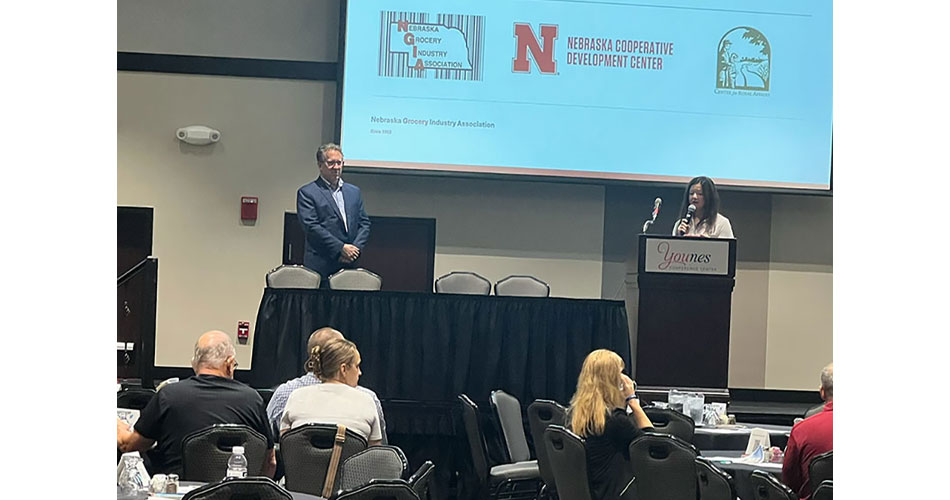
About 65 grocers, wholesalers and vendors gathered Aug. 20 in Kearney, Nebraska, for the fourth annual Grocery Industry Summit, where sessions ranged from the state’s halted SNAP restriction waivers to blockchain-based payment technology that could introduce competition into the credit card fee market.
The Nebraska Grocery Industry Association has hosted the one-day event alongside the University of Nebraska Cooperative Development Center all four years and, for the second year, with the Center for Rural Affairs.
About 70 percent of attendees were retail members, joined by wholesalers, vendors and regulatory, agency and grant funding officials.

“It started as a really practical way to introduce our retailers to the on-the-ground resources, not just showing them how and where to find some of these things but also meet some of the people that can help them access resources to help them stay competitive,” said Ansley Fellers, NGIA executive director.
That practical start has produced results. After an early summit presentation on 24-hour access grocery stores – a model in which a store stays accessible to customers without being staffed 24 hours a day – a small Nebraska community implemented the concept and returned the following year to share its experience.
“The idea is to take stuff away and be able to run with it,” Fellers said.
SNAP waivers on hold
Included in this year’s discussion was the latest update on SNAP waivers. Nebraska was the first state to implement the USDA waivers restricting SNAP purchases, adding soda and energy drinks in January.
It also was among the states covered by a federal judge’s injunction against the waivers this summer, a ruling the USDA is appealing. A candy waiver set to take effect in November is on hold pending that appeal.
“We are not enforcing it,” Fellers said of the waiver. “Essentially, our message to grocers is, you should be running SNAP the way you were in December 2025. You shouldn’t be restricting anything.”
‘Bipartisan beating’ on retailers
The reversal illustrates a broader burden Fellers sees falling on retailers.
“I think I could probably spend an entire discussion talking about what I’ve been calling the bipartisan beating that the retail industry has been taking on almost every front,” she said.
Retailers usually rely on business-friendly leaders to recognize that “every time the government acts, every time government changes its mind, every time a mandate comes down, every time a new ruling comes down, that comes at a cost,” she said. “However small it seems in your brain and however straightforward it seems, there are always direct costs and hidden administrative costs, and these businesses feel it and consumers are feeling it.”
For small town grocers, she said, the costs go beyond administration to lost customers.
“You’ve got your loyal customers, and they could come in and they could buy their soda on SNAP, and then they couldn’t. So they started going to where the soda was $1 per 12 pack cheaper, and that sounds great for everybody, but that means that they’re going to go to Walmart,” Fellers said. “It doesn’t seem significant for the most part, but it is when you’re on a fixed budget.”
She added that families cut from the program still need food.
“They’re going to get it from nonprofits and food banks, and so there’s this explosion of nonprofit grocery access in Nebraska,” she said. “Every time you cut WIC and every time you cut SNAP, it’s another dagger into a retailer.
“The way that we help serve low-income areas with grocery stores is by helping them buy food. And the numbers don’t really bear out that it was particularly unhealthy food. Most of it was actually very nutritious and good wholesome meals.”
Payments’ next frontier
Another session took aim at transaction fees from a different angle. Chris German, money transmitter and digital assets counsel for the Nebraska Department of Banking and Finance, walked attendees through state law and the new federal law on alternative payments – a category anchored in blockchain technology and cryptocurrency.
Dan Kramer, EVP of government and community affairs for Shazam, a member-owned payments network, financial services technology provider and NGIA sponsor and partner, joined the discussion.
“Just like going from cash to checks to debit cards to credit cards, this is kind of the next frontier,” Fellers said. The shift, she said, is “probably not something that’s going to happen overnight right now, but it is coming. More and more people are using it, and we’ll be expecting it at retail.
“If we’re having such a hard time getting some regulatory or statutory action on forcing competition or forcing an alternative payment network, maybe it’s worth talking about if there are some ways that we could be adopting technology to introduce competition naturally.”
Keynote and competition concerns
U.S. Rep. Adrian Smith delivered the keynote address on his federal work. Chris Jones, executive director of the Main Street Competition Coalition, joined by video to field audience questions on Robinson-Patman Act enforcement.
“You have to be pretty blind to not recognize that our little guys feel like there’s a little bit of an unfair playing field in some ways,” Fellers said.
Rural resources and local sourcing
The summit also featured an update from participants in a rural grocery cohort hosted by the University of Nebraska-Lincoln and the Center for Rural Affairs.
Food Bank for the Heartland, an Omaha-based Feeding America partner that distributes food through more than 500 network partners in 93 counties in Nebraska and western Iowa, presented information on food donations and shared its “Food Keeper Guide” and “Food Donations Guidelines” documents, resources Fellers described as useful.
The day closed with a session on wholesaling local products. Grow Nebraska and other groups have created wholesale websites that let retailers buy Nebraska-based products in one place rather than going direct to individual growers and manufacturers.
“I thought that was really cool and just kind of a practical solution for what otherwise is a lot of direct to grower, direct to manufacturer work,” Fellers said. “That was a positive note to end on, too.”
Attendees left with a QR code and link to a shared drive containing every presentation and contact referenced during the day.
Related: Nebraska Grocers Grappling With General Sense Of Unease, Labor Costs