
U.S. grocery sales grew 1.2 percent in 2025, but the gains came from price increases of 2.2 percent while volumes declined 1 percent – a market that grew in dollars as shoppers bought fewer units, according to McKinsey & Co.’s The State of Grocery North America 2026 report.
Four leaders in the firm’s retail practice – Tom Kilroy, Bill Aull, Alexandra Kuzmanovic and Joshua Reuben – walked through the findings during a recent webinar. Released in June, the report draws on a March survey of nearly 5,000 grocery shoppers and an April survey of more than 40 grocery executives across the U.S. and Canada.
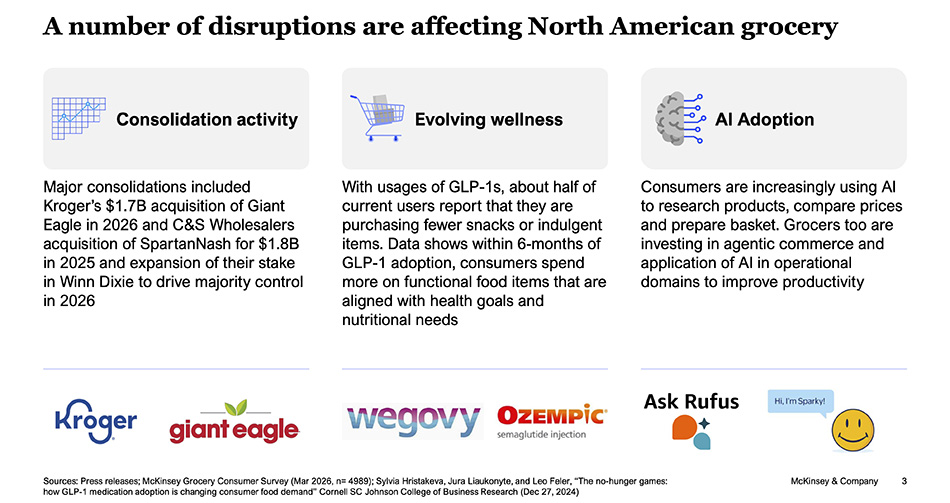
The grocery sector delivered a 12.2 percent weighted average total shareholder return in 2025, below the S&P 500’s 18.3 percent, with sharp variation by format. Aull, a partner and McKinsey’s North America lead of grocery retail, pointed to consolidation activity – including Kroger’s acquisition of Giant Eagle and C&S Wholesale Grocers taking majority control of Winn-Dixie on the heels of its SpartanNash acquisition – along with GLP-1 adoption and artificial intelligence as disruptions reshaping the landscape.
The report organizes the industry around seven forces: value, private brands, fresh, wellness, e-commerce, retail media and artificial intelligence.
Value and private brands
Consumer confidence sits near historic lows, and shoppers are managing their spend. Units per trip declined in every channel except drug over the 12 months ended June 2026, and purchase frequency – which had expanded in prior years – has started to decline as well.
“That raises the challenge in terms of really fighting for the trips of consumers, and we see that as a broad-based trend across channels,” Aull said.
More than half of shoppers report reducing impulse purchases, and some 80 percent of grocers plan to prioritize key value items in their pricing strategy.
Grocers expect the share of promotions that are personalized to climb from 35 percent today to 55 percent within two to three years, with loyalty programs as the engine – loyalty members who redeem personalized offers spend 4.3 times more each year than those who do not.
Private label grew about three times faster than national brands in 2025, reaching 20.7 percent of North American packaged food and beverage retail sales, and 29 percent of consumers expect to increase their purchases.
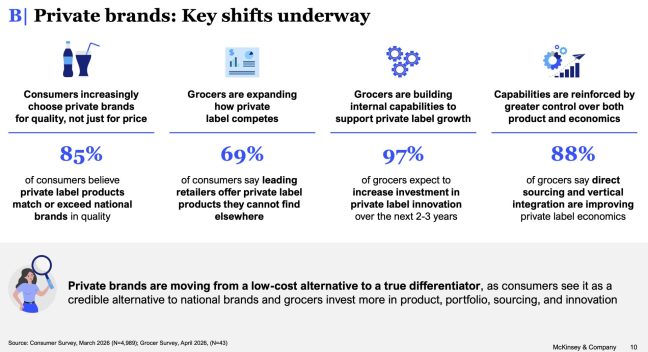
Some 85 percent of consumers believe private label products match or exceed national brands in quality, and 97 percent of grocers expect to increase investment in private label innovation over the next two to three years.
“Private brands are going to continue to be a true differentiator for grocers as they continue to compete in this era over the next four to five years,” Aull said.
Fresh and wellness
Consumers ranked fresh and quality No. 2 among factors driving in-store experience, ahead of promotions and service, while 71 percent of grocers rank fresh product quality as a top driver – their No. 1 factor.
McKinsey found 43 percent of consumers visit a retailer for its fresh offering, and 42 percent are more likely to buy additional packaged items when purchasing fresh or prepared foods.
“I think this really begs the question for grocers of where do you want to be famous? What’s your hero product?” said Kuzmanovic, a partner.
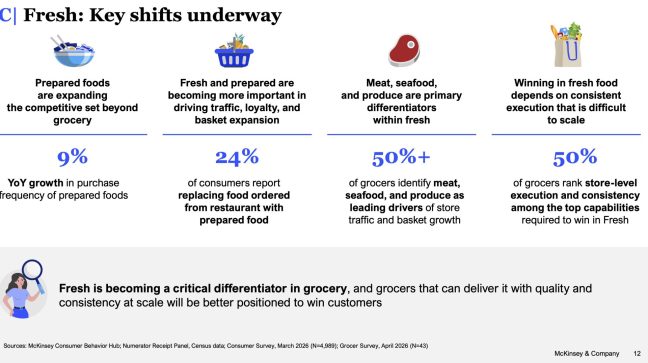
Prepared foods are expanding the competitive set, with purchase frequency up 9 percent year over year and about a quarter of consumers replacing restaurant orders with grocery-prepared food.
Execution remains the hurdle: 88 percent of grocers cite cost pressures, 78 percent point to labor availability and skill levels and 69 percent note supply chain complexity as barriers to scaling fresh.
“Fresh is becoming a critical differentiator in grocery, but delivering that with consistency is really where the rubber meets the road when it comes to fresh,” Kuzmanovic said.
On wellness, the report found 16 percent of consumers report current household use of GLP-1 medications, with another 7 percent reporting past use. Among current-use households, 48 percent report buying smaller portion sizes and 46 percent are purchasing fewer snacks and indulgent items, while spend shifts toward fresh produce, yogurt, nutrition bars and meat snacks.
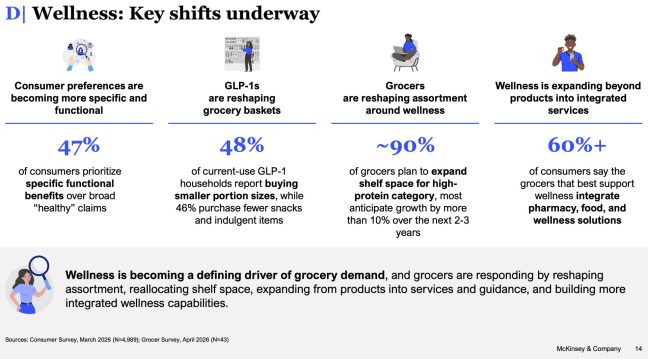
Nearly 90 percent of grocers expect to expand shelf space for high-protein products, and more than 60 percent of consumers say the grocers that best support wellness integrate pharmacy, food and wellness solutions.
“GLP-1 is important because it accelerates and makes some of these behaviors more visible, creates an opportunity for differentiation. But it sits inside this larger movement,” said Kuzmanovic, noting that about three-quarters of consumers incorporate health and wellness into their grocery choices in some form.
E-commerce and retail media
Delivery now represents nearly two-thirds of online grocery orders, a 28-point gap over pickup, per Coresight Research data cited in the report. Reuben, an associate partner, noted the data “is self-reported by consumers, which does skew a bit higher toward delivery than other analyst reporting suggests.
“What we’re seeing is not simply a continuation of a long gradual trend, but delivery has really pulled away in the last few years,” Reuben said.
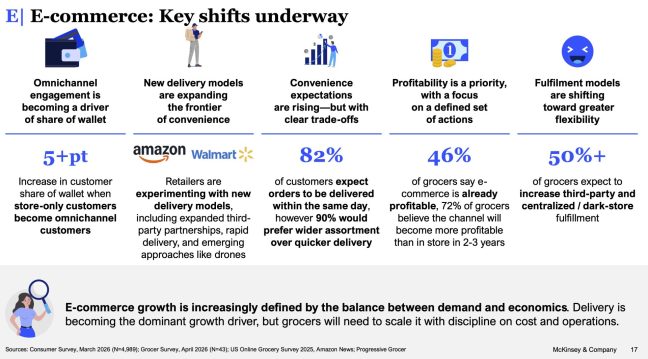
Time savings, cited by 67 percent of consumers, is the top reason for preferring home delivery. Free delivery matters to 52 percent, but just 12 percent cite discounted delivery. McKinsey’s geo-demand modeling across 182 metropolitan statistical areas found that online grocery demand could outpace current and announced fulfillment capacity by $23-$28 billion by 2030, as manual store-based fulfillment tends to hit a ceiling around 12-15 percent online penetration.
“Fulfillment strategy itself is going to be a competitive advantage. The winners will be those that add capacity in the right places,” Reuben said.
The economics are improving: 46 percent of grocers say e-commerce is already profitable, and 72 percent expect the channel to become more profitable than in-store within two to three years.
Retail media represents about 1 percent of revenue for retailers such as Walmart, Target and Albertsons but about 20 percent or more of enterprise value. At Walmart, media represents about 12 percent of EBIT and 26 percent of enterprise value.
“Retail media shouldn’t be treated as a side project. It’s not just an extra revenue stream on the side,” Reuben said.
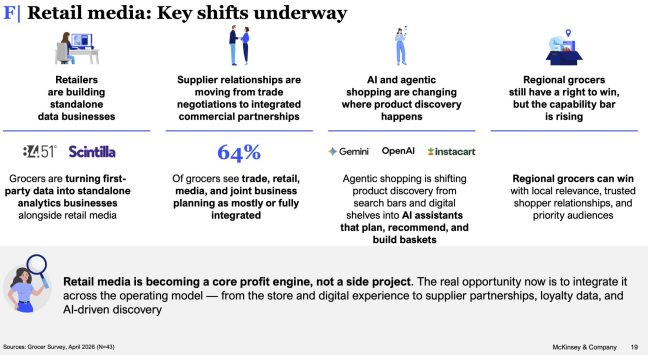
Grocers are extending media into standalone data businesses – Kroger’s 84.51 and Walmart’s Scintilla among them – and 64 percent now see trade, retail media and joint business planning as “mostly or fully integrated.”
“Regional grocers still do have a right to win. The biggest assets that regional grocers have are the local relevance, trusted shopper relationships and priority audiences,” Reuben said.
AI and the path forward
Consumer willingness to use AI declines as autonomy increases, from 51 percent for assisted product search down to 20 percent for “fully automatic ordering” with no user review.
“I think folks still like grocery shopping. They still like having a voice and a say in that shopping experience. And it’s not all just about optimizing for efficiency,” said Kilroy, a senior partner.
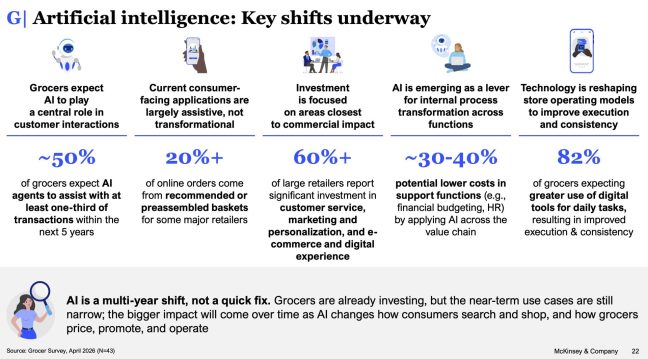
Still, about half of grocers expect AI agents to assist with at least a third of transactions within five years, and some major retailers already see more than 20 percent of online orders come from recommended or preassembled baskets.
“How can you use AI tools to make every store manager as effective as your very best store manager?” Kilroy said.
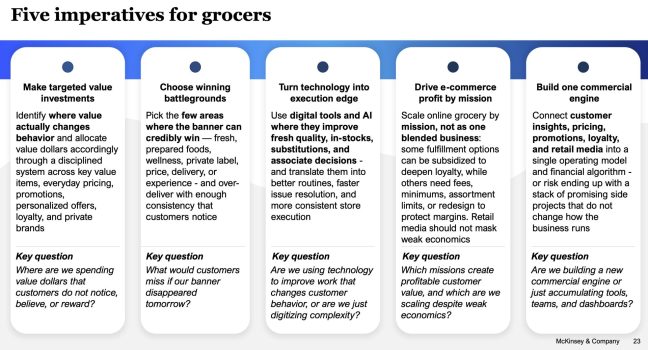
The report closes with five imperatives: make targeted value investments, choose winning battlegrounds, turn technology into execution edge, drive e-commerce profit by mission and build one commercial engine. Kilroy urged grocers to define what they will stand for, whether that is fresh, prepared foods, wellness or private label.
“The market’s becoming just more and more competitive every year, and so having that edge, that angle is going to be critical,” Kilroy said.
The through line, per the report: “Do not manage these shifts as disconnected initiatives. Build the system. That is the new grocery advantage.”