
Shrink continues to be a major issue for retailers to the tune of over $100 billion annually. It is especially true for grocery stores. Razor-thin margins of 1-3 percent means every loss drastically impacts profitability. The answer so far has been to fixate on checkout. More specifically, on self-checkout (SCO) counters. Walmart, Dollar General, Kroger, Target and Costco have all said they are cutting back on SCO, citing theft and other reasons.
SCO is a flash point for some theft, but roughly 80 percent of commonly stolen items are concealed before a shopper ever reaches checkout. Grocers need to expand loss prevention strategies to observe the entire shopper journey and chip away at shrinkage.
Lack of visibility is the source of loss prevention woes
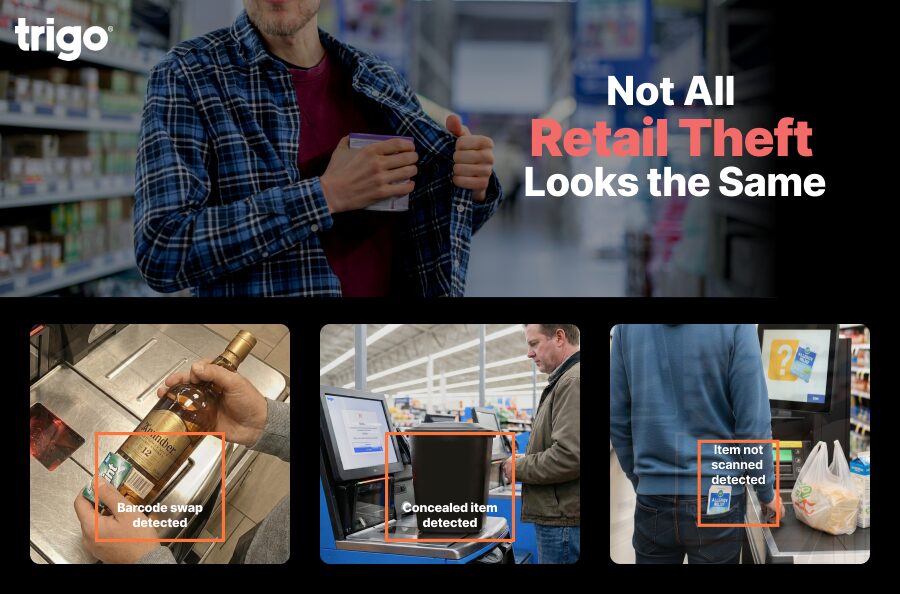
The core challenge in grocery loss prevention is a lack of store visibility. Grocers cannot understand shrink by only monitoring the point of payment. Yet, that is exactly where most strategies focus. Shrink can stem from veiled activity beginning in the aisle, often with concealment, and continue either at checkout or beyond. When grocers limit their view to the register, they miss the majority of shopping behaviors that actually drive loss. Concealment happens in a variety of ways, from being left in bags under clothing or inside other products long before a shopper approaches the front of the store. By the time a transaction begins, the outcome is often already determined.
Beyond concealment, losses occur near checkout areas that still tend to be outside the limited view of traditional SCO cameras. “Skipping” items during scanning or full cart pushouts, where shoppers exit without paying, also contribute meaningfully to loss and should be analyzed. Our retail analytics data shows that the most popular theft methods after concealment include leaving items in the basket or bagging area without scanning (31.7 percent), performing a “fake scan” where an item is passed over the scanner but not registered (27.3 percent) or deliberately holding products back and not scanning them at all (14.1 percent).
Focusing too narrowly on checkout risks means overlooking these broader patterns. Understanding shrink requires understanding a complete picture of what happens to each item. Advances in computer vision technologies are making this possible, enabling AI to layer on top of existing security cameras and track the entire product journey.
Empowering staff with real-time insights
Any loss prevention strategy must also account for the reality that store teams are already stretched thin. Adding alerts, more checks or more manual processes without improving clarity only compounds the problem.
What teams need are tools that deliver precise, timely and reliable insights that they can act on quickly without second-guessing. Instead of overwhelming staff with false positives, effective systems should surface the highest-risk situations with clear context. This shift from volume to precision allows employees to focus their attention where it matters most, improving both efficiency and outcomes.
Beyond benefits for the staff, it’s also important to the shopper experience. A lack of visibility tends to force the need for sweeping measures like receipt checks or SCO item limits that erode trust and create friction for honest shoppers. Not all loss is created equally and a less disruptive intervention is often the better answer. Thus it is important to have a way to intervene that is less heavy-handed. Computer vision providers like Trigo are working on ways to offer retailers options that allow them to match transaction risk to store policy. For example, grocers can set a full-stop on a transaction involving a hidden item of high value vs. a simple self-correctable workflow for an item when it appears they just didn’t scan it correctly.
Grocers face a difficult challenge balancing security and customer experience. Shrink will remain an ongoing problem, particularly in an environment of economic pressure and shifting consumer behavior. But loss prevention strategies that focus too narrowly on checkout will continue to fall short. By adding visibility to the entire store, grocers can reduce shrink in a way that is effective and sustainable. The goal is to create a system that is comprehensive and unobtrusive to protect margins without compromising the trust and convenience that define the modern grocery experience.