
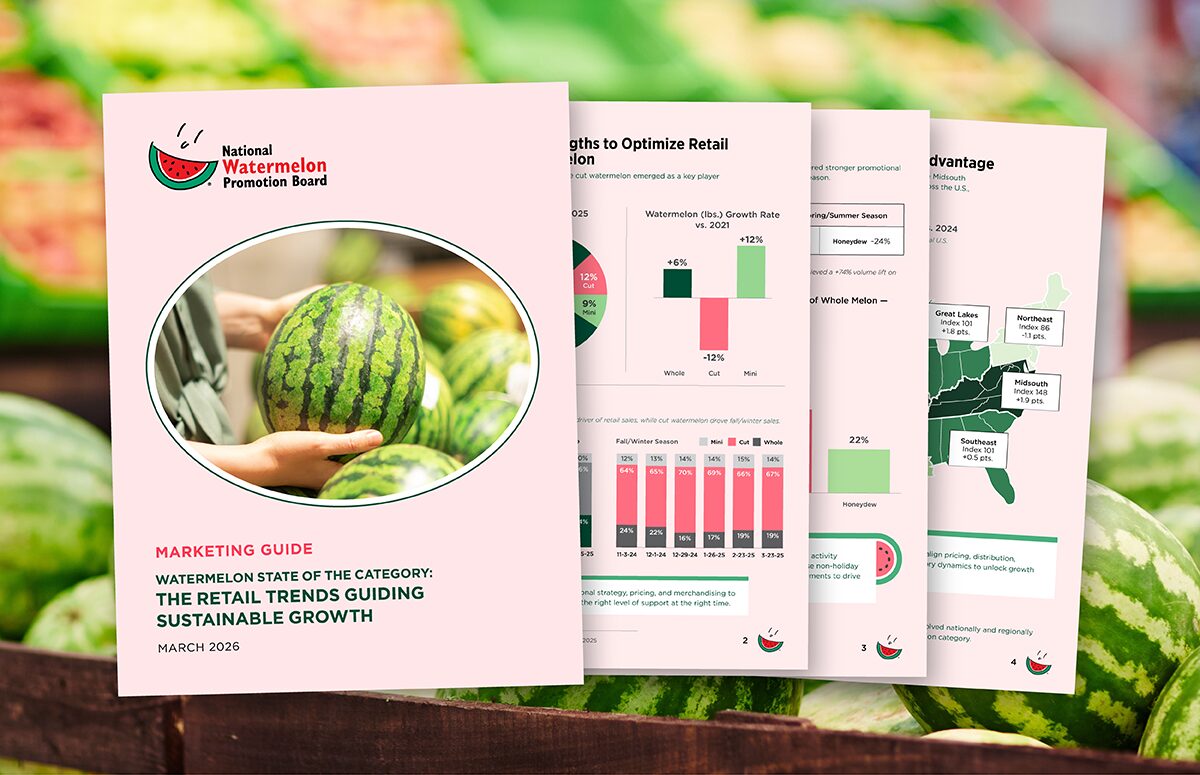
With the watermelon category surpassing 3.5 billion pounds at retail in 2025, the National Watermelon Promotion Board (NWPB) has released a new marketing guide to help the industry sustain that momentum.
The guide equips retailers, marketers and category managers with fact-based insights to drive year-round watermelon sales. The research highlights how whole and cut watermelon play distinct but complementary roles throughout the year.
Three opportunities for retail growth
The findings point to three clear opportunities for the industry to maximize retail sales:
- Capitalize on the strong promotional performance of whole watermelon during spring and summer, even beyond traditional holiday windows. It consistently outperforms other melon varieties, delivering a stronger promotional lift with a smaller average discount.
- Leverage cut watermelon strategically in fall and winter, when it drives retail sales and growth as whole watermelon availability tightens.
- Use the regional insights in the guide to adapt pricing, distribution and merchandising strategies by region to unlock growth in developed and emerging markets.
Whole vs. cut: complementary roles
On an annual basis, whole watermelon remains the primary driver of retail volume, according to the guide. It accounts for 79 percent of total pounds sold and contributes more than 41 million incremental pounds year over year.
Cut watermelon drives annual dollar sales, representing 49 percent of total sales and adding more than $117 million in incremental growth. While both forms are essential to category health, their impact varies by season and availability.
During spring and summer, whole watermelon stands as the clear category driver. It accounts for 77 percent of annual retail volume and reaches an 86 percent share in June and July.
On promotion, it outpaced cantaloupe and honeydew, delivering a 75 percent volume lift and 50 percent dollar lift on smaller discounts than either variety.
The data makes a case for extending whole watermelon promotional support beyond traditional holiday windows. Significant incremental sales opportunities remain untapped in those periods.
As the calendar shifts to fall and winter, cut watermelon becomes the category’s primary dollar driver when whole-fruit availability declines. Cut watermelon accounts for 49 percent of annual dollar sales and reaches a 70 percent share in December.
With 30 percent of cut volume sold on promotion during fall and winter, it generates efficient lift and sustained dollar momentum at a time when overall category promotion softens. That reinforces its role as a critical driver for maintaining sales outside peak summer months.
Regional performance varies across U.S.
Regionally, the data shows opportunity exists across the U.S. The Plains led national performance ,with a 17 percent increase in volume versus 2021, demonstrating how well-developed regions can continue to expand.
Wide pricing variation further underscores regional opportunities. In the Great Lakes, cut watermelon is priced up to 835 percent higher than whole fruit, highlighting differences in value perception and merchandising strategies across markets.
Whether a region is developed or still emerging, the guide delivers insights to help retailers refine pricing, optimize distribution and tailor promotional strategies to accelerate watermelon growth nationwide.
“Watermelon is a produce category performer, and we see significant opportunity for continued growth,” said Mark Arney, executive director for the NWPB.
“From extending whole watermelon promotions beyond the summer holidays to aligning promotional strategy and merchandising, the guide gives the industry the tools to drive year-round growth.”
About the NWPB
The NWPB, based in Winter Springs, Florida, was established in 1989 as an agricultural promotion group to promote watermelon in the U.S. and in various markets abroad.
Funded through a self-mandated industry assessment paid by more than 700 watermelon producers, handlers and importers, the NWPB’s mission is to increase consumer demand for watermelon through promotion, research and education programs.
Industry professionals, retailers and stakeholders can access the State of the Category report and Marketing Guide here.