
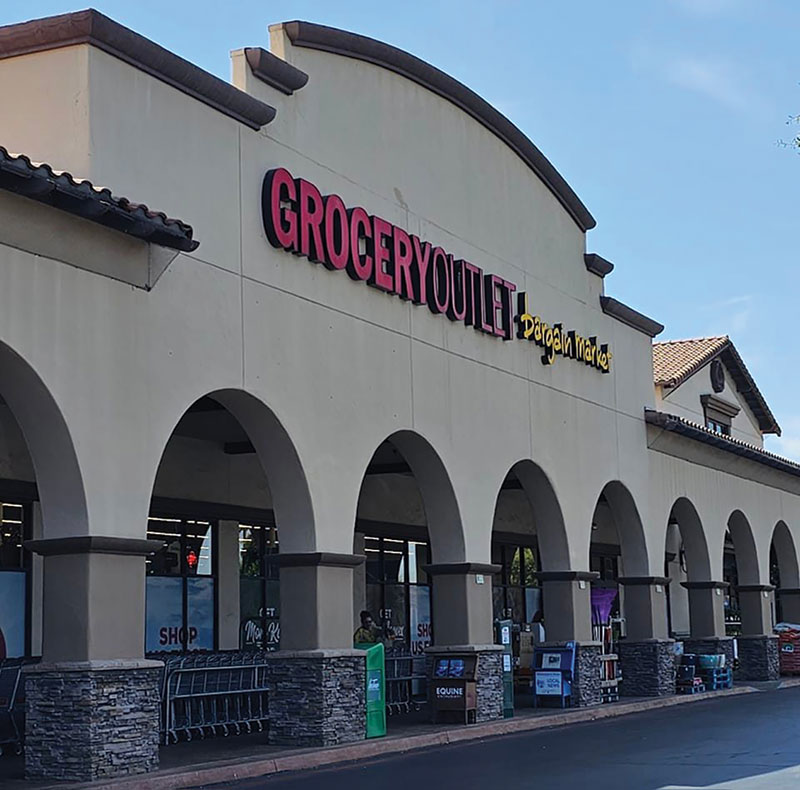
Grocery Outlet Holding Corp. reported net sales of $1.19 billion for the second quarter of fiscal 2026, a 1.1 percent increase over the prior year period, as new store sales offset closures under the extreme-value grocer’s business optimization plan and a 0.3 percent decline in comparable store sales.
Net income for the quarter ended July 4 was $5.6 million, or $0.06 per diluted share, compared to $5.0 million, or $0.05 per diluted share, last year. Adjusted net income was $20.3 million, or $0.20 per diluted share, down from $22.8 million, or $0.23 per diluted share, in the prior year. Adjusted EBITDA was $65.7 million, or 5.5 percent of net sales.
“We delivered second-quarter results ahead of our outlook, as efforts to strengthen our opportunistic offering and value perception gained traction,” said Jason Potter, president and CEO of the Emeryville, California-based company. “Comparable-store sales trends improved over the first quarter, driven by sequential improvement in our basket with traffic remaining positive. This progress reinforces our confidence that restoring the core strengths of our business and better supporting our independent operators can build a stronger foundation for sustainable, profitable long-term growth.”
On the company’s earnings call, Potter said improvement in the opportunistic assortment helped lift total company comps into positive territory in May and June, and that Grocery Outlet has completed a repositioning around extreme value and the treasure hunt shopping experience, with simpler signage and more prominent value items.
The comparable store sales decline reflected a 2.1 percent decrease in average transaction size, partially offset by a 1.8 percent increase in transactions. Gross margin was 30.2 percent, down 40 basis points from last year, due primarily to product promotions and inventory markdowns and write-offs tied to store closures, partially offset by improvements in inventory management.
Optimization plan nears completion
Grocery Outlet opened 10 new stores and closed 12 during the quarter, including nine under the optimization plan, ending the period with 547 stores in 16 states. The plan, initiated in the first quarter, called for the closure of 36 underperforming stores, all of which were shuttered by April.
“We remain on track to eliminate a $12 million drag to annualized adjusted EBITDA with the majority of the benefit expected to occur in 2027,” Potter said on the call.
Operating income for the quarter was $15.8 million, which included $5.4 million in net restructuring charges related to the plan. The company estimates it will incur between $15 million and $24 million in net total restructuring charges across fiscal 2026 and 2027, with actions substantially completed by the first quarter of fiscal 2027.
For the first half of fiscal 2026, net sales increased 2.3 percent to $2.36 billion due to new store sales, partially offset by decreased sales from store closures. The company posted an operating loss of $162.2 million for the half, which included a $158 million non-cash goodwill impairment charge recorded in the first quarter as a result of a decline in market capitalization. Net loss for the 26-week period was $174.7 million, or $1.77 per diluted share.
Guidance raised, Cyclospora headwind ahead
The company raised the low end of several full-year guidance ranges. Grocery Outlet now expects net sales of $4.70 billion to $4.72 billion; comparable store sales of negative 0.5 percent to flat; adjusted EBITDA of $225 million to $235 million; and diluted adjusted EPS of $0.51 to $0.55.
“Given our stronger-than-expected second quarter performance, we are raising the low ends of our full year financial outlook ranges,” said Ian Ferry, EVP and CFO, who joined the company following the recent retirement of longtime CFO Chris Miller.
Management tempered the raised outlook with caution around the third quarter, guiding to comparable store sales of negative 1 percent to flat. Potter said the multi-state Cyclospora outbreak pressured produce sales in July and is expected to create a headwind of roughly 100 basis points to total company comps for the third quarter, though he noted Grocery Outlet’s products have not been involved in any Cyclospora recalls and called the impact temporary. Ferry added that the produce pressure brings elevated shrink that will weigh on third quarter gross margin.
Potter also pointed to continued progress on the opportunistic sourcing engine at the center of the turnaround, telling analysts new supplier acquisitions are up about 11 percent this year and that the company still sees price gaps of 15 to 20 percent below mass retailers and 30 to 40 percent against conventional grocers.
“It’s still early, but the business is responding,” Potter said.
Projected total new store openings for fiscal 2026 remains at 30-33.